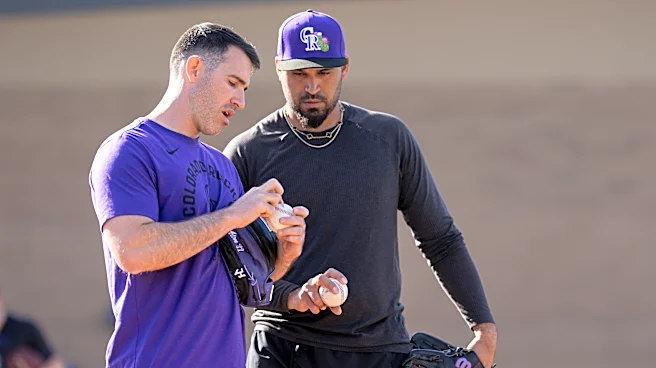






If you ask Colorado Rockies manager Warren Schaeffer to discuss the team’s decision to call pitches from the dugout, he will politely, but firmly, issue a correction.
“It’s pitch suggesting.”
The nomenclature matters, a point Thomas Harding made back in the waning days of spring training.
First, if the coaching staff is calling pitches, the implication is that the players have no control over this part of the game. The battery must comply with a sign from the dugout. Period. The Rockies — and every
member of the clubhouse — are clear that’s not the case here. Ultimately, the pitcher decides with the only consequence being the outcome of the at-bat.
Second, one of the defining characteristics of Schaffer’s career has been an emphasis on communication and collaboration, and for the Rockies, the decision to suggest pitches from the dugout marks an additional area of improved organizational communication and player development. The coaching staff is sharing information to the battery, and they’re all working together — having an in-game conversation, if you will.
In other words, it’s a small-d “democratic” system with all involved having a say.
Last weekend, a number of pitchers, catchers, and members of the coaching staff discussed the new system.
TLDR: They like it.
The process
Rockies pitching coach Alon Leichman first experienced this system while with the Miami Marlins. It has largely remain unchanged since he joined the Rockies.
Catcher Brett Sullivan explained how it works.
It beings with a pre-game meeting: Catchers Sullivan and Hunter Goodman, the starting pitcher, the bullpen staff, and the pitching coaches have a discussion. They consider who they’ll be facing and the pitches they like in a given situation.
During the game, Leichman, as Sullivan describes it, “puts in his suggestion” by flashing a sign to the catcher, which corresponds to a card he wears. Then the catcher makes a decision: Is this the right call in this situation? If he likes it, the catcher signals to the pitcher; if he has doubts, he “go[es] with what he thinks in that moment,” Sullivan said.
That decision is based on a number of factors:
- How the hitter has reacted to a pitch.
- If the hitter made an adjustment.
- What’s working for the pitcher.
Ultimately, though, it’s up to the pitcher.
“The final decision is the pitcher,” Sullivan said. “He’s the guy on the mound, and he has to make that final call. If he’s convicted in that pitch, then it’s three minds coming together, saying, ‘We all like this pitch.’ Or he maybe is more comfortable with something else, and he goes with that.”
Sullivan added, “The most important thing is what the pitcher wants.”
The Rockies rely on constant communication in addition to using data to better prepare pitchers. First, there’s that pre-game meeting. Then, according to Sullivan there’s “lots of communication, before, after, during, in-between innings.” Finally comes the debrief.
“The next day, we’ll go over it and talk about it and what we saw, maybe what we could use more, what we could go do instead,” Sullivan said.
There’s a reason the Rockies wait to debrief.
“I feel like after the game is more just, ‘Hey, we won. Everybody kind of is happy about it. Let’s just go tomorrow.’ Or ‘We lost. Let’s just wait till tomorrow, let everybody cool down, or whatever it is,’” said Goodman. “So usually we talk the next day more than we do after the game.”
That’s the process, but what do those using it think?
The answers are overwhelmingly positive.
The coaches like it
So far, Schaeffer is pleased with the results, saying, “I think it’s working very well.”
He explained, “The biggest thing that people need to know when we’re doing that, when the pitcher, catcher and Alon come off the field, the conversations about how we’re going to attack hitters goes through the roof. So we’re getting the right answer.”
Moreover, this is a highly collaborative system that requires all involved to “put away their ego,” according to Schaeffer.
“It’s three people signing off on one pitch. If you’ve got the right people, it works.”
For Leichman, it’s a way of moving the off-the-field conversations into the game.
“I have some information in front of me. It’s basically me suggesting a pitch when they have the ability to say ‘Yes’ or ‘No,’” Leichman said. “It’s kind of like me talking to the pitcher: ‘Hey, I’m thinking slider here. What do you think?’ And if they agree, then, yeah, we’re going slider. If they disagree, we’re going with whatever they want.”
Then he added this: “It’s basically a way for me to talk to the pitcher while he’s out there.”
The catchers like it
Both Goodman and Sullivan have praised the new system.
“We’ve thrown the ball well. It’s been a little less stress on me as well,” Goodman said.
Plus, pitch suggesting takes into account that the catchers see things the coaching staff cannot.
“There’s just certain (things) throughout the course of a game, as being behind the plate, you can see a little bit different things to the game than you can from your dugout sometimes,” Goodman said. “So certain situations, you maybe want to change something or go a different route.”
The flexibility of the system allows for improvisation.
Finally, it reduces the cognitive load of one of the busiest players in the game.
As Brennan Bernadino points out, “It is very tough for a catcher to go over their at-bats and then know every pitcher, the starter, and then all the relievers and memorize exactly what that hitter’s holes are to certain pitchers. So I think it’s a good thing.”
The pitchers like it
Rockies pitchers have endorsed the system for a number of reasons.
Zach Agnos appreciates the flexibility of being able to adjust to a given situation.
“Obviously, Alon can’t tell really how your stuff is that day from the side,” he said. “So that’s where he relies on us. Where ‘Hey, I’m throwing my slider, and it’s not that great today,’ then we shake to something that’s working better for us that day.”
Plus, Agnos doesn’t miss the mental work. “I don’t like to think a ton when I’m up there. I just like getting the ball and going.” Then he added, “For me, I love it. I think it’s great.”
Kyle Freeland agrees: “It’s just kind of able to take something off our plate and our catcher’s plate in a game that’s turning very, very analytical.”

Ryan Feltner, too, is a fan.
“I love it. I’ve always been into the data and the numbers and everything. And I think with nine guys in every lineup, it’s a lot of information for the pitcher and catcher to remember. So logically, to me, it just makes a lot of sense if somebody has the information in front of them that they can relay (that) to the catcher to put us in the best position to succeed.”
Bernadino highlighted that its very close to the existing pitch-calling system, saying, “Once again, it’s just a suggestion, so I don’t think it’s any different than when the catcher is calling the pitches.”
Jaden Hill highlighted two additional benefits of the Rockies system. First, it removes some of the pitcher’s emotions from the equation; second, it’s a tool for learning.
“It’s been great for me personally,” Hill said, “just because I think it allows us to take our mind off of the emotion part of it, and we make a more logical decision in the thinking process. And I believe that coming from [Alon], he’s done the scouting report. He has more calm-minded thoughts than we do. And so I really like it.”
Then he added, “I think as we’re going, it also teaches us to learn from what he’s calling, and you begin to repeat it so many times that it becomes a natural instinct. So that way, you can kind of think along with his process.”
And with that, for Hill, comes confidence. “If three people all were thinking the same thing, I think that’s the right thing to do.”
Since it was a group decision, Hill finds accepting the outcome easier.
“All of us are all on the same page,” he said, “and I think that you can live with the results, whether good, bad or ugly. You can live with it. You can talk about it. We’re all in agreement, and failure is going to happen, but you can accept it, move on, and go from there.”
Closing thoughts
In late March, Ben Lindbergh wrote “Keep MLB front offices away from the playing field” in which he opposes what the Rockies are doing now. (Noteworthy is Alon Leichman’s presence in the story’s artwork.)
Lindbergh’s argument is lengthy, but he writes that, for two primary reasons, pitch calling from the dugout is a terrible idea. The first is aesthetic (it looks bad), and the second is philosophical (the players become “wind-up players pointed toward targets the front office sets”). Later in his essay, Lindbergh writes this: “Every pitch call is consequential, which is why team decision-makers are so motivated to commandeer that duty.”
For the Rockies (who are mentioned in Lindbergh’s piece as, presumably, evidence to support his thesis), there is no “commandeering” involved. Every coach, catcher, and pitcher endorsed the new system (and I asked all but two members of the pitching staff). The Rockies are engaged in a highly collaborative process with all stakeholders having a voice and the pitcher the final decision.
Maybe I’ve just watched too much bad pitching as a Rockies fan because, Reader, you and I have surely done that. And maybe I’m just energized by a team finally using information in a way that’s collaborative and improves the results on the field.
But consider me a big of pitch suggesting.
This week on the internet
In case you’ve forgotten, Coors Field has a host of new menu items. Here are Ryan Spilborghs and Cory Sullivan checking out Glizzilla for themselves.
Has anyone tried a Glizzilla yet?
The Marlins call pitches from the dugout. Why the Yankees think it’s ‘terrible’ | The Athletic ($)
Given today’s topic, this seemed timely. I’ve provided a gift link. (Too many people criticizing this system need to spend more time understanding how it works — or at least for the Rockies, who are cited as a case study.)
‘Not going to panic’: Lorenzen discusses first starts with Rox | MLB.com
Thomas Harding spoke with Michael Lorenzen about his early-season adjustments.
Join the conversation!
Sign up for a user account and get:
- Fewer ads
- Create community posts
- Comment on articles, community posts
- Rec comments, community posts
- New, improved notifications system!
Please keep in mind our Purple Row Community Guidelines when you’re commenting. Thanks!