


Before the start of the 2026 season the San Diego Padres were projected to win 79-80 games by FanGraphs and PECOTA. The assumption was the bench was not deep or talented enough, the starting pitching was not deep or talented enough and the bullpen wouldn’t be as good with the departure of closer Robert Suarez.
It is obviously way too early to prove any of those assertions wrong. The returns so far show that the Padres have the potential to be way better than assumed and a lot rests on the starting
pitching.
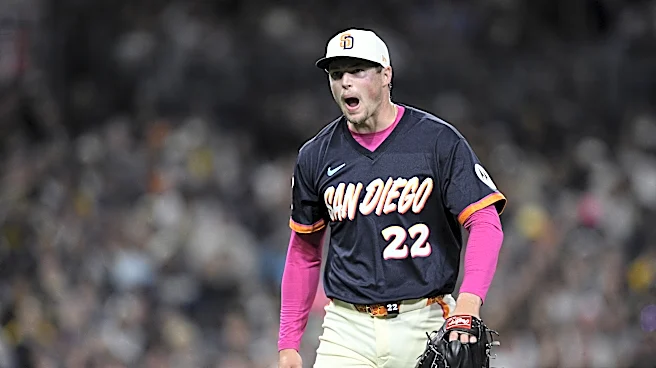
The one thing no one expected, not the so-called experts or anyone who covers, or is a fan of the team, was for new closer Mason Miller to overwhelm baseball.
Coming to the Padres from the A’s at the 2025 trade deadline, in exchange for top prospect Leodalis DeVries, Miller was the setup man for Suarez. And he was really good. He pitched in 22 games and 23.1 innings with a 0.77 ERA, allowing 10 walks with 45 strikeouts. His fastball topped out at 104.5 mph in the playoffs against the Chicago Cubs – the highest velocity of any pitch in postseason history.
While no one on the outside of the organization knows exactly what changes were made between last year and this year, there are observable differences that might help explain what we are all seeing Miller do so far this year.
Defying gravity
Modern day pitchers increasingly rely on two things in order to get hitters out. Their velocity and their ability to spin the baseball. Command is a constant in baseball with every successful pitcher needing good command of their pitches.
The “rising fastball” description is a myth. No pitch can rise after being thrown. The term “Induced Vertical Break” (IVB) was developed to describe the illusion of a ball rising as it approaches the plate. What actually occurs is that the spin the pitcher puts on the ball causes it to drop less than we expect due to the forces of gravity on the pitch. That is called the “ride” of the pitch and backspin is the only way to induce it.
What Mason Miller does incredibly well is throw both of his dominant pitches (fastball and slider) for strikes consistently and also has the most break on his slider this season that he has ever had.
The hitters are timing up for a fastball that normally comes at them from 100-104 mph (his average is 101.4) and they often get a slider that looks like it’s coming right over the plate and ends up off the plate.
In 2025, Miller had a 44.4% K-rate and a 45.2% whiff rate with a 35.7% chase rate over the entire season. Those are all great numbers and put him in the 98-100% ranking among all pitchers. He threw these pitches from a 35-degree arm angle. In his previous professional seasons, his arm angle was fairly consistent, between 34-36 degrees.
2026 dominance
In the 7.1 innings pitched so far this season, Miller has thrown to 24 batters and has struck out 19 of them. 18 of those are swinging strikeouts. The best K-rate for a pitcher normally is 40-50%, exactly where Miller sat last season.
His success this year puts him at a 79.2% K-rate with a 60.8% whiff rate and a 57.1% chase rate against those 24 batters. Some of this can actually be explained. Miller has more IVB on his slider this season than ever before. Measured in inches, his previous slider broke 1.6 inches more than expected and he currently is sitting at three inches more break than expected. Sliders break laterally and down, as opposed to fastballs that appear to rise when they don’t drop as much as expected. Breaking pitches either move down or laterally and some do both.
His arm angle has changed significantly from previous seasons. He is now throwing from a 39 degree angle and that could explain the significant difference in his slider break from last season.
The effect on his fastball is less dramatic with less than an inch difference from last year to this year. (Stats per Baseball Savant)
Ben Clemens of FanGraphs wrote an article for the site detailing how dominant Miller has been and how unprecedented this dominance is.
We’re still squarely in small-sample season, but Miller stands out even there. His slider is missing more bats than anyone else’s in baseball, of course. The gap between his slider’s swinging-strike numbers and second place (Erik Miller) is the same as the gap between second and 11th place. That 80% whiff rate looks just as silly. Mason Miller has recorded as many swinging strikes on his slider as Jesús Luzardo, a slider-dominant elite starter. But Luzardo has thrown more than twice as many sliders! They’re tied for the sixth-most slider whiffs in the majors so far this year – and Miller has gotten there in only 7 1/3 innings.
Can he sustain this?
The obvious answer is no.
The Cy Young conversation has begun in baseball because of how dominant he has looked in this young season. The last reliever to win a Cy Young Award was Eric Gagne in 2003.
Miller is fast approaching the record for scoreless innings for a Padres reliever, held by Clay Meredith at 33 ⅔ innings in 2006. Randy Jones holds the record for starters at 30 scoreless innings. Miller currently sits at 28 ⅔ scoreless innings dating back to last August.
All over baseball, the Mason Miller appearance is considered must-watch. MLB Network put together a compilation showing his progress through his career and how dominant he has become.
No matter what happens this season with Miller, he has elevated the excitement on a national level and brought more attention to the Padres with his performances. His new walk-up music and the video show that Petco Park presents when he enters, also went viral at the start of the season.
All eyes remain on Miller while he tries to continue his dominance and set new records. The Friar Faithful have the best reliever in baseball. Enjoy it.