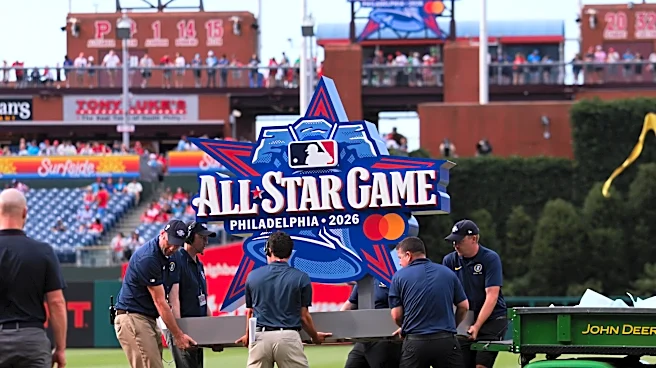




This year will mark the fifth time the MLB All-Star game will take place in Philadelphia, but only the fourth time it will be hosted by the Phillies. The Midsummer Classic first came to Philadelphia in 1943, but it was the Athletics that played host at Shibe Park as the American League reigned victorious over the National League by a final score of 5-3. The first time with the Phillies running the show at Shibe offered some rain too.
No, that is not a typo.
The 1952 All-Star Game hosted by the Phillies
on July 8th was a rain-filled, sloppy mess. It was the first and to this day remains the only All-Star Game to be called early due to rain. It featured numerous instances of future Hall of Fame players failing to perform their routine duties thanks to the deluge of rain turning the field into something akin to a swamp.
But it didn’t start out that way, despite heavy rain in the days leading up to the day of the game and forecasts predicting even more to come by game time. Despite those forecasts, commissioner Ford Frick decided that he didn’t want to be the man who cancelled the All-Star game and that they would play ball come hell or (literal) high water. There were no on-field warmups or batting practice, and the start of the game was delayed by almost 20 minutes, but over 32,000 people lined Shibe Park to see if the NL could win for the third year in a row.
They would try to do so behind the Phillies own Curt Simmons who was slated to be the starting pitcher. the 23-year-old lefty had been dynamite for the local club, as he was sporting a 1.74 ERA and a 7-1 record through the first half of the season. But as a steady drizzle began to fall, Simmons walked the AL leadoff hitter Dom DiMaggio, bringing Hank Bauer to the plate. Simmons quickly recovered and struck out Bauer before also punching out Dale Mitchell for the first two outs. Al Rosen then grounded into a forceout to NL shortstop Granny Hamner, Simmons’ Phillies teammate, to end the first of Simmons’ three scheduled innings.

Opposing Simmons was Vic Raschi of the Yankees, the chosen starter by AL and Yankee manager Casey Stengel. Stengel, like Frick, was also trying to avoid a dubious distinction. No manager had lost three straight All-Star games, but Stengel was in danger of doing so after being on the losing end in 1950 and 1951. Therefore, Stengel went with his own best starter to begin the game. Raschi retired the first hitter before Jackie Robinson blasted a pitch into the upper deck in left field to give the NL an early 1-0 lead. But Raschi recovered in a similar manner to Simmons, retiring Stan Musial and Hank Sauer on strikeouts to end the inning.
Both starters pitched clean innings in the second as the rain continued to fall. DiMaggio laced a two-out double off of Simmons in the third, but the Phillies ace once again was able to quickly escape any damage as he finished his final scheduled inning of work. Raschi meanwhile was already out of the game, giving way for Bob Lemon of Cleveland. He induced a trio of flyouts to end the third, but not before some controversy. Stengel attempted to replace his left fielder Dale Mitchell with Minnie Miñoso mid-inning, but Durocher protested, stating that by rule all starters except pitchers have to play at least three innings. Umpire Al Barlick agreed, and Mitchell went back to the slowly-getting-wetter field despite a bad leg that Stengel claimed was the reason for the attempted switch.
Luckily for the starters who could now leave the game after three innings, the rain started to get worse as the game moved into the fourth with the NL still leading 1-0. The infield had become filled with puddles while the outfield was becoming a sloshy mess. Simmons’ replacement, Bob Rush of the Cubs, was left to try and find a way to pitch through the downpour. Miñoso was finally allowed to enter the game as a pinch-hitter, and he promptly greeted Rush with a double. Rosen then worked a walk, bringing Yogi Berra to the plate with runners on the corners and no outs. The stage was set for Berra to have a signature moment, but instead he popped out to first baseman Whitey Lockman, who probably had to stare up into biblical amounts of rain to catch the ball.
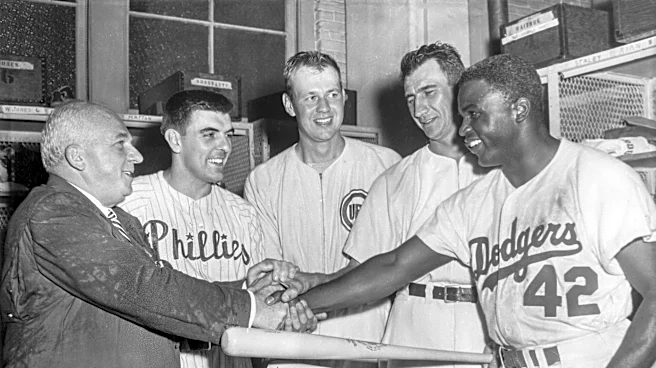
It was with the next batter that this game took a turn towards performance art, as Eddie Robinson hit a ball directly to Jackie Robinson at second base that was a routine double play ball. But the latter Robinson slipped on the mud in the infield, allowing the ball to pass under his glove and Miñoso to score, tying the game. Robinson had a chance to redeem himself when the next hitter Bobby Avila hit a ball up the middle. But once again, Robinson had trouble getting through the “muddy morass” that used to be the infield and was only able to knock the ball down rather than field it, allowing yet another run to score that put the AL up 2-1. Phil Rizzuto then grounded to Hamner who flipped the ball to Robinson, who on his third attempt to maneuver the multiplying layers of mud, finally turned the inning-ending double play. But the mud would still have its way on the American hero, as Robinson slipped off the bag while making the turn and pulled Lockman off the bag with the throw, but the first baseman recovered in time for the out.
Robinson began the bottom half of the inning with a golden chance to redeem himself, but he popped out against Lemon. If only he had waited a little longer, as it appeared Lemon was having trouble locating the ball due to the still heavy downpour, as he plunked the next batter in Musial. Hank Sauer followed that up with a titanic 430 foot, two-run homer into left field to put the NL back on top 3-2. It was personally rewarding for Sauer who had been voted in as the starter for the 1950 All-Star game but then Dodger manager Burt Shodden had tried to insert his own centerfielder Duke Snider into the spot instead. After the game, Sauer told the media that he hoped Shodden “wherever he was, was watching and listening. I wouldn’t want him to miss this for the world.”
The NL continued to then load the bases against Lemon, bringing up the pitcher’s spot in Rush. But for some reason possibly related to hypnosis from the sound of the rain pelting the diamond, Durocher elected not to pinch hit, and Rush promptly struck out to end the inning. Stengel, who perhaps may have been thinking of a way to appease some sort of rain deity, decided not to pinch hit for his pitcher either to begin the fifth, and Lemon quickly grounded out to second. Bauer collected a two-out single off of Rush’s glove but then was thrown out trying to steal by Roy Campanella to end the inning. It was a head scratching decision, but when you remember that Bauer had already been standing in the rain for an hour, it makes more sense.
Stengel, failing to offer an acceptable sacrifice to the rain gods, replaced Lemon in the bottom of the fourth despite having him hit in the top half of the inning. In came Bobby Shantz of the hometown Philadelphia Athletics, and he dazzled by striking out the side consisting of Lockman, Robinson, and Musial on 13 pitches. He did it without the use of his knuckleball, as Shantz had deemed the ball too slippery to attempt to throw the pitch.
It appeared that Shantz may have a chance to match or better Carl Hubbell’s feat from the 1934 All-Star game when Hubbell struck out five future Hall of Famers in a row. But his strikeout of Musial would prove to be the final official at-bat of the game, as the rain finally became too heavy to bear as Miñoso stepped to the begin the sixth. The umpires decided to put the game into a delay and 56 minutes later, concluded that the disaster of a field was in no playing condition and officially called the game with the final score being a 3-2 NL win.
Frick, despite his best efforts to tempt fate and laugh in the face of nature, did become the first commissioner to oversee a rain-cancelled All-Star game. It would also prove to be the shortest All-Star game ever played with only five official innings. Frick probably would’ve loved to play an 11+inning game in a stadium with a roof instead.
Sources
The Philadelphia Inquirer, July 6th, 1952
Allen Lewis, The Philadelphia Inquirer, July 7th, 1952
Stan Baumgartner, The Philadelphia Inquirer, July 8th, 1952
Art Morrow, The Philadelphia Inquirer, July 9th, 1952