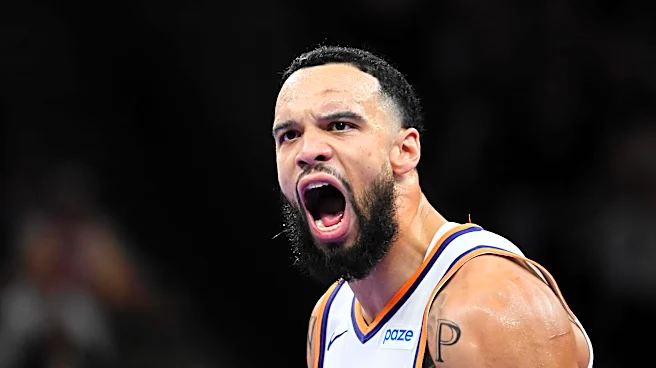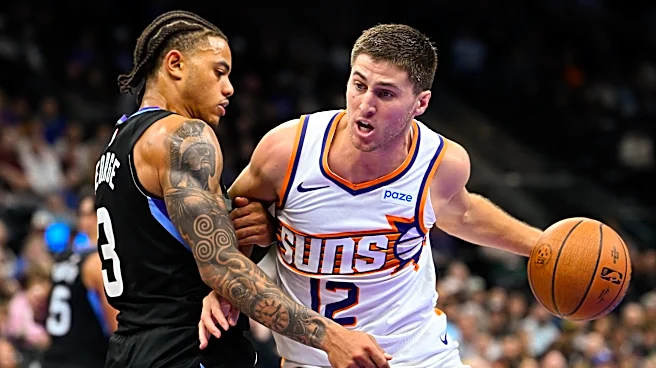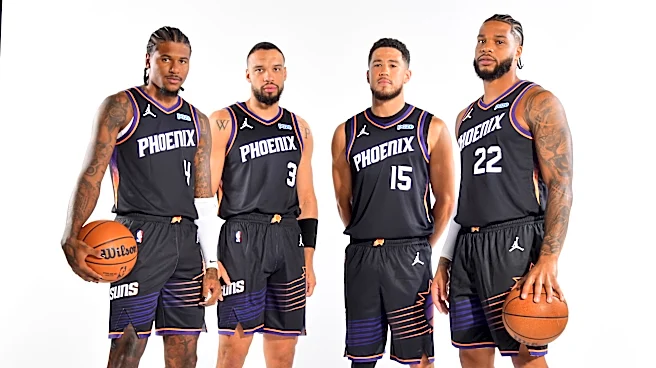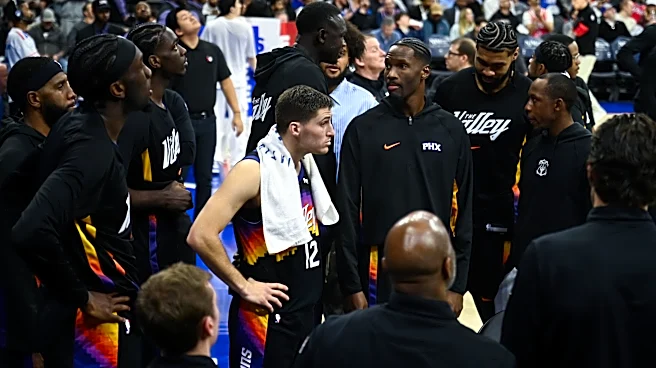




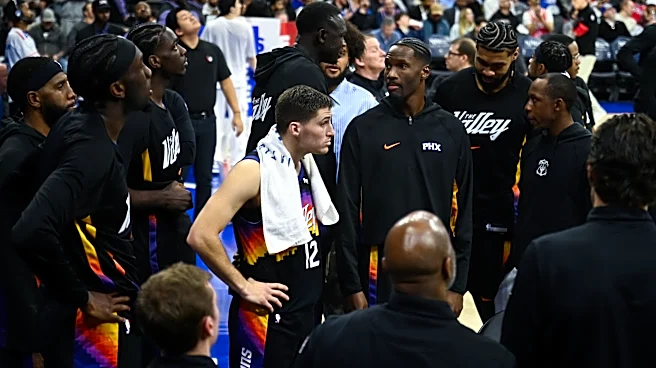
As the Phoenix Suns move into ninth place in the Western Conference, riding a 3-0 record on their current road trip, you might think everything is hunky-dory. That this team is finally gelling in a way that’s translating into victories. And I’m not going to argue against that. I think there’s merit to it. But that doesn’t mean everything is right in Phoenix. It means this team is finding its footing and taking advantage of some inferior competition, as well it should. That’s what good teams do.
One
thing continues to be clear, however. The starting five that Phoenix trots onto the court every night remains one of the worst in the league.

And I know, I know. It’s not about who starts. It’s about who finishes. That’s something I firmly believe, although when your starters aren’t getting the job done, you’re forced to rely on your bench to stabilize things. That’s hardly ideal. Thankfully for Phoenix, they possess one of the most productive bench units in the NBA, a testament to the team’s overall depth.
Still, when your starting unit consistently fails to set the table, you’re going to struggle against quality opponents. We’ve seen that play out throughout the early portion of this season. Starting matters, despite my personal philosophy on the subject. Especially when you factor in the egos of players and the agents who represent them. If someone believes they should be starting, particularly when they’re being compensated like a starter, you can bet that any suggestion of moving them to the bench will be met with resistance from an agent who believes his client’s value is being diminished.
One thing working in Phoenix’s favor has been relative health. I know that might sound strange considering the injury to Mark Williams, but holistically, the starting unit has enjoyed considerable continuity through the first 15 games. In fact, only two teams in the NBA have utilized only two different starting lineups this season. The New York Knicks and the Phoenix Suns.
That continuity hasn’t necessarily translated into production, however. When you examine the numbers associated with Phoenix’s two starting lineups, they’re pretty abysmal. The unit featuring Khaman Maluach has posted a net rating of -11.5 across nine games together. The lineup featuring Oso Ighodaro? An even worse -14.4.
If we’re looking for ways to tweak the Suns’ approach, exploring changes to the starting lineup might be where the answer lies. Whether that means adding playmaking, improving the rebounding, or injecting a little more attitude into the mix, Phoenix might benefit from experimenting with different combinations if it wants to compete more consistently against the league’s better teams.
Now, I understand the importance of establishing continuity. The more time these players spend together, the better they’ll understand where their teammates are supposed to be on both ends of the floor. That familiarity builds cohesion, and cohesion can eventually translate into success. So I’m not necessarily advocating for an immediate change, especially with the Suns playing quality basketball and winning seven of their last nine games.
But there comes a point when you’ve seen enough from a particular lineup to understand its strengths, its limitations, and what it ultimately provides. When that point arrives, it might behoove Jordan Ott to explore some alternatives. With that in mind, here are three starting lineups the Phoenix Suns could experiment with.
Lineup 1: Start Goodwin
I’ll start simple here by adding Jordan Goodwin to the starting five.

Goodwin has been stellar this season, and when you look at his on/off metrics, the Suns have been better in nearly every category, including defensive rebounding percentage. His net rating differential sits at +20.7, the ninth-best mark in the league.
Now, you can look at that two ways. The first is that he clearly has a positive impact whenever he steps onto the floor. You feel it. You see it. He’s one of those emotional players who has the ability to affect everyone around him, like that positive coworker who walks into the office and immediately makes the day better. Everybody enjoys playing alongside Goodwin because of the effort he provides.
The other way to interpret that number, and probably the way I lean, is that the starting lineup has been so bad that Goodwin benefits from being part of a second unit that consistently outperforms it. When the group you’re replacing struggles as much as Phoenix’s starters have, it’s easier to generate an impressive net rating differential.
The interesting question is where Goodwin fits if you move him into the starting lineup. My choice? I’d replace Dillon Brooks, primarily because Goodwin provides a greater rebounding presence than Brooks currently does. Brooks is averaging 3.6 rebounds per game, while Goodwin is pulling down 4.7. From a rebounding percentage perspective, Brooks sits at 6.1%, compared to Goodwin’s 10.9%.
If rebounding is an issue for the starting unit, which it certainly is, adding Goodwin helps address that deficiency while providing a player whose skill set complements what Miles Bridges brings to the floor rather than overlapping with it.
It’s also worth noting that a lineup featuring Devin Booker, Jalen Green, Jordan Goodwin, Miles Bridges, and Oso Ighodaro has already appeared for eight minutes this season. The net rating for that combination? +37.5. Yes, it’s a small sample size. But within that limited opportunity, the results have been pretty damn good.

Lineup 2: Start Luke Kennard
If there’s one guy I’d really like to see get going, it’s Luke Kennard. Through 14 games, he’s averaging 17.3 minutes per night, providing 8.6 points, 1.7 rebounds, and 1.6 assists. His shooting? It’s been as advertised, connecting on 43.8% of his three-point attempts. The issue is that he’s attempting only 4.6 threes per game.
That was one of the concerns when Kennard arrived in Phoenix. Would he be willing and able to become a volume shooter? Because ultimately, that’s what the Suns needed him to be. You’re replacing the three-point production of Grayson Allen and Royce O’Neale, two players who certainly weren’t afraid to let it fly. Allen averaged 8.9 three-point attempts per game last season. O’Neale? 6.7.
Perhaps one way to stoke the flame of what Kennard could become is to insert him into the starting five.
His efficiency has been stellar, although you’d be sacrificing some of what Jalen Green does well and probably doesn’t receive enough credit for, most notably his rebounding and defensive length. In return, you’re adding another legitimate perimeter threat alongside Dillon Brooks, who has been fantastic from deep to start the season.
You’d have Devin Booker handling much of the facilitation and distribution, although Kennard has demonstrated an ability to contribute in that department as well. He doesn’t do it in volume, because quite frankly, nothing he’s doing right now comes in volume. But his 12.3% assist percentage isn’t all that far removed from Green’s 17.3%.
Perhaps the most telling statistic comes from the on/off numbers. In the 325 minutes Jalen Green has been on the court without Luke Kennard, the Suns have posted a net rating of -9.8. When Kennard is on the floor without Green? Across 165 minutes, that number skyrockets to +26.9.

That’s a pretty significant difference, and one that makes me curious about what Kennard could provide with an expanded role. I’d be willing to gamble a little and see what that looks like.
Lineup 3: Start Gillespie and Maluach
All right, I’m going to give you the one you’ve been waiting for, and you’re probably surprised I didn’t list it first. Yeah, I toyed with you a bit. Can’t bury the lead, you know?
It’s starting Collin Gillespie.
In my opinion, this is one of the most obvious options for the Phoenix Suns. Jalen Green has been inefficient, and much of what he provides offensively overlaps with Devin Booker. If you can somehow convince Green (and his agent, Andrew Morrison) that moving to the bench is a good idea, the Suns could ultimately benefit. And so could Green. If he embraces that sixth man role, becoming the guy who comes in and uses his athleticism to score against opposing second units, it could actually increase his value over the long term. Or it could completely disrupt what has become one of the most productive second units in the league. I don’t know.
But when you look toward the future, knowing that Collin Gillespie is likely to be around longer than Green and continue playing alongside Devin Booker, it might behoove the Suns to give him more opportunities to develop that relationship on the court.
Thus far this season, Gillespie and Booker have played 200 minutes together, posting a net rating of -7.7. Clearly, there’s room for improvement, and perhaps that improvement begins by giving Gillespie an opportunity with the starting five.
Now, you might be wondering why I’m suggesting starting Khaman Maluach over Oso Ighodaro in this scenario. It’s simple. What Oso does well is facilitate from the center position, utilizing high screens and dribble handoffs to create opportunities and open up different aspects of the offense. When you have someone like Gillespie, who can effectively navigate an offense with the ball in his hands, you don’t necessarily need that additional wrinkle in your starting five. What you could use, however, is more effective rebounding and shot blocking. That’s where Maluach comes into the equation.
We’ve actually seen this combination on the court this season, although it has existed for only six minutes. But what a glorious six minutes it was. The Suns posted a net rating of +92.3 with that lineup. Clearly, that’s not a statistic you can live and die by given the limited sample size, but if you’re thinking about the future of this team, getting Gillespie and Maluach opportunities to develop together could be highly beneficial.

Another reason I’m not advocating for Oso in this particular lineup is that we’ve already seen what that combination looks like, albeit in another limited sample. Across 10 minutes featuring Gillespie, Booker, Brooks, Bridges, and Ighodaro, the Suns posted a net rating of -47.6.
Again, we’re dealing with extremely small sample sizes, but I think that further fans the flames of my thesis. Having Oso in a starting lineup alongside Gillespie potentially diminishes some of what makes Ighodaro effective and valuable to this team. His ability to facilitate becomes less essential when another capable ball handler is already providing that element.

Of the three lineups I’ve explored, this is the one I’d most like to see the Suns experiment with. That doesn’t necessarily mean Gillespie and Maluach need to become permanent starters. But at some point this season, I’d like to see them share the floor more frequently so we can gather meaningful data and determine whether those early numbers hold up. And you best believe I’ll be keeping an eye on it.
Those are my lineups. Those are my suggestions. Again, they don’t necessarily need to be starting lineups. It’s fun to suggest three different starting fives that the Suns should trot onto the court, but in reality, we know that’s unlikely to happen for the reasons I mentioned above. Agents, egos, and contracts ultimately determine which players get introduced at the beginning of games, with fireworks going off and a gorilla waving a giant flag.
That being said, there’s an opportunity for head coach Jordan Ott to weave some of these combinations into games, giving his coaching staff a chance to evaluate how productive they can be. As you can see, there’s very little data available on some of these lineups, which leaves plenty of room for speculation. The best way to eliminate that speculation is to actually put these combinations on the court and see what happens. That provides meaningful data, helps us better understand what works and what doesn’t, and ultimately gives the coaching staff more information to make decisions that may eventually become necessary.
The Suns have won seven of their last nine games, and that’s encouraging. But winning shouldn’t prevent Jordan Ott from exploring ways to make this team better. The starting lineup has consistently struggled, and there are intriguing alternatives worth investigating. Maybe none of these combinations provides the answer. Maybe one changes everything. We won’t know until they’re given meaningful opportunities. Because continuity is valuable, but at some point, continuing to do something that isn’t working becomes stubbornness rather than strategy.