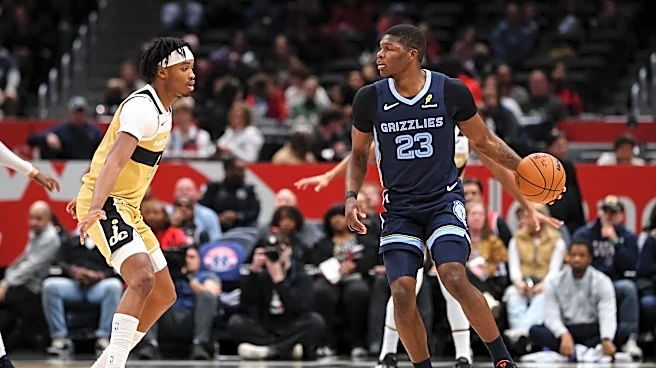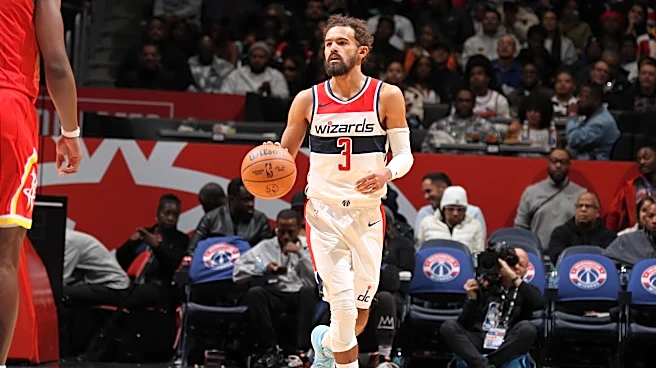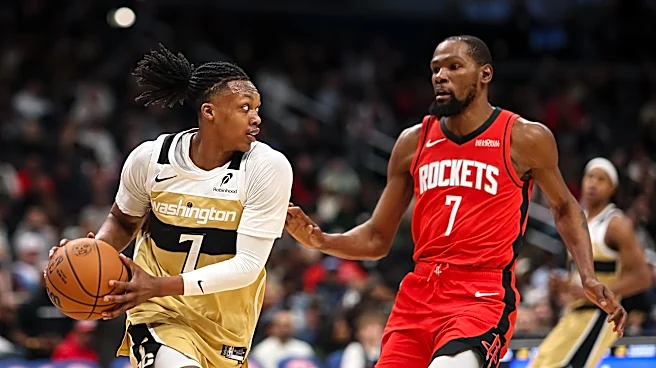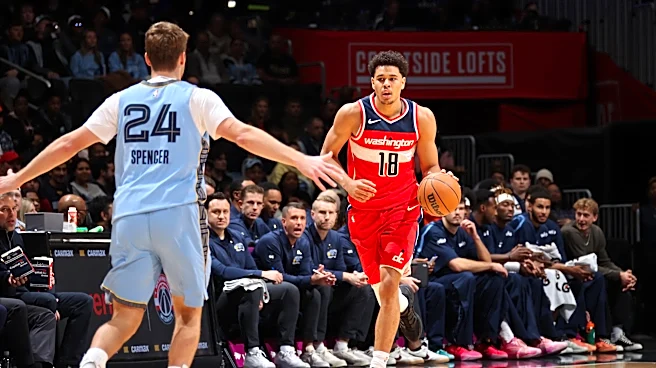


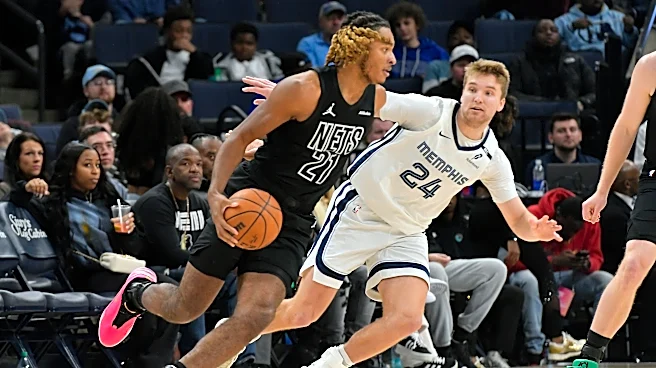
The Wizards played 24 good minutes against the Memphis Grizzlies. Unfortunately, the game lasted 48 minutes. Their worst 12 minutes came in the third quarter. They started the period up 10 and finished it down 14, courtesy of a 42-18 beatdown by Cameron Boozer, Zach Edey, and the rest of the Grizzlies.
Fifteen games into the season where they hoped to compete again, the Wizards have a 4-11 record, and they’re currently on an eight-game losing streak. It’s starting to feel like last year. And the year before.
And the year before.

If you missed this one, a) congratulations, and b) here are a few tidbits to illustrate how this one went:
- Washington’s defensive game plan was built around defensive indifference — they were going to concede three-point shots to Boozer. He missed his first five…and then made seven of his last eight. Boozer finished with a career-high 29 points,.
- Edey dominated Washington’s Twin Towers lineup, notching 23 points (on 10-15 shooting) and 10 rebounds in just 21 minutes.
- Javon Small had his first career double-double — 12 points, 12 assists.
- The Grizzlies shot 64.2% (effective field goal percentage) and rebounded 42.9% of their misses.
That’s the second consecutive game the Wizards gave up a 60+% efg and an opponent offensive rebound rate above 40%. I don’t know for sure because it probably never occurred to anyone to track this combination of stats, but I suspect it’s exceedingly rare to do both in a single game. I mean, it never occurred to me to pay attention until the Wizards did it Sunday night. It never occurred to me they’d do the same thing on Monday night.
By the way, the Wizards entered the game ranked 28th in strength of schedule adjusted scoring margin. They probably can’t fall in the rankings — they’re ahead of the Milwaukee Bucks and Charlotte Hornets. But man…this is the team that’s supposed to be trying to compete.
The problem is kinda everything. Trae Young and Anthony Davis are supposed to be the bedrock. The youngsters are supposed to be making some version of The Leap. Except, Young and Davis have been up and down. Both have exhibited problems with effort and focus (more on that in the notebook section). And none of the kids are leaping.
I mean, except Kyshawn George, if you squint just enough to miss all the crazy turnovers and dumb fouls.
While I don’t think Xs and Os are a problem, there’s a disconnect somewhere that shows up in the team’s effort, execution, and ability to maintain focus for a full 48. Last night, for example, the team looked good for half the game. In the second half, they got pummeled, and no one showed a bit of fight. They all just kinda let it happen.
Brian Keefe was frustrated enough by the Houston debacle Sunday night that he publicly challenged their effort. That’s a sign of desperation — a coach whose message isn’t breaking through. And then they got thoroughly outplayed by Memphis.
Yikes
From the Notebook
- Six minutes into the game, Memphis had six offensive rebounds. The Wizards had five defensive rebounds. For the game, it was 17 offensive boards for Memphis, and 20 defense rebounds for Washington.
- What the hell was that? In the first quarter, the Grizzlies had a quasi-fast break led by Javon Small. Four Wizards were back. Trae Young looked like he was going to pick up ball, when he inexplicably gestured to Bilal Coulibaly to take ball, and then abruptly switched out onto a Grizzlies player on the wing. That gave Small a free run at the basket (Coulibaly was standing under the basket when the “pick him up” suggestion arrived). Coulibaly fouled late, and Small got a three-point play. I rewatched the play 10-12 times, and I still have no idea why Young didn’t just pick up Small.
- Late in the first quarter, Young had a thoroughly disgusting shot attempt — a 29-foot heave with nine seconds still on the shot clock, and a plenty of space to drive or make a good play.
- Washington’s defensive indifference meant that Boozer had more firts quarter three-point attempts in Grizzlies history.
- Egregious effort from Anthony Davis midway through the third quarter. He tried for a steal and missed. And then…instead of hustling back into the action, he stood around on the perimeter watching and leaving his teammates to defend 5-0n-4. Memphis got an open three.
- Keefe is trying a tighter and older rotation. Last night, they played nine while trying to compete — a nine that replaced Bub Carrington with Khris Middleton.
- Another effort issue with Davis. He tried a shot, fell down, and didn’t get the call he wanted from the refs. Instead of getting up and sprinting back, he lollygagged on the floor complaining and never got back across halfcourt. In the five-on-four, Boozer got a wide open three.
- Defensive communication issue — in the third quarter, Davis dropped off Boozer at the three-point line and drifted down into the paint. No one picked him up, and a few seconds later, Boozer got a wide open three, which he converted into his sixth made triple.
- I have two notes about Kyshawn George fouls in the fourth quarter. The first came early and was utterly pointless — he grabbed Cam Spencer on an Iverson cut for no discernible reason. The second came midway through the period when the Wizards seeemd to be cutting into the Memphis lead. For no reason I could determine, George grabbed Cedric Coward and sent him to the free throw line. It was dumb, pointless, and momentum-killing.
- Edey was impressive. He scored comfortably on Davis and Sarr. He big-boyed George for an offensive rebound and foul on the putback. He’s massive, strong, and skilled — great touch with both hands.
- Edey had a great nope against George. George made a nice dribble-drive attack in transition, shook Spencer and seemed ready to make a run straight to the rim for a bucket and maybe a free throw. Except, the 7-3 Edey was in the way. George came to a screeching half, fired a crosscourt pass, which ultimately resulted in Young driving and missing a floater.
- The Wizards led by as much as 12 in the first half…and trailed by as much as 20 in the second half.
- Against the Wizards, you’re never more than two passes from an open three.
Four Factors
Below are the four factors that decide wins and losses in basketball — shooting (efg), rebounding (offensive rebounds), ball handling (turnovers), fouling (free throws made).
The four factors are measured by:
- eFG% (effective field goal percentage, which accounts for the three-point shot)
- OREB% (offensive rebound percentage)
- TOV% (turnover percentage — turnovers divided by possessions)
- FTM/FGA (free throws made divided by field goal attempts)
Stats & Metrics
PPA is my overall production metric, which credits players for things they do that help a team win (scoring, rebounding, playmaking, defending) and dings them for things that hurt (missed shots, turnovers, bad defense, fouls).
PPA is a per possession metric designed for larger data sets. In small sample sizes, the numbers can get weird. In PPA, 100 is average, higher is better and replacement level is 45. For a single game, replacement level isn’t much use, and I reiterate the caution about small samples sometimes producing weird results.
POSS is the number of possessions each player was on the floor in this game.
ORTG = offensive rating, which is points produced per individual possessions x 100. League average so far this season is listed in the Four Factors table above. Points produced is not the same as points scored. It includes the value of assists and offensive rebounds, as well as sharing credit when receiving an assist.
USG = offensive usage rate. Average is 20%. Median last season was 17.7%.
ORTG and USG are versions of stats created by former Wizards assistant coach Dean Oliver and modified by me. ORTG is an efficiency measure that accounts for the value of shooting, offensive rebounds, assists and turnovers. USG includes shooting from the floor and free throw line, offensive rebounds, assists and turnovers.
+PTS = “Plus Points” is a measure of the points gained or lost by each player based on their efficiency in this game compared to league average efficiency on the same number of possessions. A player with an offensive rating (points produced per possession x 100) of 100 who uses 20 possessions would produce 20 points. If the league average efficiency is 115, the league — on average — would produced 23.0 points in the same 20 possessions. So, the player in this hypothetical would have a +PTS score of -3.0.
Players are sorted by total production in the game.