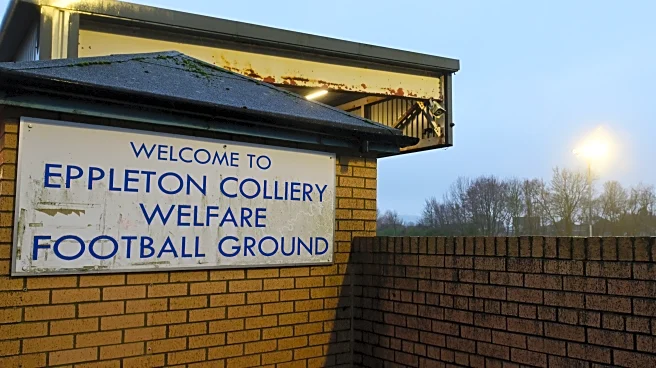

The cold seems to come in sideways at Eppleton.
It always has, and even on days when the sun sits low and orange over the stand, there’s a bite in the air that seems stitched into the place, as if the ground
remembers every winter it’s ever endured.
On this particular afternoon, the wind is sharp enough to make your eyes water but the small cluster of supporters gathering by the railings don’t seem to notice. They’re too busy greeting each other, stamping their feet and laughing about the same things they’ve laughed about for years.
“Aye, it’s Baltic,” says one of them, a man in his fifties with a red and white scarf. “But it’s nowt compared to that day at Hetton when the snow was comin’ in sideways. You remember that? Couldn’t see the pitch for half the match.”
His mate nods, hands shoved deeply into his coat pockets. “Aye. Froze me toes off. Still worth it, mind.”

They’re the kind of supporters who don’t need introductions. They know each other by face, by routine and by the way they stand in the same spots every matchday.
They’ve been here through everything: the WSL highs, the enforced drop, the long slog back — and the quiet years when crowds were thin and the media barely noticed. They’re the fanbase that never left; the ones who kept turning up even when the club was pushed down the pyramid through no fault of its own.
And in their stories, you can trace the entire history of Sunderland AFC Women — not as a timeline of leagues and results — but as a lived experience, shaped by loyalty, stubbornness and a deep sense of belonging.
The match hasn’t even started yet, but the atmosphere is already familiar.
Kids in oversized shirts chase each other along the railings. A woman with a Thermos pours tea into a paper cup for her husband. A group of teenagers, faces half‑hidden by scarves, argue about who’s going to score first. It’s small, intimate, and unmistakably Sunderland. And for the supporters who’ve been here the longest, it’s a reminder of why they stayed.
One of them, a woman called Denise, has been following the team since the early 2000s. She stands with her daughter, who wasn’t even born when Lucy Bronze was bombing up and down the flank in red and white. Her voice is warm and matter‑of‑fact; the kind that’s told this story before but never gets tired of it.
“I started comin’ when they were still playin’ up at Hetton,” she says.
“Back then, you’d get maybe a couple of dozen of us, if that. But you could see straight away there was somethin’ special about the lasses. Proper talent. Proper graft. And they were ours, you know? From here. From the North East. You felt proud watchin’ them.”
She remembers the early WSL days vividly, the excitement, the sense of being part of something new and the pride in seeing local players rise to national prominence.
“When you saw the likes of Jordan Nobbs and Lucy Bronze comin’ through, you knew they were goin’ to be massive. You could just tell. But they were still just lasses from round here, chattin’ to you after the match, takin’ photos with the bairns. It felt like a family.”
That word comes up again and again: family. Not in the corporate, branded sense, but in the way people talk about their own. The supporters weren’t just watching a team — they were investing in people they knew, people they’d seen grow, people they’d spoken to in car parks and clubhouses.
When the club was thriving, they celebrated together. When the club was hit by the FA’s restructuring and forced down the leagues, they grieved together.

“It felt like a kick in the teeth,” says another supporter, a man called Gary who’s been following the team since the early 2010s.
“We’d just had some of the best years we’d ever had. We were producin’ England players left, right and centre. And then suddenly we’re told we’re droppin’ down the leagues. Not ‘cos of results, not ‘cos of anything the lasses did. Just… paperwork. Money. Decisions made miles away from here.”
He shakes his head, still frustrated even now. “It was wrong. Everyone knew it was wrong. But what were we gonna do? Stop comin’? Nah. If anything, it made us more determined. If the lasses were gonna keep goin’, then so were we.”
That determination became a defining feature of the fanbase during the years in the third tier.
Crowds were small, sometimes barely enough to fill a single stand. Away trips were long and thankless, and often made to grounds with little more than a fence around the pitch, and media coverage was minimal. But the supporters kept turning up week after week because they believed in the club and the players who refused to give up.
One of those away days comes up repeatedly in conversations: a trip to Hull, played on a bog standard university pitch which lacked any personal touch. The weather was grim, the facilities basic and the match itself scrappy, finishing in a 4-2 win for Sunderland. But the supporters remember it fondly, almost affectionately.
“There were about five of us,” says Denise, laughing. “We’d driven all that way and when we got there, we were like, ‘Is this it?’ But the lasses grafted, as they always do. And we made more noise than the home fans. We always did.”
Gary nods. “That’s the thing about this fanbase. We don’t need fancy stadiums or big crowds. We just need our team. And as long as they’re playin’, we’ll be there.”
The enforced drop didn’t just test fan loyalty — it strengthened relationships. With fewer people around, supporters and players became even closer. They’d chat after matches, share frustrations and celebrate small victories. The sense of community deepened, even as the club faced some of its toughest years.
“It was hard,” says Lee, who started following the team during the WSL era but stayed after the drop. “You’d see the lasses givin’ everything, week in, week out, and you’d think, ‘They deserve better than this.’ But they never complained. They just cracked on. And that made us want to crack on too.”
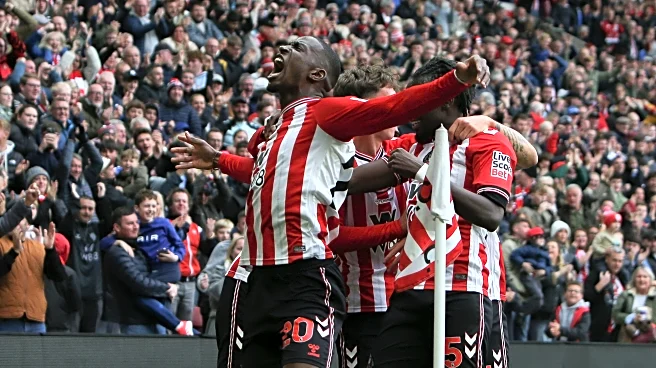
When the club finally began to climb again, finally earning promotion back to the Championship, the celebrations were emotional — not loud or flashy, but heartfelt.
Supporters, some with tears in their eyes, hugged each other because they knew what it meant. They’d been there when the club was pushed down, when the crowds were tiny and when the future felt uncertain. Yet now they were seeing the club rise again, slowly but surely.
“It felt like justice,” says Denise. “Like we were finally gettin’ back to where we belonged.”

The present‑day scene at Eppleton reflects that sense of renewal.
The crowds are bigger now. The atmosphere is livelier and the sense of momentum is unmistakable. But the core of the fanbase, still stand in their usual spots, greeting each other with the same warmth and carrying the memories of every era.
As the match kicks off, the noise rises. It’s not the roar of a packed stadium, but it’s passionate, committed and unmistakably Sunderland. The supporters shout encouragement, groan at missed chances and cheer every tackle. They know the players, their strengths and their stories — and the players know them too.
At half time, a few supporters gather near the Centre Spot Cafe, warming their hands on cups of tea or cheesy chips. They talk about the first half, the referee and the weather. But they also talk about the past, the WSL days, the enforced drop, the long away trips and the players who came through the system and went on to play for England.
“You look at what some of them have gone on to do,” says Gary. “World Cups, Euros, Champions League. And we saw them when they were just bairns. That’s somethin’ special, that.”
There’s pride in his voice, but also a hint of wistfulness. The club has always been a producer of talent, often losing its best players to bigger teams with bigger budgets. But the supporters don’t resent it. They see it as part of the club’s identity, part of what makes Sunderland AFC Women unique.
“We’re a proper football city,” says Lee. “We produce players. That’s what we do. And we’re proud of them, wherever they go.”
As the second half begins, the wind picks up again, whipping across the pitch. But the supporters don’t flinch. They pull their scarves tighter, stamp their feet, and keep cheering. They’ve stood in worse weather than this. They’ve stood through worse times than this — and they’re not going anywhere.
After the match — a heartbreaking loss that feels like it could’ve been a win on another day — a few players come over to the railings to chat with supporters. It’s a small gesture but it means a lot. The connection between players and fans has always been one of the club’s strengths, and it’s still alive today.

One of the younger players smiles shyly as she talks to a group of supporters.
She thanks them for coming, apologises for the loss and a missed chance, laughs at a joke about the referee, signs personalised items and takes selfies with those only a few years younger than her. She’s part of the new generation, the one that didn’t live through the WSL era or the enforced drop, but she understands the history. She knows what the supporters have been through. And she knows what their loyalty means.
“They’re class, like,” she says quietly as she walks back towards the changing rooms. “Proper class.”
As the crowd begins to thin, the long‑timers linger a little longer, chatting about the match, making plans for the next one and sharing memories of matches played years ago.
They talk about Hetton, South Shields and the early WSL days. They reflect on the heartbreak of the drop, the joy of promotion, players who became household names and players who quietly grafted without ever getting the recognition they deserved.
They also discuss long away trips, freezing nights, last‑minute winners and heavy defeats. They talk about everything they’ve seen, everything they’ve endured, and everything they’ve celebrated.
And through it all, one thing becomes clear: this fanbase didn’t just follow the club. They carried it. When the club was pushed down, they held it up. When the crowds were small, they filled the silence. When the future was uncertain, they provided certainty. They were the constant, the anchor, the heartbeat.
As the last of the supporters drift towards the car park, the sky over Eppleton turns a deep shade of blue. The floodlights cast long shadows across the pitch and the wind finally begins to ease. It’s quiet now, but the echoes of the afternoon linger: the chants, the laughter, the conversations and the memories.
For the fanbase that never left, this isn’t just a football club. It’s a part of their lives, woven into their routines, their relationships and their identities. They’ve seen it all: the highs, the lows, the injustices, the triumphs. And they’re still here, still standing by the railings, still cheering, still believing.
Because in Sunderland, “loyalty” isn’t a slogan. It’s a way of life — and for these supporters, there was never any question of leaving.
*Certain names have been changed for purposes of anonymity