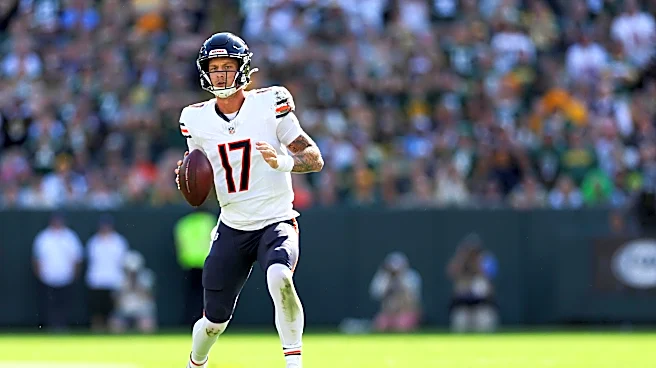


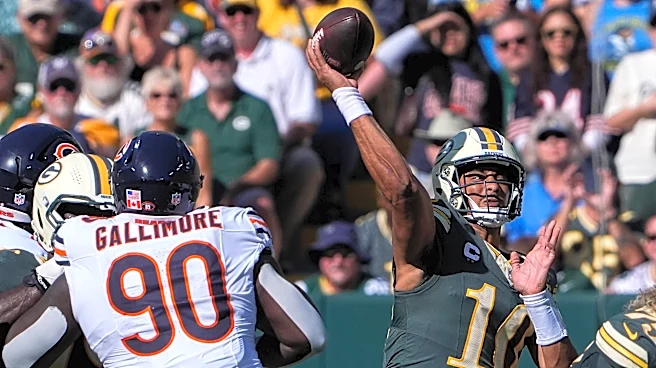

Well, remember last week when I ended this article by asking which version of Tyson Bagent would show up at Lambeau Field?
We got our answer.
And unfortunately, it was about as bad as it could have been. There was actually quite a bit of optimism surrounding the Bears entering Week 5. Chicago had won three straight games, two of them without Caleb Williams, and Bagent was getting something none of the Bears’ backup quarterbacks had really been afforded yet: a second consecutive start with a full week
of preparation knowing the offense was his.
Last week, I came away from the Jets game encouraged by some of the growth Bagent had shown since we last saw him start games in 2023.
He looked more comfortable operating within structure. He was getting through concepts with more confidence, keeping the offense on schedule and, when the pocket stayed clean, was borderline automatic. Against New York, Bagent completed 21 of 23 passes from a clean pocket for 202 yards.
There were warning signs, particularly when pressure arrived and with a handful of turnover-worthy throws, but overall it looked like a more polished version of Tyson Bagent.
Against Green Bay?
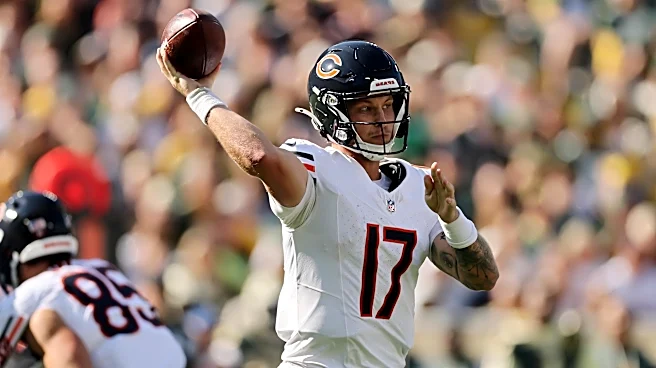
Almost all of those encouraging signs disappeared. Bagent completed just 12 of 21 passes for 87 yards, no touchdowns and two interceptions, finishing with a 27.4 passer rating before being benched in favor of Case Keenum. One week after averaging 7.9 yards per attempt against New York, that number cratered to just 4.1 at Lambeau.
And honestly, the box score doesn’t completely capture how difficult the afternoon was.
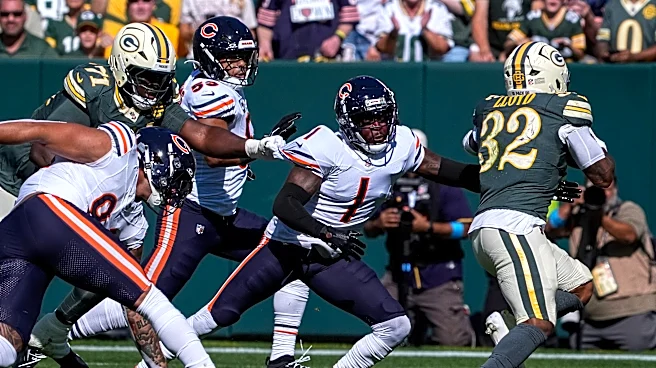
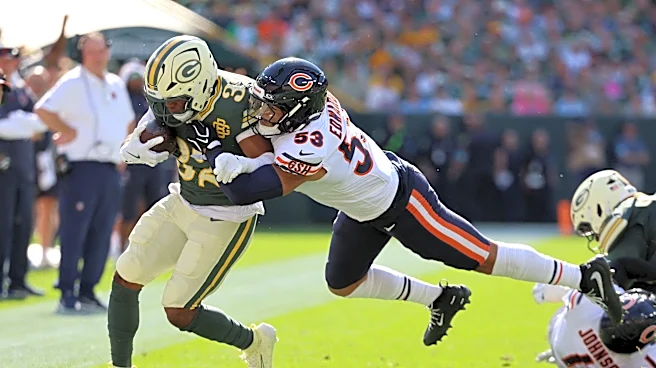
Green Bay consistently sped Bagent up, forced him off his initial reads and made it difficult for Chicago to find any sort of rhythm offensively. The Bears finished with only 246 yards, averaged 3.6 yards per play and turned the football over five times in a 31-7 loss.
That is about as sharp of a reversal from Week 4 as you’re going to find. Against New York, Bagent generally took what the structure gave him. Against Green Bay, he too often tried to manufacture answers that weren’t there.
His first interception was a good example. After Green Bay opened the game with a touchdown, Chicago had an opportunity to answer, but Bagent tried to force the football to Luther Burden III over the middle. Javon Bullard got underneath the route, deflected the pass and Xavier McKinney came away with the interception.
Green Bay took over in Chicago territory and quickly made it 14-0.
After the game, Bagent acknowledged that he needed to trust his progression and work down to Colston Loveland rather than forcing the ball where he initially wanted to go.
Chicago eventually put together a 16-play touchdown drive late in the second quarter to cut the deficit to 14-7, but that ended up being just about the only sustained offensive success the Bears found all afternoon.
Bagent’s second interception essentially ended any realistic hope of a comeback.
Green Bay initially showed what Bagent believed was a zero blitz before rotating into Cover 2 after the snap. Bagent recognized the change, but not quickly enough, forcing another pass over the middle that McKinney intercepted.
Bagent’s explanation afterward was pretty simple: he was late, and he forced it.
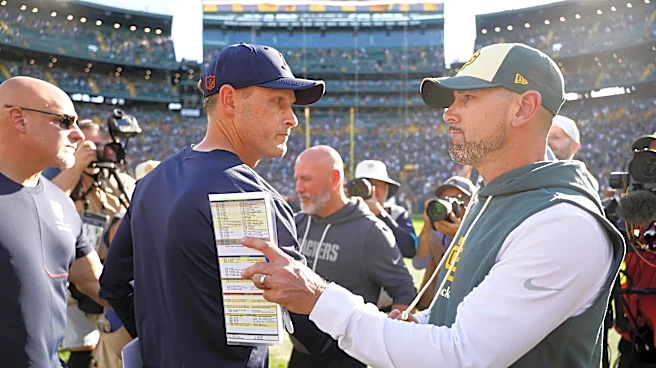
At that point, Ben Johnson had seen enough.
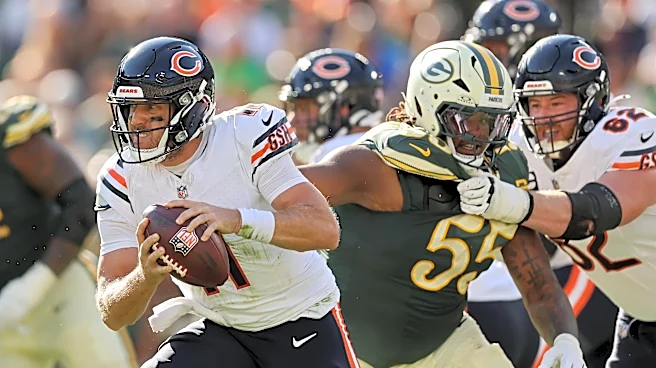
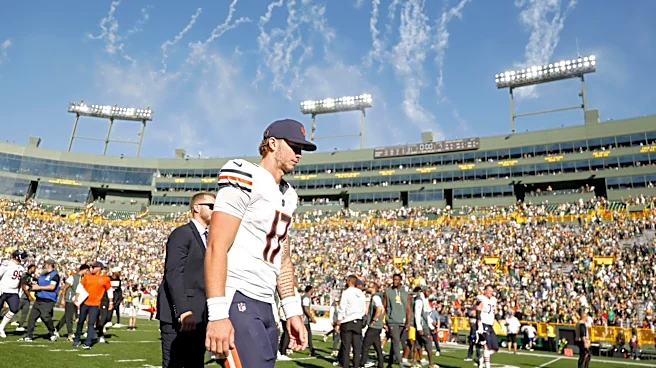
Keenum replaced Bagent after three quarters, with Johnson later saying Bagent never seemed to find a rhythm and that the second interception played a major role in the decision to make a change.
Keenum wasn’t able to rescue the offense either, eventually throwing an interception of his own and losing a fumble as Chicago finished the afternoon with five turnovers.
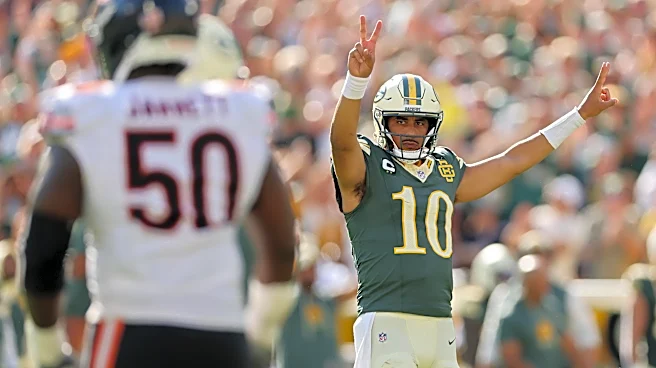
This certainly wasn’t all on Bagent. The running game that controlled the Jets matchup never got going, while Jordan Love carved up Chicago’s defense for 367 yards and two touchdowns. Green Bay finished with 428 total yards and averaged an absurd 7.3 yards per play.
Nobody wearing a Bears uniform is going to enjoy watching this tape.
But for the purposes of this series, Bagent’s performance is where things get particularly ugly.
Last week, I talked about legitimate signs of development. I thought he looked more comfortable within the offense, more confident in what he was seeing and better equipped to operate within his physical limitations. Sunday was a reminder of just how small the margin for error can be for Bagent.
The accuracy wasn’t consistently there. The processing that looked improved against New York took a major step backward. He forced throws when Green Bay changed the picture, struggled when the defense sped him up and ultimately put the football in danger often enough that Johnson pulled him from the game.
To Bagent’s credit, he didn’t run from it afterward, saying he couldn’t “look any further than the mirror” when evaluating what went wrong.
That’s the response you want from your backup quarterback.
It doesn’t make grading the tape any easier.
I’ve charted plenty of bad quarterback performances since starting this project, but once everything from Sunday was graded and the necessary adjustments were applied, Bagent finished with the lowest adjusted game grade I have ever handed out.
So…This should be fun. Let’s get into the numbers.
Benchmarks
Stat Formatting Key: This week we will be comparing Tyson Bagent’s week 5 start against Williams’ Season Totals and Averages.
(Season totals are underlined, Season Averages in Italics, and this week’s stats appear in regular text.)
C/A: 36/55 (65.5%) | 18/27.5 (65.5%) | 12/21 57.1%
Yards: 407 | 203.5 | 87
Touchdowns: 4 | 2 | 0
Turnovers: 1 | 0.5 | 2
QB at Fault Sacks: 0 | 0 | 2
aDOT: 7.7 | 7.1
Passer Rating: 92.0 | 27.1
True Passer Rating: 113.4 | 10.1
Time to Throw: 3.34s | 3.17s
Time to Pressure: 2.75s | 2.86s
Pressure Rate: 41.57% | 24.00%
On-Target Rate: 83.3% |60.0%
Poor Play Rate / Big Play Rate: 7.5% PPR / 5.0% BRP | 29.6% PPR / 0.0% BRP
EPA per dropback: +0.31 | -0.41
ANY/A: 6.2 | -0.9
Game Scorecard

The full grading sheet for each play can be foundhere.
Game Notes
Note: Last year, I included PFF grades in these breakdowns. With PFF continuing to expand its use of AI across its platform, and with my confidence in how accurately its grades reflect quarterback performance declining, I’ve decided to move away from them this season. In their place, I’ll be using PFN’s Impact Score, which will be notated as PFN on grading sheets moving forward.
NFL Passer Rating / True Passer Rating / PFN Impact Score: 27.4 / 10.1 / 65.9
- The NFL’s average passer rating through Week 4 sat at 92.2. For some added perspective, if Bagent simply threw every pass harmlessly incomplete without an interception, his passer rating would still be 39.6. His actual mark was 27.4. So, yeah… not great.
- A 10.1 TPR is an absolute disaster of a start.
- A lot has to go wrong to post a TPR this low. Bagent was inefficient over a decent-sized sample, took two sacks, threw two interceptions and generated almost nothing downfield. By my charting, he completed just one pass more than 10 yards downfield. All of that converged into a 10.1 TPR, the lowest mark I’ve recorded in any QB start I’ve graded.
- On the PFN scale, where 75 represents an average qualifying starter and 90 is elite territory, Bagent finished Week 5 with a 65.9 Impact Score, ranking 24th of 30 qualifying quarterbacks.
- The underlying numbers fell off a cliff as well. His EPA/dropback dropped from +0.22 in Week 4 to -0.41, while his CPOE fell nearly 20 percentage points, from +8.0% to -10.9%. His Week 5 EPA/dropback ranked 26th, while his CPOE ranked 28th of 30 qualifiers.
- His success rate also fell from 61.1% in Week 4 to 40.0% against the Packers.
On-Target Throws: 2026 Average: 83.3% | Week 5: 60.0%
- Reminder: Completion percentage ≠ On-Target Percentage. I only chart aimed passes, meaning throwaways, spikes and passes deflected at the line are excluded. Drops can still be credited as on-target.
- Short-Level Passing (Behind LOS–9 yards): 11/15 | 73.3% On-Target
- Deep-Level Passing (10+ Yards Downfield): 1/5 | 20.0% On-Target
- Bagent’s inability to push the ball downfield made Green Bay’s job considerably easier. He attempted just five passes more than 10 yards downfield, completing one, while two ended up in Packers hands.
- Green Bay was able to focus on taking away the run and underneath game while daring Bagent to beat them farther downfield. He simply couldn’t do it.
Poor Play Rate / Big Play Rate: 29.6% PPR / 0.0% BPR
- Last week I said an 11.6% Poor Play Rate was less than ideal. A 29.6% rate is borderline criminal.
- Bagent recorded two turnover-worthy throws, giving him five across his two starts, while the negative grades continued piling up elsewhere.
- The biggest difference from Week 4? A 0.0% Big Play Rate. Bagent recorded just two plays graded above “Average,” with his best mark coming on a “Good” throw to Rome Odunze for 17 yards early in the third quarter.
- There wasn’t a single “Great” or “Elite” play to offset the mistakes.
EPA per Dropback: -0.41
- Another massive reversal from Week 4, when Bagent ranked 11th among qualifying quarterbacks at +0.22 EPA/dropback. His -0.41 mark against Green Bay fell to 26th of 30 qualifiers.
- Two interceptions and a pair of costly sacks loomed large, and there simply weren’t enough positive plays to dig the offense out of that hole.
Under Pressure: 24.0%
- By my charting, Bagent was pressured on 24.0% of his dropbacks. The Bears’ offensive line wasn’t as dominant as it was against New York, but that still isn’t an overwhelming amount of pressure for a quarterback to deal with.
- Pair that with a Time to Throw north of three seconds, and you would hope Bagent could take advantage of the time he was afforded. Instead, the accuracy and processing issues persisted even when Green Bay wasn’t immediately disrupting the pocket.
- That tracks with the broader film evaluation. NFL.com noted Bagent struggled to diagnose coverages and became increasingly skittish in the pocket before Chicago eventually turned to Case Keenum.
From Here to Infamy
- To date, I’ve graded more than 200 NFL quarterback performances. I’ve seen some dizzying highs and some absolutely cratering lows, but Bagent’s -10.20 adjusted game score is the lowest I’ve ever handed out. As a reminder, graded games get an adjusted score if they fall under 39 total plays to grade, by taking the average points per play (amount of graded points earned totaled and divided by total plays graded) we multiply that number by however many plays we need to get to 39. In Tyson’s case that was -0.2625 graded points per play.
- Even without the adjustments, his raw game score of -7.05 would still rank among the bottom five performances I’ve graded.
- And he managed to do all of that in just 27 graded snaps.
Play Reviews
This week I’m doing something different, I want to highlight a few examples of things that (in my opinion) Tyson missed out on, whether that be due to blinders, purposefully moving past a receiver, or misdiagnosis of a defense is up to the individual, but the tape was rife with Bears receivers open, with Tyson seemingly missing them, or throwing to someone who clearly was not open.
Play 1: Tyson escapes the pocket and has Luther Burden III working with him towards the left sideline with no defender within 5 yards, if Tyson hits his man here it’s an easy chunk play and with Burden’s YAC ability maybe even a score, Bagent instead scrambles for 4-yards on the play.
Play 2: Another play with Bagent rolling to his right this time he has Kalif Raymond breaking open with a defender trailer, an accurate throw to Raymond gives him a chance to turn up field and do some real damage, Tyson does pick up 6 yards on the scramble which constitutes a successful run, but one wonders the meat left on bone.
Play 3: We have a clean pocket on this play with Bagent scanning the middle of the field, a throw with anticipation as Raymond is making his break gives him a legitimate shot at scoring, but Bagent hesitates then breaks out of the pocket leading to this. Fortunately the Packers were called for a hold leading to a first down.
Play 4: This is another simple one where Bagent bypasses an easy completion due to hesitation, it’s a simple hitch route, throwing it with a small amount of anticipation should lead to an easy 6-yards. Instead Bagents moves on, scrambles out of the pocket, slips and takes a sack.
Play 5: Bagent starts this rep working the corner route to Loveland, the window is there with proper anticipation and ball placement, however he quickly moves off that, and begins to stare down the checkdown to Kmet, despite the backside dig from Burden coming open. This ends up as an incompletion due to an inaccurate throw to Kmet on the checkdown.
Play 6: Interception #1, the dig is well covered, the underneath defender has depth on the route taking away any throwing window. Instead of checking the ball down to an open Loveland, Tyson forces a ball into a non-existent window, and the Packers come away with a turnover.
Play 7: Burden and Rome are running a Cross concept from the top of the screen, with some anticipation and touch Bagent should be able to get the ball over the intermediate defenders allowing Burden to do his YAC thing, instead Bagent checks the ball down to Raymond for 3 yards.
Play 8: Probably the most egregious miss by Bagent, the Packers fail in passing off Burder as he runs a shallow crossing route, Bagent is literally all eyes on Burden, but does not pull the trigger. With Burden’s after the catch ability this has a chance for a touchdown, instead it ends with Bagent wrapped up by a Packers defender for a sack.
Play 9: Bagent has a clean pocket here, targeting Loveland with an shallow dig. The Packers have numbers on the left side and drop into zone coverage meaning every key defender on the left side can react to Bagent throwing. Instead of working the play to the backside with Raymond, Bagent forces the ball into impossible coverage, and is lucky the ball sails past defenders harmlessly.
Summary
Bagent finishes Week 5 with final grades of 1st Half (-4.50) / 2nd Half (-2.55) / Game (-10.20) (adjusted score), equating to a truly “Awful” game grade.
There really isn’t much of a positive spin to put on this one.
One week after I came away encouraged by some of the growth Bagent showed against the Jets, nearly everything went in the opposite direction at Lambeau. The accuracy cratered, the processing became increasingly shaky when Green Bay changed the picture after the snap, and the turnover-worthy decisions piled up without enough positive plays to offset them.
The result was the lowest adjusted game score I’ve handed out in more than 200 quarterback performances.
Of the quarterbacks I’m grading this season, you can see where Bagent’s Week 5 score landed him, 6th of 6 players graded in Week 4. For a look at the entire season thus far, along with some quick notes on the other quarterbacks from this week, you can find that here.
This wasn’t simply one or two disastrous plays sinking an otherwise competent afternoon. Bagent finished with a 29.6% Poor Play Rate, failed to record a single Big Play and produced just two snaps that I graded above “Average.” Even his unadjusted score would still land among the five worst performances I’ve graded.
Twenty-seven graded snaps were enough to reach some pretty remarkable depths.
That’s especially disappointing after Week 4. Against New York, Bagent showed legitimate signs that he had developed from the quarterback we saw starting games in 2023. I don’t think one afternoon completely erases that progress, but Green Bay provided a pretty harsh reminder of the limitations that can surface when the offense needs Bagent to consistently make plays beyond its structure.
Eventually, Ben Johnson had seen enough too, turning to Case Keenum for the fourth quarter.
Thankfully for the Bears, there may finally be some light at the end of this weird three-week quarterback tunnel.
Caleb Williams took his biggest step toward returning Wednesday, when the Bears listed him as a full participant for the first time since the hamstring injury he suffered against Minnesota in Week 2. Johnson is still keeping his cards close to the vest, calling the quarterback situation “fluid,” but this is easily the most encouraging update we’ve received since Williams went down. The Bears have more on Williams’ progress here.
After watching Keenum and Bagent combine to keep the Bears afloat for a couple of weeks, followed by everything completely unraveling in Green Bay, the possibility of getting Williams back against Atlanta couldn’t come at a much better time.
We’ll see if he’s ready to go.
Until then, Bear Down!
Gary Baugher Jr. is a second year contributor to WCG, bringing football insight backed by over 16 years of experience in organized football and more than 30 years as a passionate fan of the game. You can follow him on Twitter at @iamcogs.