


Tyler’ Take: New coordinators, talent give Commanders the ability to be ‘multiple’
With training camp now underway, the guessing game of what Washington’s new offense and defense will look like this season is almost over.
Earlier this week I wrote about weapons in this new-look David Blough offense and gave some scenarios as to how those weapons may be deployed. We discussed quite a bit in the comments section, and you saw me use the word “multiple” many times.
I want to talk a bit more on this, and
how being “multiple” on both sides of the ball will help breed success for both new coordinators.
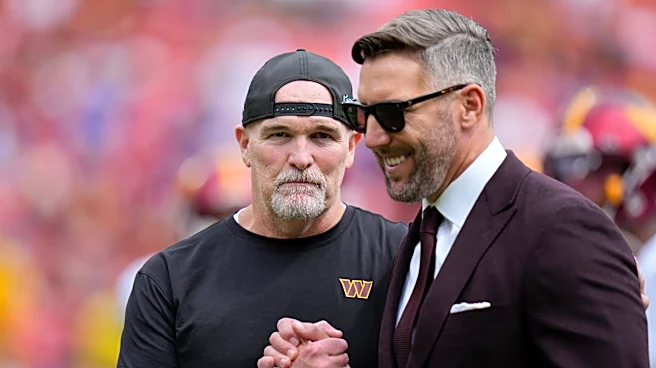
During Tuesday evening’s training camp opening presser, general manager Adam Peters spoke a bit about Washington’s new offense and defense.
- New offense will be more “multiple”.
- Many different ways to attack a defense.
- Quarterback friendly
- Defense has “multiple” ways to attack you
Being “multiple” on both sides of the football is a theme that has come up now on, well, MULTIPLE occasions.
So, what exactly does it mean to be “multiple?”
Being “multiple” on offense
Being “multiple” on offense is about different ways to attack a defense using:
- Same formations, but different plays out of those formations
- Same play, out of different formations
- Moving guys around to create favorable mismatches
- Having versatility on offense, so defenses can’t key in on anything
- Being unpredictable
Over last two years, Washington was too predictable under then-offensive coordinator Kliff Kingsbury. Opposing defensive players would often say they knew exactly what was coming based on formations, pre-snap calls and personnel.
One example of this includes former Commander Zach Ertz in the tight end role. You knew what you were getting with Ertz. He would work the short to intermediate area of the field in a “post-up” fashion. It was infrequent that you get a designed route where he was given the opportunity to run after the catch, such as a shallow crosser or over route.
The same could be said with receiver Terry McLaurin. Kingsbury often lined him up on the outside left and didn’t put him in motion much. This allowed defenses to key on him and often have a “bracket” defender shaded to his side.
This Davis Blough offense should be much different. In my offensive weapons article, I gave some examples of how Blough could attack opposing defenses out of certain personnel groupings. In my opinion, this ability to be so “multiple” on offense really flows around the players we have and the versatility they possess.
I talked a lot about the tight end room — more specifically, Chig Okonkwu and Ben Sinnott — and how defenses couldn’t key on these guys doing any one specific thing in the sets. This is a good example of this new scheme being “multiple.”
Being “multiple” on defense
With a heavy zone-coverage scheme being implemented by defensive coordinator Daronte Jones this season, head coach Dan Quinn spoke about the ability to be “multiple” on the defensive side:
Every good defense that plays zone, you better have a pass rush in order to do that because there is not the leverage, so the quarterback has to feel like he’s getting affected.
Quinn emphasized that he wants to see different personnel groups who can do this during camp.
The Commanders defense under Joe Whitt was anything but “multiple.” Instead, it turned out to be incredibly predictable. In the NFL world, predictability is the impediment to progress.
Under Jones, the defense is said to be “multiple.” What does that mean in this instance?
This new look should feature a 3-4 UNDER base look. The UNDER aspect means the nose tackle shifts to the weak side and a SAM linebacker (strong side), is usually in a stand-up position as the EMOLS (end man on the line of scrimmage).
The fun part about this defense being “multiple” is that you don’t know exactly where the rush will come from and what player(s) could get home. You may see certain guys coming from different areas of the formation, while others may show a certain look but drop back into coverage. All three levels of this defense have the ability to be “multiple” when it comes to getting after the head of the snake, and the athletes Washington now has will make that job a lot easier.
Being “multiple” is just as important on the back end, as disguising coverages is an integral part of a successful scheme.
We are expecting to see a lot of three-safety looks, with one of those guys being a hybrid linebacker type. The hybrid player can rush, drop or rob, which can help dictate to an offense instead of having the offense dictate to the defense (which we saw all too often last season).
In sets where there is a more traditional slot corner being used, that player can also create confusion with disguised coverages that are meant to look like man, but turn out to be a cloud zone. Having guys with inside/outside versatility certainly help to make this job easier.
Commanders Versatility
Offense:
- Jayden Daniels: Can beat you as a passer and runner
- Rachaad White: RB who can double as a WR out of the backfield
- Chig Okonkwo: Move TE who plays more like a Jumbo WR
- Ben Sinnott: More traditional TE who can play as an H-back
- Antonio Williams: WR with inside/outside versatility who can uncover quickly
- Luke McCaffrey: Bigger-bodied receiver who has inside/outside versatility
Defense:
- Javon Kinlaw: Multiple techniques along the D-line
- Daron Payne: Multiple techniques along the D-line
- Tim Settle: Multiple techniques along the D-line
- Charles Omenihu: DT/EDGE versatility
- Deatrich Wise: DT/EDGE versatility
- Sonny Styles: Versatility to play all three LB spots
- Leo Chenal: Versatility to play all three LB spots
- Frankie Luvu: Pass rush versatility from linebacker spot
- Mike Sainristil: Inside/outside CB versatility
- Amik Robertson: Inside/outside CB versatility
- Quan Martin: CB/S versatility
- Nick Cross: S/Hybrid-LB versatility
- Tyler Owens: S/Hybrid-LB versatility
In today’s NFL, being able to do a variety of different things with a variety of different players from a variety of different sets is instrumental. Washington is now focused on being “multiple” on both sides of the football and it’s because of the scheme and personnel that allow them to do that.
As training camp moves forward and the regular season approaches, you are going to hear this word used more and more – so be prepared; its definitely a good thing!