


Game notes
- Time and date: Saturday, December 20 at 3:30 p.m. ET
- Network: TNT/HBO Max/truTV
- Location: Vaught-Hemingway Stadium — Oxford, MS
- Spread: Ole Miss (-17.5)
- Over/under: 56.5
- All-time series: Ole Miss leads, 46-28
- Last meeting: Ole Miss 45, Tulane 10 — September 20, 2025
- Current streak: Ole Miss, 14 (1989-25)
- Tulane last bowl: 2024 Gasparilla Bowl, 33-8 loss to Florida
- Ole Miss last bowl: 2023 TaxSlayer Bowl, 52-20 win over Duke
Setting the scene
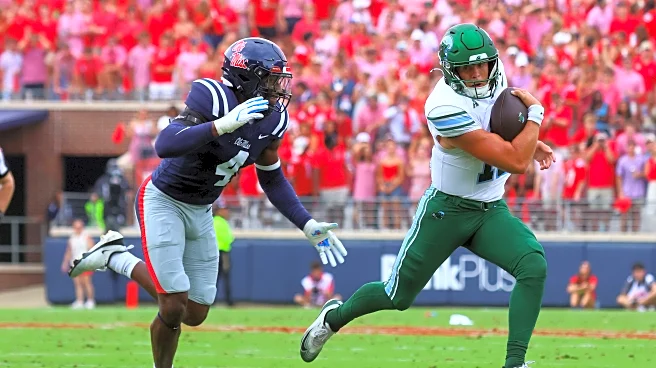
So we meet again, except this time, it’s in the College Football Playoff.
Ole Miss and Tulane squared off in Oxford, MS on Sept. 20, and the Rebels rolled the Green Wave in 45-10 fashion to pick up a signature non-conference win. What neither sideline understood at the time was that a December rematch would be on the docket in the second year of the 12-team CFP. Although Ole Miss won in decisive fashion, it’s hard to beat a team twice — and five of the seven rematches this year were split at 1-1.
But both teams are strikingly different from September. The Rebels and Green Wave were both subject to head coaching changes, although the separations were handled differently. Ole Miss head coach Lane Kiffin departed to LSU and will not coach the CFP, and defensive coordinator Pete Golding was promoted as the team’s new full-time head coaching, gearing up for his debut Saturday. Tulane head coach Jon Sumrall left for Florida but promised to finish the 2025 season, and he will remain the frontman until the Green Wave’s playoff run is complete.
It’s an old SEC rivalry with 74 previous meetings, including three in the past five years. However, no Ole Miss vs. Tulane matchup holds the weight of Saturday afternoon’s showdown in Oxford, as one team is certain to secure its first-ever College Football Playoff victory.
Tulane Green Wave outlook

Tulane (11-2, 7-1 American) is the second team to represent the American Conference on this stage, following in the footsteps of 2021 Cincinnati which qualified in the 4-team bracket. The Green Wave started the season with quality non-conference wins over Northwestern and ACC champion Duke, but the path wasn’t all smooth-sailing. Tulane’s two losses were lopsided beatdowns, falling by 35 at Ole Miss and by 22 at UTSA. However, this team showed its resiliency after the debacle in the Alamodome, rattling off 5-straight wins including its second American Championship Game victory. In that CFP or bust game, Tulane handled North Texas in the trenches and dominated the turnover battle to solidify its spot in this event.
Last year Tulane scored over 40 points in six games. This year the Green Wave didn’t showcase the same explosive offense and never managed 40 points but still provided enough firepower to get the job done 11 times. Quarterback Jake Retzlaff became the program’s third starter in three years and he initially provided a hint of mobility to the offense, rushing for over 110 yards in the Duke and Northwestern wins. However, as the season progressed, Tulane relied increasingly less on zone reads, and Retzlaff hasn’t rushed for 70 since Sept. 13. Yet, he’s still the team’s leading rusher and an elusive threat by the goal line — riding a 7-game streak of notching a rushing touchdown entering this postseason matchup.

But what Tulane needs most is Retzlaff the passer. In the prior Ole Miss game, the BYU transfer quarterback completed 5-of-17 passes, relying on quick strikes to the outside while facing a heap of pressure. Retzlaff, who didn’t arrive to New Orleans until late July, grew as a passer as the season progressed, putting up his magnum opus vs. Memphis with 332 passing yards and three touchdowns on 16 completions. The verticality Tulane showed in that Memphis game must translate to Oxford. The receivers in charge of that are Shazz Preston, Anthony Brown-Stephens, Omari Hayes, and Zycarl Lewis Jr. forming a balanced wide receiving corps that doesn’t have a truly established No. 1 option — as Preston’s 598 yards rank atop the unit.
Tulane’s run game also saw a committee-based approach throughout the season, but the team finally solved its year-long quest to find a No. 1 running back in November. Jamauri McClure took the reins with a 122-yard showing vs. Florida Atlantic and never looked back. His 121 yards in the American title game were instrumental to clinching the CFP, and he’ll receive a nice boost from one of the conference’s top o-lines. Two-time all-conference left tackle Derrick Graham is back for the rematch after sitting out the September matchup in Oxford, and his presence will be vital. That will also allow two-time First Team All-American Conference left guard Shadre Hurst to play in his natural position after filling in Graham’s vacancy the first time around. The Green Wave blocked acceptably in the run game, but pass protection was the team’s fatal flaw in the 45-10 loss to the Rebels (11 QB pressures allowed).
Defensively, Tulane continues to brand itself as a takeaway machine. The Green Wave started the year with five takeaways against Northwestern and concluded with five takeaways in the American Championship vs. North Texas. Currently, the Green Wave are one of 12 FBS teams with a +10 or better in the turnover battle, generating the 8th-most takeaways in the country.
However, Tulane did not force one on Sept. 20 in Oxford. Thus, it’s up to the defensive line to set the conditions for turnovers to happen, as it did against the Mean Green. Once again, it’s a committee-based approach as a slew of defensive linemen and edge rushers such as Santana Hopper, Harvey Dyson, Mo Westmoreland, Kam Hamilton, and Tre’Von McAlpine all collectively contribute to the Green Wave’s success up front — leading to 2.6 sacks per game.
Add in the tackling prowess of linebackers Sam Howard and Chris Rodgers, and Tulane’s defense is best at stopping the run. The Green Wave are 26th nationally by letting up 3.5 yards per carry, and this showed in the first Ole Miss game with their ability to limit Kewan Lacy. However, teams enjoy much more success against Tulane by targeting the back end. The Green Wave passing defense is 124th in average yards allowed, and they’ve yielded 22 passing plays of 30+ yards — only 13 FBS teams surrendered fewer.
The primary name to watch in the secondary is Jack Tchienchou, the team’s leading tackler who earned MVP honors of the American Championship with an interception, a forced fumble, and a fumble recovery. Jahiem Johnson and Javion White are other ballhawks in the secondary, combining for seven interceptions and 14 pass breakups in a defense that relies heavily on the havoc plays.
Rounding out this Tulane group is the league’s Special Teams Player of the Year, and that’s kicker Patrick Durkin. Tulane enjoyed pinpoint accuracy from its kicking game all year long as Durkin connected on 24-of-27 field goals — which could come in handy should the Green Wave need clutch fourth quarter heroics.
Ole Miss Rebels outlook

Ole Miss (11-1, 7-1 SEC) already tied its program record for wins and currently stand an 8-point road loss to Georgia away from perfection. Now, the Rebels seek to stack on more historic accomplishments in this unforgettable 2025 season. They’ll become one of the first eight campuses to host a College Football Playoff game, welcoming a crowd of approximately 68,000 to Vaught-Hemingway Stadium for this high-stakes clash, and home teams went 4-0 in the opening round of the 2024 CFP.
Even in the midst of this special season, there are still hard feelings within the fanbase due to Lane Kiffin’s departure to a conference rival at the conclusion of November. But the fanbase and players alike are rallying around third-year defensive coordinator Pete Golding, who is slated to lead the team as head coach beyond 2025.
Ole Miss is the significant favorite, already laying down its stake in a 45-10 throttling of Tulane in September. The Rebels dominated in both facets of the game, creating repeated significant gains on offense while funneling in backfield pressure on defense to completely dismantle the Green Wave. However, the second time around is always different from the first, but Ole Miss understands the advantages it has over the American Conference champion.
One advantage the Rebels offer is 8th-place Heisman finishing quarterback Trinidad Chambliss. The former Division II national champion didn’t starter the year as QB1 for the Rebels, and the Week 4 Tulane game was just his second start at quarterback. In that game, Chambliss accomplished something he never did in his other nine starts, and that was rushing for 100 yards. Chambliss totaled 112 on the Green Wave defense, constantly slipping through tackles on designed QB draws to matriculate the offense downfield. However, he never managed 75 rushing yards in his other nine starts, but he still showcased his mobility to the tune of 470 yards and six touchdowns on a 5.0 average.
Chambliss needed to run on Tulane, because the Green Wave were one of the few teams to bottle up Doak Walker Award finalist Kewan Lacy. The star running back is ninth in the FBS with 1,279 yards and second with 20 touchdowns, but against Tulane he never exceeded 12 on a single carry, averaging just 3.8 per attempt. Lacy enters this game scalding hot with averages of 146 yards and two touchdowns across his last four outings, looking to continue that rampage in front of the home crowd.

Perhaps the biggest advantage Ole Miss cultivated against Tulane in the first meeting was seen in the wide receiving corps. The Rebel receivers — particularly Harrison Wallace III and De’Zhaun Stribling — blocked tremendously well on the outsides, allowing several significant pickups toward the boundary. Then in the receiving game, Deuce Alexander and tight end Dae’Quan Wright made several explosive plays by regularly finding soft spots in Tulane’s zone defenses. Wallace, Stribling, Alexander, Wright, and Cayden Lee are all viable options in the nation’s 3rd-ranked passing offense, and all have 489+ yards at their disposal this year.
The Rebels’ deep receiving corps was one reason for their 3rd-ranked total offense, and another reason was a fortified offensive line. Led by All-SEC left tackle Diego Pounds, the unit only surrendered 16 sacks on the season (zero to Tulane), keeping the passing game upright to ensure the offense stayed in rhythm.
Ole Miss’ defense wasn’t as commanding as the offense, but the group still posted 24th and 33rd ranks in scoring defense and total defense, respectively, on a national scale. What the Rebels do best is defend the air, and this showed in the prior Tulane meeting as the Green Wave quarterbacks finished 10-of-29 for 104 yards and an interception. Ole Miss is 20th in fewest yards allowed, surrendering a completion rate of 56.4 percent as safeties Kapena Gushiken and Wydett Williams Jr. are frequently on the scene for misfires.
Another contributing factor to teams’ inaccuracies against the Rebels is the oncoming pass rush. While Ole Miss didn’t produce a sack vs. Tulane in September, Kam Franklin and Princewill Umanmielen combined for seven QB pressures, feasting in the backfield all game to force quick and errant throws. Those two are forces on the edge, and Zxavian Harris (7.5 tackles for loss, 3.0 sacks) is the 6’8”, 330 pound presence in the middle that causes enough chaos to allow these edge rushers to thrive.
Manning the linebacking corps for the Rebels is the tandem of TJ Dottery and Suntarine Perkins — who rank first and second on the team with 77 and 64 respective tackles. They’ll look to limit Tulane’s endeavors in the ground game, and Ole Miss was susceptible to allowing breakaway runs throughout the year.
When it comes to special teams, Ole Miss also features an accurate kicker in Lucas Carneiro. The WKU transfer is 12-of-14 from 40-49 yards and 7-of-8 from 50+ in a successful college career. He sunk three field goals against the Green Wave three months ago, including a season-long 54, and can be a reliable source of points if the defenses wind up controlling this game.
Prediction
Round two in Oxford will be substantially more competitive than the regular season meeting. Tulane arrives into this matchup with a key cog in Derrick Graham on the defensive line, Jake Retzlaff has more comfortability with the offense, and Jamauri McClure is the established No. 1 running back the Green Wave didn’t utilize much in September. The offense can certainly generate a better output than a field goal and one late fourth quarter touchdown, but Ole Miss’ pressure led by Zxavian Harris and the edge rushers will still be a lot for Tulane’s defense to fend off.
Also, the Rebels possess advantages on offense against Tulane’s defense, which can be susceptible to big plays. Trinidad Chambliss offers his dual-threat abilities, capable of launching 300 yards or producing another 100-yard rushing barrage. But where the Rebels will benefit most is their physical, explosive receivers vs. the Tulane secondary. Ole Miss capitalizes on homefield advantage and uses a double-digit victory to propel itself to the Sugar Bowl, where it will face Georgia in yet another rematch.
Prediction: Ole Miss 35, Tulane 20