

Dating back to 1947, the Yankees have used Old-Timers’ Day as a chance to celebrate players from years past. Former superstars and role players alike don the pinstripes once more, hear the roar of the Bronx faithful, and engage in a half-comedic exhibition game. For those who recently left the game, Old-Timers’ Day serves as an opportunity to signal acceptance of one’s dotage, leaving behind the glamor and intensity of MLB competition for the more stately life of a retired athlete.
Only once has a player
ever returned from this ceremonial final nail in the coffin to resurrect their Yankees career. It was a man valued at least as much for his disposition as for his skill set, a man who had already lived many baseball lives by the time he retired (and un-retired). A man who, above all, was dependability personified.
Luis Sojo
Born: January 3, 1965 (Caracas, Venezuela)
Yankees Tenure: 1996-99, 2000-01, 2003
Luis Sojo was a late bloomer. Signed out of Venezuela by the Blue Jays on his 21st birthday, Sojo didn’t make it to the major leagues until the age of 25. Listed at 5-foot-11 and 172 pounds, the stocky infielder never cut the figure of a prototypical star athlete. But, after a brief debut in Toronto, he latched on with the Angels, appearing in 219 games across the 1991-1992 seasons. And, while his .265/.297/.352 line didn’t impress, he demonstrated value in other ways. Sojo played four positions with California, including a sturdy second base, and provided a consistently professional at-bat, striking out just 50 times and leading the AL with 19 sacrifice bunts in ‘91. The Angels traded their light-hitting second baseman back to Toronto after the ‘92 season, kicking off a journeyman odyssey that would lead him to baseball’s highest peaks.
Sojo signed with the Mariners as a free agent before the 1994 season. He spent two-and-a-half years in a utility role with them, including as their starting shortstop in the 1995 postseason in replacement of a struggling Felix Fermin — helping them earn their long-awaited playoff berth in the first place with a bases-clearing knock in the AL West tiebreaker.
Hitting at the bottom of the order that postseason, Sojo hit a respectable .250 while knocking in four runs in 11 games. It would be far from the end of his postseason exploits.
After struggling to start the 1996 season, the Mariners cut Sojo in mid-August. The Yankees claimed him off waivers, using him down the stretch mostly as a defensive replacement for Mariano Duncan late in games. He cracked the playoff roster and, while he drew only one start, Sojo appeared in 10 games during the Yankees’ title run, including five of six World Series games, during which he went 3-for-5 to help his new team take home their first championship in 18 years.
The jack-of-all-trades was re-signed by New York after the season, settling into a utility role which would characterize the rest of his career. This is due perhaps in no small part to the intervention of a future captain. On Alex Rodriguez’s The Deal podcast, Derek Jeter relayed that, during one offseason amidst the Yankees’ ‘90s dynasty, he told owner George Steinbrenner that Sojo “helped me more than any infielder at the time that I’d played with, or any coach. And he re-signed Sojo after that.”
“I learned so much from him,” the Hall of Famer added, emphasizing the importance of the oft-overlooked backup on his development and the team’s culture.
Jeter was not alone in praising his versatile teammate. Bernie Williams dubbed him “El Mejor,” Spanish for “The Best,” due to his knack for coming through in clutch situations. His manager agreed. ”He’s such an unusual player because he doesn’t play for two or three weeks and he comes off the bench and rises to the occasion,” Joe Torre said of Sojo’s excellence in a reserve role. ”He did it on the biggest stage of all in the World Series. He forces you to believe.” Roger Clemens opined that, after his many clutch performances, the role player was deserving of his own bobblehead day.
As Torre alluded to, Sojo’s finest hour, exemplary of his flair for the dramatic, came during the 2000 World Series. Pressed into full-time duty that postseason after regular second baseman Chuck Knoblauch yipsed his way into the DH spot, Sojo had hit .231 in 44 appearances through the ALCS. After that middling performance, Torre turned to José Vizcaíno at the keystone, giving Sojo only one World Series start. That didn’t keep him from making an impact.
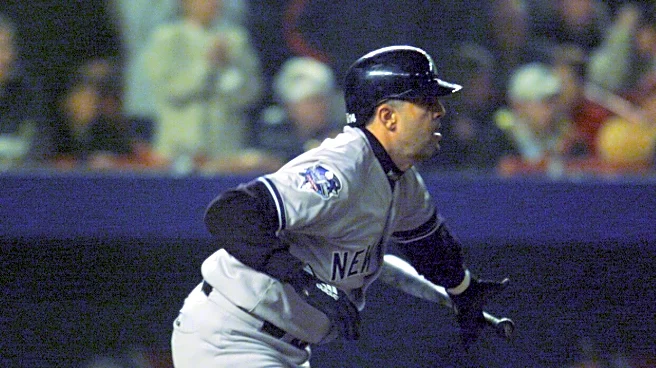
In the decisive Game 5, played at Shea Stadium without the benefit of a DH, Knoblauch came in to pinch-hit for Vizcaíno in the eighth. With the score knotted at two, the erstwhile second baseman fouled out. Given his defensive struggles, Torre was left with no choice but to replace Knoblauch with Sojo in a double switch. That brought the Yankees’ resident Swiss army knife up to the plate in the ninth for his first plate appearance of the night. With two outs and Jorge Posada representing the go-ahead run at second, Sojo laced a seeing-eye grounder up the middle. Mets starter Al Leiter, having just thrown his 142th, and final, pitch of the night, flailed towards it. Shortstop Kurt Abbott dove for it. Second baseman Edgardo Alfonzo slid near it. None of it mattered. The dribbler skated by all of them into center field, where Jay Payton rifled a throw to the plate. The ball ricocheted off catcher Mike Piazza as Posada barreled into home, allowing another runner to score as the Yankees took a two-run lead they would not relinquish.
Sojo stuck around through the next season, appearing in two more World Series games before hanging up his cleats upon failing to make the team out of 2002 spring training camp. In all, the sparkplug was a .400 hitter in the Fall Classic, helping the Yankees to four championships during his tenure in the Bronx. In retirement, he managed the Yankees’ Double-A affiliate to a championship in 2002, signaling where his future lay.
That’s when he accomplished his Old-Timers’ Day feat which warms the hearts of retirees everywhere, returning for a short stint late in 2003 to fill in due to a minor injury to Jeter in late August. The unlikely comeback was a chance for the 38-year-old to wrap up his improbable career on his own terms. “They released me last year in spring training. It was not the way I wanted to end my career, and I don’t want to play for anybody else,” he said after returning to the Yankees. “I could have played for somebody else, but I wanted to retire with the Yankees. Now I get my chance.”
Sojo appeared in three games, going 0-for-4, before walking away for good. He had another memorable Old-Timers’ Day moment the next year, walking off the game with a long ball against Ron Guidry.
Sojo then embarked on what has been a long coaching career, serving as the Yankees’ third-base coach in 2004 and 2005 before several managerial stints within their minor-league system. He was also Team Venezuela’s manager in each of the first three World Baseball Classics and has served as Team Spain’s manager since then, including in this year’s upcoming tournament. Luis Sojo is the definition of a baseball lifer, a man who makes those around him better and endears himself to fans everywhere through his love of the game and devotion to it. While never the most talented man on a big-league roster, Sojo was always among the most memorable and the easiest to root for.
See more of the “Yankees Birthday of the Day” series here.