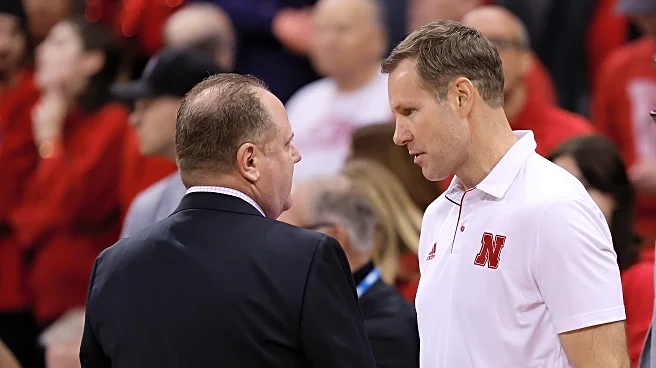




The Wisconsin Badgers were humiliated on Wednesday in a 90-60 loss to the Nebraska Cornhuskers, marking their worst loss under head coach Greg Gard as they fell to 7-3 on the season.
Coming into the game, it was known that the Badgers were going to face a challenge, going up against the 9-0 Cornhuskers, who broke into the AP Top 25 for the first time since 2018 this week at No. 23.
And Wisconsin started off well, even leading 21-19 with under 10 minutes to go in the first half. But then, everything
unraveled for the Badgers, who had a disastrous end to the first half and were non-competitive in the second half of the blowout.
Here are three quick takeaways from Wisconsin’s 90-60 loss to Nebraska on Wednesday.
Ugly end to 1st half
With 10 minutes to go in the first half, Wisconsin was up 21-19 after a three from Andrew Rohde.
Nebraska proceeded to go on a quick 8-2 run to completely flip the script over the next two minutes, heading into the sub-8 media timeout up 27-22. Things remained fairly competitive up until near the sub-4 media timeout, as Wisconsin trailed 37-31 with 3:50 left in the half.
That’s where things really got ugly. Nebraska proceeded to end the half on a 10-0 run as Wisconsin went scoreless for the remainder of the period, trailing 47-31 at halftime. The Badgers went 0/5 from the field during that stretch, including three consecutive misses from deep.
They also had two offensive fouls and another turnover in the final minute. Meanwhile, the Huskers got to the free throw line for five points, while also getting a layup after one turnover and a three-pointer in that stretch.
That was the defining moment of the game. Nebraska had all the momentum heading into halftime with a 16-point lead and it felt like Wisconsin just wasn’t competitive afterwards.
Three-point shooting
When Wisconsin loses this year, there’s a trend that goes with it: ugly three-point shooting.
The Badgers have been one of the highest-volume three-point shooting teams in the Big Ten this season. After Wednesday, they rank third in the conference in three-point makes, while ranking atop the conference in three-point attempts.
Threes account for over 51 percent of Wisconsin’s shots. And that’s fair, considering their offensive philosophy is to maximize shots from beyond the arc, at the rim, and at the free-throw line for efficiency. The only problem? They’ve been very streaky from three this year.
When they’re hitting, they look like one of the best teams in the country. But, when they’re missing, like in losses to TCU, BYU, and on Wednesday, they miss bad. Wisconsin shot 24 percent from three in the 98-70 loss to BYU. They shot 25 percent from deep in the 74-63 loss to TCU. On Wednesday, they were 7/32 (21.9 percent from three).
In some wins, when the Badgers aren’t hitting threes, they’ve pivoted well to attacking more, which frees up better looks. That wasn’t the case on Wednesday, though. Wisconsin had just 24 points in the paint and only got to the free-throw line 11 times.
Wisconsin will need to hit threes, and they’re probably a better shooting team than they’re showing. But, they aren’t going to have a successful season until they find more balance because the efficiency has been way too streaky to start the year.
Defense
When you have a group of incoming transfers, defense is usually something that takes some figuring out. Wisconsin is finding that out the hard way.
The Badgers were abysmal defensively on Wednesday. Yes, Nebraska hit some tough shots, but they shot 54.1 percent from the field and 36.7 percent from three-point range. They were the team looking to attack, finishing with 44 points in the paint. They finished strong at the rim, converting 16 of their 20 layups. And their ball movement was pristine.
Wisconsin was slow rotating and just looked out of place at times, giving up some easy looks at the rim. It felt they had given up for stretches in the second half. I’m sure Greg Gard will show the film and find the areas the team needs to improve on.
But, this defense has a ton of work to do, and this isn’t only a one-game occurrence.