

The Twins were the most active sellers at last season’s trade deadline, offloading an incredible ten big league players in a fire sale aimed at both reopening a contention window for 2026 and building a prospect base for their long-term plans. Recent reports indicate that they will not be taking such an axe-handed approach to the major league roster this offseason and are instead looking to make a few modest additions. Regardless of the public stance of their front office, Minnesota has several players who
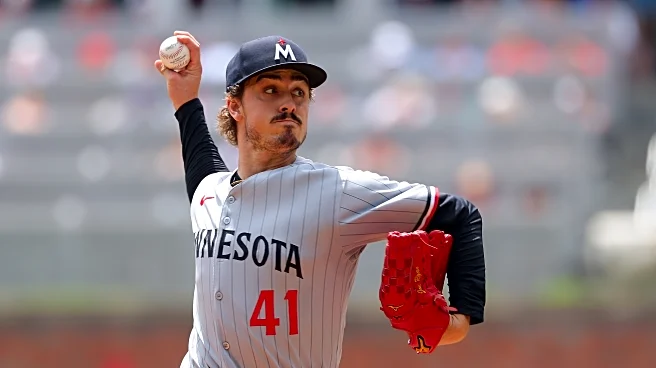
firmly fall into trade candidate territory, and one who might intrigue the Yankees is starting pitcher Joe Ryan.
2025 Statistics: 30 games started, 171 IP, 13-10, 3.42 ERA (125 ERA+), 3.74 FIP, 3.70 xFIP, 28.2% K%, 5.7% BB%, 1.04 WHIP, 3.1 fWAR
2026 FanGraphs Depths Charts Projections: 31 games started, 182 IP, 11-10, 3.83 ERA, 3.71 FIP, 26.5% K%, 5.9% BB%, 1.14 WHIP, 3.4 fWAR
Contract Status: Projected to earn $5.8 million in second of three years of arbitration eligibility. Free agent following the 2027 season.
Ryan is about as steady as they come for a mid-rotation starter, putting up four straight seasons of at least 2.2 fWAR. Since his first full season in 2022, he places among the top-25 qualified starting pitchers in strikeout rate (27.6-percent), WHIP (1.08), SIERA (3.48) and fWAR (10.8). He’s a command artist who sits comfortably above the 90th percentile in walk rate across the last three seasons, which combined with his consistently good strikeout numbers allows him to place among the 19 qualified starters who clear the elite threshold of at least 20% strikeout-minus-walk rate (K-BB%) since the start of 2022.
Ryan typifies certain aspects of the modern starter — namely, he leads with his four-seam fastball, racks up strikeouts, and limits walks. Despite having neither top-end velocity (93.6 mph average velo) nor movement (13.6 inches induced vertical movement), Ryan’s fastball has been the most valuable four-seamer in MLB across the last four seasons, accumulating a +67 Statcast Run Value. This owes to the volume with which he throws it — 51.2-percent usage rate in 2025 — and his ability to spot the pitch to the edges of the zone, but that doesn’t tell the whole story. Despite the lack of elite induced vertical movement, the fact that Ryan throws from a relatively low arm slot paired with premium spin efficiency means that his fastball has one of the shallowest vertical attack angles (-3.9 degrees) of any four-seamer in baseball — basically another way of conveying that desired illusion of rising action for a four-seamer.
Despite the non-pareil results with the four-seamer, you wonder if Ryan could break into the tier above with some minor tweaks to his pitch selection. He possesses an impressively diverse pitch mix of sweeper, splitter, sinker, slider and curveball to back-up the four-seamer. If he were to scale back the four-seamer deployment a touch, say to around 40-percent, while throwing each of his other pitches around 12-percent of the time, I would seriously question how hitters would be able to track that many different looks.
Of course, that brings us to the issue of his availability. Ryan was the biggest story in the closing minutes of last year’s trade deadline, with certain outlets claiming that the Red Sox and Twins got to the five-yard line of a potential swap before the deadline buzzer sounded. More recent reports indicate that the Twins were never close to dealing their pitcher, and this lines up with the repeated messaging coming from the Minnesota front office of late. Team president Derek Falvey has reiterated the team’s intention to hold onto Ryan as well as fellow trade candidates Byron Buxton and Pablo López. That being said, the Pohlad family recently sold off more than 20-percent of the team to a minority investment group, possibly setting the table for a majority sale in the near-to-mid future. Any future majority owner may prefer to inherit a team with as few significant payroll obligations as possible, which perhaps underlies the continued rumors swirling Ryan, Buxton, and López.
Gerrit Cole, Carlos Rodón, and Clarke Schmidt are all rehabbing from elbow surgery and are therefore not expected to be available at the start of the season, creating an obvious need for starting pitching reinforcements. However, recent comments from Brian Cashman indicate that the team feel comfortable heading into the season with Ryan Yarbrough as the fifth starter until their horses get healthy, Rodón expected to be the first of the trio to return. There was also the report that owner Hal Steinbrenner would ideally like to depress payroll below last season’s $319 million figure, which helps explain the many reports denying interest in free agent starter Tatsuya Imai.
Ryan would give the Yankees a controllable starter at a team-friendly price for the next two seasons, providing extra insurance as a proven starter beyond a pure stop gap in case there are setbacks in the injured pitchers’ recoveries or if a young pitcher like Cam Schlittler, Will Warren, or Luis Gil really struggles to start the year. Of course, those two years of control mean that Ryan would not come cheap, the Red Sox rumored to have offered any two of Payton Tolle, Jhostynxon Garcia, and Franklin Arias in their deadline proposals last year. That’s a steep price to pay for a pitcher with a No. 2 ceiling. When you combine these factors with all of the public comments from the Yankees’ and Twins’ front offices — that the Yankees are happy with what they’ve got and that Ryan is unequivocally not for sale — there is little to no chance of Ryan pitching in pinstripes in 2026.