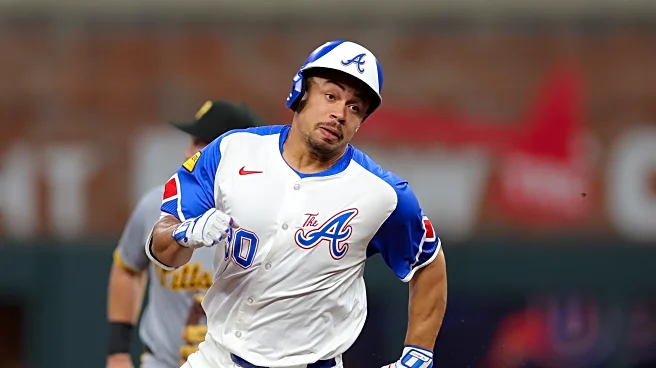

Drake Baldwin had nothing short of a phenomenal start to his MLB career. Of course, you probably knew that, since he won the NL Rookie of the Year award. While the team struggled a bunch offensively for
various reasons, none of it seemed to deter Drake Baldwin from making the most of his rookie campaign, earning a permanent stint in the big leagues. Here’s how his season panned out in 2025.
How acquired
Hailing from Madison, Wisconsin, Baldwin became the Braves’ third-round, 96th overall pick in the 2022 Draft out of Missouri State. He hit well at every stop of the minors, and flew through three levels in 2023, though he started back at Double-A to begin 2024. His promotion to Triple-A in the middle of that season saw him post a 138 wRC+ through the end of that campaign.
Baldwin was invited to Spring Training in January 2025 for his second training camp with the team before being selected to stay with the club in March.
What were the expectations?
Baldwin’s season was a whirlwind in basically every respect. In the offseason, Sean Murphy lobbied to become the Braves’ primary catcher (despite his hip injury, apparently), and the Braves moved on from Travis d’Arnaud without signing another player to share time with Murphy. When spring camp began, it looked like the Braves might give Murphy the lion’s share of catching duties and backfill with Chadwick Tromp, while Baldwin honed his craft in Triple-A and waited in the wings.
While Baldwin’s tear in Triple-A in 2024 led to him flying up prospect rankings, he wasn’t exactly expected to set the world on fire. ZiPS had him around 1.8 WAR in 461 PAs as a point estimate before the season began, which is certainly respectable for an MLB starter, but not the sort of guy you trip over yourself to give playing time in lieu of Murphy. That said, all of this quickly became irrelevant when Murphy suffered a ribcage fracture in Spring Training, and the Braves opted to hand the reins to Baldwin in lieu of any other alternative.
2025 Results
The Jackie Robinson National League Rookie of the Year title says it all, but a little more detail helps paint the picture of just how successful his year truly was.
The top line is smashing: 3.1 fWAR, a 125 wRC+ with no wOBA/xwOBA shenanigans, and that accumulated in 446 PAs (i.e., an fWAR per 600 PAs of over 4.1).
Baldwin didn’t exactly hit the ground running in Murphy’s early absence, with just a 26 wRC+ in his first 29 major league PAs, but then started to rake at an insane rate once he and Murphy entered into a pseudo-timeshare going forward. He had a 185 wRC+ in his next 29 PAs, and then followed that up with a 180 wRC+ over 56 May PAs. He didn’t have a wRC+ below April’s 106 in any calendar month, and finished strong with three straight months of a batting line around 20 percent better than league average. Really, so much of his game was about consistency: his lowest xwOBA in a month was a fine .324, he handled his own against lefties with a .326 xwOBA and a 129 wRC+, he had at least a 109 wRC+ across all three leverage splits, and even though some xwOBA shenanigans did obscure that he actually hit worse as a DH (.316 xwOBA, compared to a .364 xwOBA as a catcher), he really didn’t falter against most specific things or challenges that came his way.
For his efforts, he became the tenth Brave — and third in the past eight seasons — to take home Rookie of the Year honors.
If that wasn’t impressive enough, Baldwin had another goal he achieved during the offseason—finishing his Bachelor’s degree in General Business at Missouri State, which he earned this December.
What went right?
More or less everything. Baldwin’s consistent presence even managed to turn an unfortunate Spring Training injury to Murphy into not just a spectacular success of a debut season, but something that netted the Braves an unexpected Prospect Promotion Incentive pick.
On the meta-slash-batting approach level, Baldwin seemed to achieve what the Braves were perhaps hoping for from many of their batters — namely that he blended contact and power in an effective way. Baldwin featured a relatively compact swing (compared to most of his teammates, anyway) that led to above-average contact frequency and average-ish swing decisions; critically, this didn’t affect his ability to post well-above-average contact quality, while also walking a reasonable amount. It’s hard to say that Baldwin’s offensive season epitomized what the Braves were going for, but it also feels like the powers that be wouldn’t complain if the entire team managed to morph into a bunch of Baldwins, which seems very unlikely given that so many guys in the core were deliberately acquired and/or coached to be power-over-contact guys with long-but-very fast swings and no real propensity or care for maximizing the transfer of velocity from bat to ball (i.e., Statcast’s “squared up rate”).
He absolutely obliterated four-seamers (.424 xwOBA) and had little issue with sliders (.363 xwOBA). He had a fairly insane .369 xwOBA against sliders from southpaws, though that came in just 19 PAs that ended on sliders. Overall, he was just so incredibly consistent in hitting pretty much everything and doing pretty much everything offensively at a reasonable level, which is kind of crazy to see in a rookie bat, when you think about it.
All of those skills came together for him on a near-daily basis, but also led to some huge games. One of his biggest was actually a game where he didn’t even start: August 31, against the Phillies. He entered that game in the eighth, and then drew a walk to put the tying run on second. The Braves did end up tying the game in that frame, which set up Baldwin for a game-winning blast (off a lefty, at that) in the top of the ninth:
And, of course, sometimes he just had luck on his side. This game-winner that turned a one-run deficit into a one-run lead against the White Sox was hit at just 86 mph off the bat, but did the business when it avoided becoming another disappointment in a season full of them:
What went wrong?
It feels a bit tone deaf to nitpick Baldwin’s superb season, but let’s put it this way: his defense behind the plate has a lot of work to do to catch up to his offensive acumen at this point. Baldwin’s 2025 didn’t suggest a bad catcher or anything, but there’s some clear work to do. He was fantastic at blocking, but slightly below average at framing, and really struggled to hamper opposing running games, in part because he simply doesn’t throw that hard despite pretty good catch-and-throw mechanics. On the framing end, which is probably his quickest avenue to better defensive value, at least until an electronic strike zone implementation levels the playing field there, he really struggled to frame the pitches he was “bringing back” when reaching across his body, as well as high pitches more broadly. Given that he was really good at framing pitches to his glove side and those marginally below the zone, this seems like something that can be cleaned up with additional effort.
Beyond that, what else can really be said? He had a weird thing where, for whatever reason, he wasn’t dominating sinkers while killing four-seamers, but it’s unclear whether that’s a result of some kind of flaw, or just a quirk. He also really struggled against changeups, but it wasn’t the sort of thing opposing pitchers were able to leverage to put a damper on his season overall.
If he fixes any of these things, the league should prepare to cower.
2026 Outlook
With few exploitable flaws in his game on paper, it’s hard to see Baldwin taking a step back in 2026. Steamer has him as a 3-win guy over a full season, but that appears to impute a sizable DH workload — which may reflect reality, or not, depending on how things go. ZiPS appears to do the opposite, with a 3.7 WAR point estimate that appears to involve average catcher defense over about 500 PAs of playing time. Split the difference and you end up with something close to a repeat of 2025. That’d suit the Braves fine, but don’t be surprised if he hits another gear on either side of the ball.