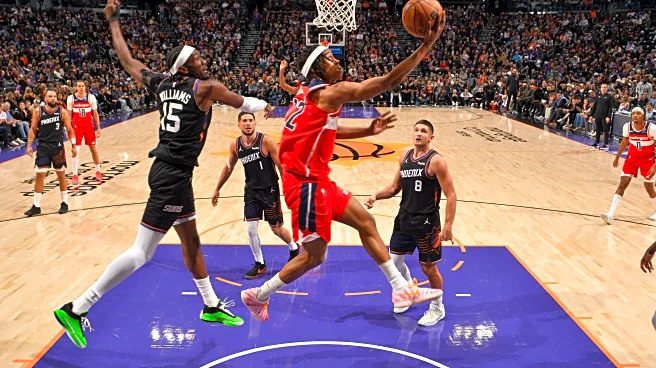




For three quarters, the Phoenix Suns administered lessons on playing hard as a cohesive unit, at the end of which the Washington Wizards trailed by 29 points. Then the Suns slacked off a bit and the Wizards trimmed the final margin to a semi-respectable 19.
For a second straight game, the Wizards offense was a disorganized mess. They ran up and down the floor, attempted nutty passes with little chance for success, and flung the ball at the rim whenever the urge struck — regardless of normally considered
factors such as whether the team had run an offensive action, the relative position of defenders, and the relative openness of teammates.

It was a fascinating contrast: the Suns routinely screening for teammates, making hard and timely cuts, and moving the ball to open teammates — using coordinated teamwork to get good shots, while the Wizards seemed to be playing games of one-on-three.
This is not to let the team’s defense off the hook. The final numbers (a 110 defensive rating — 5.5 points better than league average) might lead an observer to believe the Wizards defense was pretty good. Don’t be fooled. Through three quarters, the defensive rating was 123.
With the game out of reach, the Suns took their foot off the proverbial gas pedal and the Wizards had a 64 defensive rating. That result was very much a case of Phoenix missing open looks and throwing the ball away than it was Washington affirmatively playing well.
A few examples from the numbers? So glad you asked. Through three quarters, the Suns had six turnovers. In the fourth quarter, they committed seven. For the game, Phoenix shot 17-52 — just 32.7% — from three-point range. In the first three quarters, it was 16-41 (39.0%). With a little math, we can see they shot just 1-11 from deep in the final period.
Thoughts & Observations
- Washington’s defensive plan was to load up on Suns star Devin Booker. Bilal Coulibaly and help defenders limited Booker to 5-14 shooting and left other Suns open and wide-open shots. Booker had a personal best six first-quarter assists, and finished the game with eight.
- During a stoppage at the 8:13 mark of the first quarter, Phoenix analyst Eddie Johnson said, “It’s pretty obvious the Suns will get whatever they want on offense. The key is not settling for bad shots.”
- A truly rare event occurred during last night’s game: Dillon Brooks drove into the lane and “created space” by ramming his forearm into Khris Middleton and shoving him back. It was (properly) called an offensive foul.
- Brooks, by the way, has very little offensive game when he drives if refs don’t let him commit offensive fouls with that off arm. He was unable to get past any of Washington’s perimeter defenders (including Middleton). I wasn’t entirely sure getting past a defender was even a goal. I guess, why would it be if he can just dribble into the lane, shove a defender out of his way, and then take a shot?
- In my notebook, I had several entries with some combination of “Kyshawn George” and “sloppy.” He had five first-half turnovers, and they were all either sloppy passes (risky, pointless, inaccurate) or poor ball security. He needs to learn to value possessions.
- By the way, the Suns had four turnovers in the first half.
- Phoenix’s Ryan Dunn had a highlight reel put-back dunk because when the shot went up, Tre Johnson and Will Riley watched the ball in flight instead of blocking out.
- Bub Carrington keeps throwing lobs that make no sense. He’s surprising teammates who (correctly) believe they’re well defended, and the passes themselves are off target.
- While the above note is about Carrington, in fairness he’s not the only Wizards player tossing up nonsensical lob attempts. Alley-oops are cool and everything, but perhaps the team could benefit by focusing on making plays that increase the team’s odds of scoring.
- Another notebook entry: “Kyshawn looks thoroughly overwhelmed. Tried to pressure Grayson Allen, who just drove by him. Got ripped by Allen.”
- For a couple minutes in the second quarter, the Wizards played some real defense on Booker.
- 3:14 — Coulibaly WOW block on Booker
- 2:14 — Alex Sarr got switched onto Booker, who drove. Sarr made an impressive recovery block
- 1:46 — Sarr ended up on Booker again. Booker drove, pump faked under the basket, and then got his shot swallowed by Sarr.
- I was fairly impressed with Booker’s response to Washington’s defensive attention. He kept making the right passes. While he didn’t always get the assist, he empowered his teammates to make plays.
- Sarr was good in the losing effort — 19 points, 15 rebounds, 3 blocks. While his 105 offensive rating was more than 10 points below league average, it was 15 points better than the combined offensive rating of his teammates last night.
- Weird stat line of the night: Suns guard Collin Gillespie had a 92 PPA while shooting 0-6 from the floor. He did it with six rebounds, five assists, four steals and zero turnovers.
Four Factors
Below are the four factors that decide wins and losses in basketball — shooting (efg), rebounding (offensive rebounds), ball handling (turnovers), fouling (free throws made).
The four factors are measured by:
- eFG% (effective field goal percentage, which accounts for the three-point shot)
- OREB% (offensive rebound percentage)
- TOV% (turnover percentage — turnovers divided by possessions)
- FTM/FGA (free throws made divided by field goal attempts)
Stats & Metrics
PPA is my overall production metric, which credits players for things they do that help a team win (scoring, rebounding, playmaking, defending) and dings them for things that hurt (missed shots, turnovers, bad defense, fouls).
PPA is a per possession metric designed for larger data sets. In small sample sizes, the numbers can get weird. In PPA, 100 is average, higher is better and replacement level is 45. For a single game, replacement level isn’t much use, and I reiterate the caution about small samples sometimes producing weird results.
POSS is the number of possessions each player was on the floor in this game.
ORTG = offensive rating, which is points produced per individual possessions x 100. League average so far this season is 115.1. Points produced is not the same as points scored. It includes the value of assists and offensive rebounds, as well as sharing credit when receiving an assist.
USG = offensive usage rate. Average is 20%.
ORTG and USG are versions of stats created by former Wizards assistant coach Dean Oliver and modified by me. ORTG is an efficiency measure that accounts for the value of shooting, offensive rebounds, assists and turnovers. USG includes shooting from the floor and free throw line, offensive rebounds, assists and turnovers.
+PTS = “Plus Points” is a measure of the points gained or lost by each player based on their efficiency in this game compared to league average efficiency on the same number of possessions. A player with an offensive rating (points produced per possession x 100) of 100 who uses 20 possessions would produce 20 points. If the league average efficiency is 114, the league — on average — would produced 22.8 points in the same 20 possessions. So, the player in this hypothetical would have a +PTS score of -2.8.
Players are sorted by total production in the game.