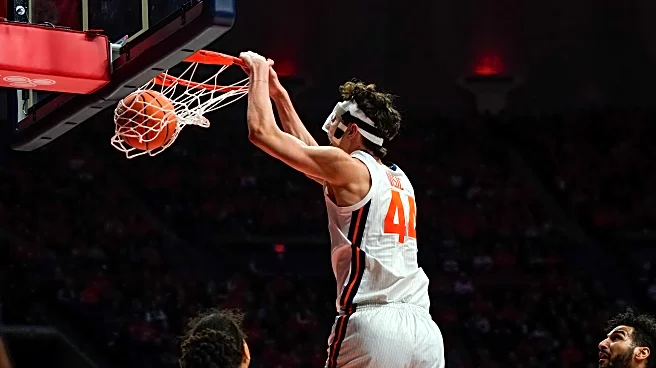



With non-conference season wrapping up on Tuesday, it is time to get our first glance at how the bracket is shaping up. For Illinois, wins already banked against Texas Tech, Tennessee, and at Ohio State give them three Quad 1 wins and have the Illini well on their way to another tourney appearance. What Underwood and the Balkans will be playing for (besides Big Ten supremacy) will be an easier path to a Final Four in Indianapolis.
Besides getting a higher seed to get easier early opponents, there
is a dream path out there of St. Louis to Chicago to Indianapolis, but Illinois has a lot of competition for those spots. Who do the Illini need to pass on the seed line to get those spots?
For St. Louis, the teams to pay attention to are Iowa State and Purdue. Illinois will have to finish above one of those teams to get the Saint Louis first and second round site. Right now, both of those teams are projected as 2-seeds, so Illinois will have some work to do, or one of them needs to have a disappointing conference season. There is a chance a team like Kansas or Nebraska goes to St. Louis as well if Oklahoma City has already been filled, and a team like Iowa or Louisville could rise up and go for those spots as well, but the main competition are the Cyclones and Boilermakers.
For Chicago, it basically means being the highest seeded Big Ten team. Illinois, Purdue, Michigan, Michigan State and Nebraska would all have Chicago as their preferred regional site, but the seeding procedures say the top four seeded (1-4 lines) teams need to go in different regions, so after the first one takes Chicago, the next three will need to go to Houston, Washington D.C., or San Jose. Since the Big Ten is so strong, there is a chance that there will be more than four teams on the top four lines and Chicago becomes an option again for the fifth team, but at that point a bunch of other seeding procedures also come into play. In this iteration for example, Illinois is the fifth seeded Big Ten team, but because Michigan is the top seeded team overall, they required a weaker four seed than Illinois (the second 4-seed in my bracket) to balance out their region, so the last four-seed Kansas took that spot.
Midwest (Chicago)
- Michigan (Buffalo)
- Vanderbilt (Greenville)
- Houston (Oklahoma City)
- North Carolina (Tampa Bay)
- Tennessee
- Iowa
- UCF
- Georgia
- St. John’s
- NC State
- St. Louis
- McNeese
- High Point
Notes on the Region:
Undefeated Michigan and erstwhile Illini Morez Johnson hold down the top seed in the country at the moment. Their combination of positional size, athleticism and coaching will make them a serious national title contender. In this case, Dusty May might need to take out some of his coaching heroes to get there, with matchups with elder statesmen Rick Pitino, Rick Barnes and then Kelvin Sampson possible. The St. John’s second round matchup would be a rematch of an exhibition game that Michigan won 96-94 in overtime. St. John’s was a preseason top 10 team that has disappointed in the non-conference season, but the talent is there to pull an upset.
The other Big Ten team in the region sees Iowa head coach Ben McCollum on the other side of the Cinderella story. Last year, McCollum took 11-seed Drake to the second round by beating Missouri. Now, he is at a power conference school and draws one of the most dangerous mid-majors in the country this year. The coaching battle of Ben McCollum vs. Josh Schertz is a big one for basketball nerds who like excellent tactical coaching. Also, check out Robbie Avila.

South (Houston)
- Arizona (San Diego)
- Duke (Greenville)
- Michigan State (Buffalo)
- Kansas (San Diego)
- Virginia
- Villanova
- Florida
- SMU
- Kentucky
- Boise State
- Miami/Ohio State
- Akron
- N. Colorado
Notes on the Region:
This is the Champions Bracket. Eight of the top nine seeds have won a NCAA championship in the past 30 years, with Duke, Kansas, Villanova, Florida and Kentucky owning multiple championships, and altogether they own 16 of the past 30 NCAA champions. The second round matchup with reigning champions Florida and freshman superstar Cameron Boozer and Duke would be a highlight of the first weekend. Those two have already played this season, with Duke hanging on to a 67-66 victory at home, which has been the story of the Gators season so far, close losses in their biggest games.
Buckeye star Bruce Thornton has one last chance to avoid being the Malcolm Hill of Ohio State: great player with no tournament appearances. As of now, they are the last team in the field. That earns a first four showdown with Miami, in a rematch of the memorable 2003 college football championship game. Miami stars ex-Hoosier star Malik Reneau, and he and Thornton can fight for a chance to actually make it to the weekend of the tournament.

East (Washington D.C.)
- UConn (Philadelphia)
- Purdue (Saint Louis)
- BYU (Portland)
- Illinois (Philadelphia)
- Louisville
- USC
- Utah State
- LSU
- Clemson
- Baylor
- Tulsa
- Yale
- Liberty
Notes on the Region:
To get out of Philadelphia like Will Smith, Illinois will have to defend the three-point line. Liberty makes the 12th-most threes in the country, and Louisville makes the second-most. The matchup to watch in that Louisville game is the battle of the star freshmen. Will Mikel Brown’s explosive athleticism beat Keaton Wagler’s brilliant slow-motion playmaking?
If Illinois gets out of the first weekend, the boogeyman is waiting in the Sweet 16. Dan Hurley has had Brad Underwood’s number in their previous two encounters, and precise half court sets with lots of back cuts and off ball movement are the biggest weakness of this defense, which is what UConn excels at. Slaying the dragon and getting to the Elite Eight over UConn would be oh-so-sweet though.
On the other side of the bracket, I don’t see a lot of competition for Purdue or BYU in the bottom of the bracket. That Sweet 16 match up would be a fun, high scoring affair. I don’t think BYU has anyone who can stop Braden Smith from dissecting the defense, but Purdue doesn’t have any wing defenders that have a prayer of slowing projected top two pick AJ Dybantsa. For Illinois, making a Final Four by going through UConn and then Purdue seems improbable, but would be cathartic.

West (San Jose)
- Gonzaga (Portland)
- Iowa State (Saint Louis)
- Nebraska (Oklahoma City)
- Alabama (Tampa Bay)
- Texas Tech
- Arkansas
- St. Mary’s
- Auburn
- Seton Hall
- UCLA
- Butler/Indiana
- Belmont
- William & Mary
Notes on the Region:
Another spicy Dayton play-in game involving a Big Ten team. Indiana refuses to schedule Butler for fear of humiliation from its tiny in-state rival, but it is forced upon them by the committee in this case. That’s what you get for losing to Minnesota.
There are two other Big Ten teams in the bracket, and I predict this is the highest we see Nebraska all year, and the lowest we see UCLA. Nebraska has gotten off to a terrific start, with the win in Champaign as the gold star on its resume, but I would expect them to settle more into the 5-7 range as the conference season grinds along. UCLA had some near misses in the non-conference season and a bad loss to California, but they are too talented to not start building a stronger resume.

First Four Out: California, Oklahoma State, Oklahoma New Mexico
Next Four Out: Virginia Tech, Creighton, Wisconsin, Washington
Bids By Conference:
- Big Ten: 10
- SEC: 9
- Big 12: 8
- ACC: 8
- Big East: 5
- West Coast: 2
- Mountain West: 2