


Offensive Summary
Oregon has continued to have a very balanced offense with strong yards per play numbers in both the run and pass games. Unlike recent seasons however, in two of the six quadrants hythloday and I track this offense is only average. Though very efficient in the run game the Ducks have not been particularly explosive, while in the passing game they are only just above water in efficiency despite reaching championship level explosiveness. Much of this can be explained by the offensive line enduring a heavy
dose of the transfer portal effect. The line is talented enough to move most defenses, but lacks the cohesiveness to spring the runners for gains of 10 yards or more.
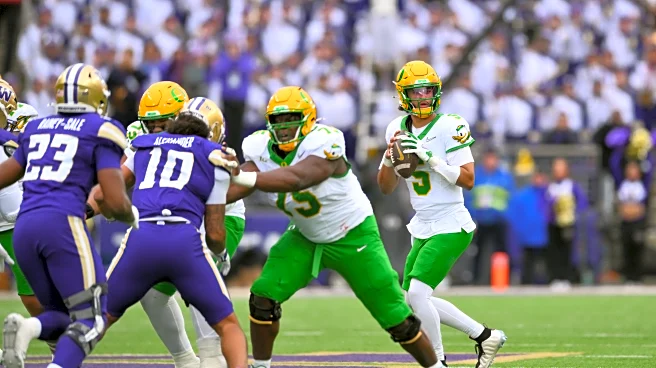
Similarly, when #5 QB Dante Moore has time to go through his progressions he has shown the ability to deep balls to his play-making receivers. Early in the season he was spending too many plays scrambling to keep the the passing efficiency up. As the season has gone on protection has improved, but issues with injuries to the receiving corps and some continued errors by Moore (especially this last week) have kept the passing offense just treading water in efficiency.
Offensive Line Errors Over Time

The error rates in pass blocking have proceeding as predicted by hythloday’s logistic regression model. The variation in weeks 5 and 7 can be attributed to factors in the game plans against Penn State and Indiana, respectively. The run game errors were on model until the Week 11 game against Iowa, when starting right tackle #71 OT Alex Harkey was out and replaced by reserve #78 OT Genorris Wilson. Run blocking requires more precision timing and teamwork than pass blocking, so it makes sense for run errors to tick up more with personnel shuffling. Harkey returned in week 12 (though the guards switched spots as he wasn’t 100%) and the error rate dipped back down. Multiple reserves played in week 12 against USC, and though both #72 C Iapani Laloulu and #76 LT Isaiah World returned against Washington neither looked fully healthy. An optimist hopes that if the line continues to heal before the playoffs the error rates will go down near their week 12 nadir. A pessimist might fear the performance in Seattle is indicative of how this line will fare against stiffer competition in the post season.
Individual Offensive Line Error Rates
We are in somewhat uncharted territory with regard to the transfer portal effect. This season was 14 weeks rather than the usual 13, so had the injury situation not interfered we might have seen even greater improvement late into November than we are used to seeing. Could these numbers continue to improve over a longer post season? It is plausible, but depending on specific match ups the opposing talent may well more than cancel out marginal improvement. Of greater concern for me are the athletic ceilings of Harkey (mobility) and World (anchoring against the bull rush). I am skeptical either can handle truly elite pass rushers without running back or tight end help. Run blocking by the tight ends has also been less than exemplary. Both #9 TE Jamari Johnson and #18 TE Kenyon Sadiq grade out at around 30% error rate on my tally sheet.
Offensive Performance by Down and Distance
The above table takes a more granular view of the offense with 11 games worth of data against FBS competition. 1st and medium means 1st and 10 (other distances are possible but rare so I don’t have good sample sizes). On 2nd and 3rd down “short” means 3 yards or less to go, “medium” is between 4 and 6 yards, and “long” is 7 to 15 yards (any longer is non-representative). The lack of explosive plays on 2nd down is disappointing, this is the “money down” when an offense can go deep and still be confident in converting on 3rd and short (as Oregon is very good at). It seems OC Will Stein has been more willing to wait until 3rd and short when he is willing to go on 4th down, but I’d like to see more deep field shots on 2nd downs as well. Last year the offense was much more efficient in 3rd and medium situations than this season. Not coincidentally, I have yet to see Stein run his favored outside zone toss into the boundary in a key third down situation in 2025. I have a sneaking suspicion he simply doesn’t trust this offensive line to execute that blocking scheme in a critical situation.
Oregon Rushers
Senior Whittington was dinged up to begin the year but has become the player the staff trusts most in single back sets. Veteran #27 RB Jayden Limar was the second most used back early in the season, but has missed every game since week 8 with injury. He was listed as Questionable last Saturday rather than simply Out, so he could be available in the post season. I suspect that Davison and Hill will continue to get the bulk of the carries that don’t go to Whittington. Hill is the most explosive runner on the team, and I think Davison’s explosiveness and YPA numbers are a bit lower than they should be because he is also the short yardage specialist. Both of these freshmen limit options in the passing game, however, so I would think Whittington continues to have the most snaps of any back. Moore has proven very effective in short yardage or punishing an over aggressive defense on reads, hence his high per carry efficiency.
Rushing Performance by Down and Distance
Runs in 3rd and medium or long have been so rare I didn’t have a good sample size for the performance statistics. The Ducks have been extremely efficient in short yardage, over 80% efficiency in both 2nd and 3rd down. The most productive situations to run the ball 1st and medium (best in terms of expected yardage) and 2nd and medium (more efficient, but fewer yards per play). Even against a defense like Iowa that has historically held opposing rushers to short gains only, the Ducks could count on getting ahead in the down sequence by running on early downs.
Oregon Pass Catchers
In his first season starting at Oregon #5 QB Dante Moore has shown all the high level passing ability that made him such a sought after recruit, and improved mobility in the run game over his prior film at UCLA. He has yet to achieve to the consistency in his decision making and mechanics that is expected of the most elite college quarterbacks. Another year of experience behind an offensive line not dealing with such a large transfer effect could see him achieve these heights if he returns to school next season.
Dakorien Moore and Gary Bryant Jr. have both been listed as out since Iowa (Bryant started but was hurt after his first catch). The primary beneficiary of their absence has been Jamari Johnson, who has seen greatly increased usage with so many more 12 and 21 personnel sets. His per target metrics are the best on the team, even greater than start Kenyon Sadiq despite being targeted less than half as many times. Sadiq has seen more use split out as a #2 or slot receiver, and some defenses have chosen to treat him as such in terms of matching personnel.
Previously only the third most targeted wide out, Benson’s production matches that of a true number one receiver. His additional targets are likely to improve his draft stock if he doesn’t challenge for an additional year of eligibility. In the past few weeks Jeremiah McClellan has shown he has the down field ability to remain in the rotation regardless of the injury situation in the post season. His efficiency is only average, but his usage has changed since Iowa and that has the potential to tick up. When using three true wide receivers on the field since the injuries to Bryant and Dak we have seen veteran #14 WR Justius Lowe and true freshman #17 WR Cooper Perry (almost exclusively in the slot). Both have been used as blockers and/or distractions and don’t have a significant number of targets. The running backs have not been a featured part of the passing game this season, being used almost entirely on checkdowns and screens.
Passing Performance by Down and Distance
The Ducks get good explosiveness on 1st downs, and are about as productive as one could reasonably expect in long yardage. The difference between 2nd and 3rd downs in short yardage is stark, and reinforces my criticism that this offense isn’t taking enough downfield shots in 2nd and short situations. Much of the inefficiency in the passing game comes in medium distance situations on 2nd and 3rd downs. Reasons that could account for less efficiency in medium yardage than in long yardage are pass protection (keeping more pass blockers in protection in long yardage situations and fewer receivers still get open against Big Ten secondaries), and when screen passes are being called. Screen passes (of all kinds) have only 42.31% efficiency with 1.92% explosiveness and 4.88 adjusted yards per play. Screens have accounted for 9.47% of all play calls, about FBS average. The good news is this shows evolution from 2024 when screens also dragged down the passing game but were being called more often. On the other hand, the screen game in 2025 is even worse than 2024, so if the numbers hadn’t dipped further there might have been no such self scouting.