





The unit of the universe is the atom. The unit of a baseball game, however, is the moment. A season is comprised of series, which are comprised of games, which are comprised of innings, which are comprised of plate appearances, which are comprised of pitches and the subsequent swing decisions, and all that results. You’ve heard the relevant sayings about forests and trees. Nearly every moment of a season will be subsumed by the greater sweeps of a full campaign; even the most meaningful moments,
upon which entire narratives may swing, only exist because of the gradual piling-up of moments prior. Still, by looking at particular moments in a season, we can find some interesting stories.
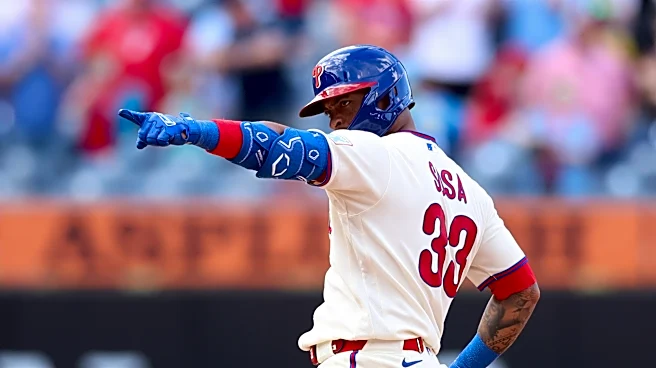
By Win Probability Added, the most significant moment of the series against the Nationals was Edmundo Sosa’s ninth inning, 2-RBI, game-tying single. Just after the previous at-bat (Alec Bohm working a free pass to put runners on second and third with two away), the Philadelphia win probability was 18%. After Sosa’s scoring slash, it was 63.4%, a difference of 45.4%.
Any starting point for this story would be somewhat arbitrary (unless we start with the first inning, but that’s a bit of a broader scope than we need). For our purposes, though, we’ll start with the bottom of the seventh, before Sosa was a factor at all. With two away, and a lead that had shrunk to three thanks to a J.T. Realmuto solo shot, the Nationals had Kyle Schwarber to deal with. He represented neither the winning nor the tying run, and the visitors were only one out away from ending the inning. Still, the Washingtons were not keen on surrendering more of their momentum to another homer. Andre Granillo, a righty, was on the mound. Cionel Pérez, a lefty, was called in to provide the platoon advantage against Schwarber. He kept the ball low in the zone against Schwarber, and induced a flyout on a curveball to end the inning.
With two of the three batters due up next for the home team being of the left-handed sort, the Nationals kept Pérez in. But the platoon advantage didn’t stop Bryce Harper from homering to narrow the lead to two. The Nationals kept Pérez in, and he quickly accrued a baserunner, in the form of Alec Bohm, through his shortstop’s fielding error. That would bring Bryson Stott to the plate. The move for Rob Thomson was obvious: get the platoon advantage by subbing in Sosa for Stott.
It didn’t pay off, at the time. Sosa grounded out.
But in the next inning, Sosa came to the plate again. The Nationals had LHP PJ Poulin on the mound, and so they made an obvious choice of their own in bringing in righty Cole Henry to thwart the very platoon advantage that had put Sosa in the game in the first place.
Henry has a four seamer, a sweeper, a sinker, a cutter, and a changeup. The changeup was always a sparingly seen offering from him, and he seems to be making the cutter sparse as well, given that it hasn’t shown up at all through 44 pitches this season. That left him with a trio of offerings with which to attack Sosa.

He started with a pair of fastballs high, getting strikes on both (via foul and whiff, in that order). In full command of the situation with an 0-2 count, Henry moved to finish off Sosa with a same-handed sweeper. Textbook stuff, but there’s a reason why it’s textbook.
The problem was that he left it too high, and put it squarely where Sosa could do damage. You know the rest.
It was all as simple as a badly placed pitch. But that badly placed pitch was built on a series of other decisions, some good, some bad, some neither until Sosa’s swing issued the final verdict.