







While the NHL gears up for the coming preseason, I have found myself wondering whether the Devils might be part of one last big trade before games get underway. Between the defensive logjam on the left side and the high number of NHL forwards, it would seem that the Devils are a little overprepared for the depth needs of this season. Maybe that is a good thing, all things considered, but it is clear that the Devils cannot keep everyone through waivers. Whether they have to waive Nick Bjugstad, Jesper
Boqvist, Amadeus Lombardi, David Rittich, Vladislav Kolyachonok, or someone we’re not yet expecting, it just does not seem like there is a path for the team to keep everyone Sunny Mehta has accumulated on the roster.
Trades now could be good for the team because they do two things at once: they clean up the excess on the roster while likely padding the team’s available futures. This is very important to get in order, as top players around the league who the Devils may be highly interested in may be more concerned with who can get them a Stanley Cup than who they personally get along with the most. So let’s dive into the biggest factors that predict how long the Devils can be good for.
Positive Factor: The Forward Core is Locked Up
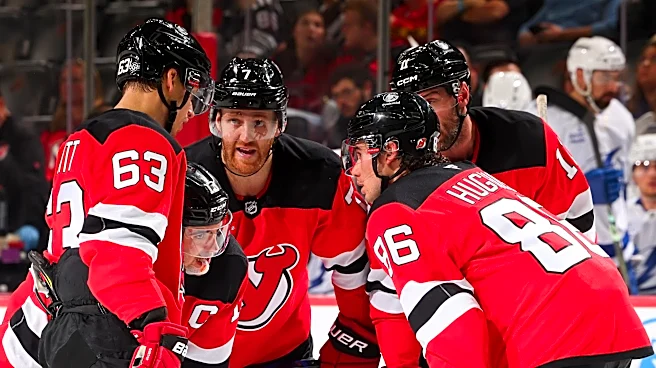
Of the New Jersey Devils’ top four forwards: Jack Hughes, Nico Hischier, Jesper Bratt, and Timo Meier, the the team does not have to worry about signing any one of them to a contract extension until 2030, when Jack Hughes’s contract expires. That is pretty much four guaranteed seasons where the Devils can range from pretty good to a Stanley Cup contender. Beyond 2030, Bratt and Meier see their contracts expire in 2031, while Hischier’s expires in 2032.
Some may have felt like the Devils paid a high price to keep Nico Hischier, but his $11.7 million contract that starts in 2027-28 has proved to be on the lower end of contracts in the new era of the high salary cap. In a world where Leo Carlsson makes $18 million and top defensemen are getting over $20 million, that price for Nico Hischier is peanuts in the grand scheme of things. Likewise, Timo Meier’s $8.8 million contract has been a sore point for some fans, but Meier getting back to being a 30-goal scorer would quickly make it merely average in the current cap environment.
Importantly, Sunny Mehta has surrounded thee forwards with a collection of great depth, but there is one problem: most of them are not signed for very long.
Mixed Factor: Lack of Term for Supporting Forwards
In many cases, you might not want your team’s depth to have a whole lot of term on their contracts. Aging players with lots of term can create issues if they become frequently injured or experience age-related decline, while young players are best to lock up early. And unfortunately for the Devils, they only have two forwards beyond the core signed to three years: Arseny Gritsyuk and Connor Brown.
These two will certainly positively impact the team as long as they’re signed and as long as Brown is healthy. Brown, 32, had a great finish to last season with Hughes and Bratt but also performed as one of the best bottom six shutdown forwards in the league. At only $3 million per season, Brown is easy to fit in the books. Arseny Gritsyuk, too, at $3.25 million, is extremely easy to fit under the cap. But since Gritsyuk is 25 and will now be an unrestricted free agent at 28 years old, we have to ask how easy it will be to retain Gritsyuk once this contract nears expiry.
The bigger issues are the young forwards on expiring deals. Cody Glass is a UFA after this season, while Dawson Mercer and Luke Evangelista are restricted free agents with arbitration rights. While the three of them make a combined $9.5 million this season, that number could come close to doubling if, say, Luke Evangelista has an even bigger year this season and signs a long-term extension. I do not think any of these three would be inherently easy to replace, so this is an actual issue to keep an eye on.
Beyond those five players, Anthony Mantha is signed for a two-year deal, but I imagine he would be open to re-signing if things go well during these couple of seasons. Two years is appropriate for a 31-year old, anyway, as Mehta giving more term to Mantha would raise the risk of the player declining during the contract.. Evan Rodrigues is also on an expiring contract, but he is 33. Hopefully he plays well and likes it enough here to sign another short contract, but the Devils are in a good place of having veteran help in the forward group that is not signed for too long.
Mixed Factor: Term Among Defensemen
The single most positive factor in the Devils’ competitive window, beyond Jack Hughes being signed until 2030 and Nico Hischier being signed until 2032, is Luke Hughes having the same remaining term as Nico Hischier. Luke Hughes’s $9 million contract itself now just carries the compensation of what a second-pairing defenseman is going to be making in free agency in 2027 or 2028. Having Luke under contract into the 2030s, I imagine, also makes it more likely that Jack Hughes would re-sign before July 2030 — and this is the single most important thing in extending the Devils’ competitive window right now.
Beyond Luke, though, only Brett Pesce and Johnny Kovacevic have much term left on their deals. Both are signed through 2030, but Pesce is 31 and has been struggling with injury, while Kovacevic is 29 and had a difficult post-surgery season over the last year. I do not mark the term remaining on their deals as a huge positive, but they are good or even great players when healthy. Pesce in particular can be a hidden two-way force, but I believe he has been held back a bit by the Devils’ lack of forechecking and aggressiveness over these last two years.
The single most negative factor in the length of the Devils’ competitive window is Dougie Hamilton, and that’s because he’s still a really good player who is only under contract for two more seasons. I can only hope that Tom Fitzgerald did not hurt Dougie’s relationship with New Jersey too much and that he would be willing to extend in 2028 to finish his career with the Devils. While Nico, Jack, and Bratt are the powertrain of the offense, Dougie Hamilton is like the high-octane gasoline that the engine needs to run properly. Try to put 87 octane fuel in the Z4, and it won’t bring you as far. But for these next two seasons, with a better depth cast, this might be the best time for the Devils to make that run.
The Question Marks: Silaev, Casey, Yegorov, Command
The second-easiest way for the Devils to extend their championship window (after getting Jack Hughes signed again in 2030) is hitting on Anton Silaev, Seamus Casey, Mikhail Yegorov, and Alexander Command.
Anton Silaev and Seamus Casey are paired together in rookie camp, and that should be a sight to behold. These two can be the future of the team, if they play well. Silaev, with Luke Hughes, could form one of the most threatening 1-2 punches in the entire league of left-handed defensemen. If you’re not burned by Hughes’s speed, you might be crushed into oblivion by Silaev. I have high confidence that Silaev will be as good as we are hoping for.
But Seamus Casey also has a very important role to fill. If Dougie Hamilton’s contract expires in two years and is not extended, Casey is essential to the future of the Devils’ right side. But those are huge shoes to fill, and I am not sure you could fairly expect Casey to match Hamilton’s blend of productivity and average or better defensive results. So far, Casey has shown offensive flashes, but he has played poor defense in the NHL and has been unable to stay healthy in the AHL. I am a bit worried here, and I still feel like the best image of the Devils’ five-year future includes Dougie Hamilton extended, even if Casey replaces one of the other right-handed defensemen on the roster.
Mikhail Yegorov is an interesting guy. A math major at Boston University, Yegorov has made a whole website for his own goaltending analytics. It’s yegorovstats.com, and he seems to put large stock in expected goal numbers. It’s extremely interesting to see an active hockey player not only look at these stats, but try to work with them so closely that they make their own analytics site. We now know for a fact that Yegorov does not just practice, but he keeps statistical track of his rebound control, his glove reliability, and his playmaking. I am not sure if the Devils will be able to convince him to forego his final season of NCAA hockey before his graduation (unless he’s willing to finish his degree while in the NHL), but I am looking forward to the day we have someone in net who dives into the game as deeply as he does.
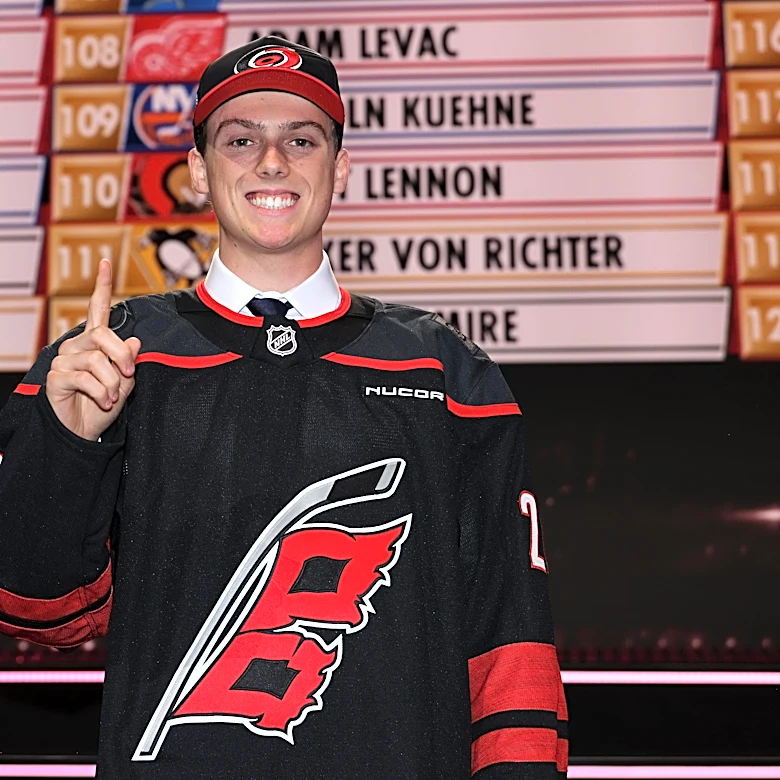
Alexander Command is the last piece. I am not sure about how Sunny Mehta will draft in the future, or even how often he’ll draft in the first round, but Command is a ways off. He is not in Devils training camp this year (which disappoints me), but he will be in the SHL. His reputation as an agitator and two-way player with offensive ability is intriguing, and the Devils can use more of that sandpaper in the lineup. If we expect Command to make the jump to the NHL around 2028, his development could extend the Devils’ contention window into the 2030s, but it is highly dependent on whether Hischier and Hughes are still on the team along with the paths of many of the other players above.
The Final Verdict
Given the range of term remaining on the team and the open questions that remain, this is how I would break down the Devils’ competitive window:
- Assured contention years: 2026-2028 (two seasons)
- Biggest factor for 2026-27: goaltending
- Biggest factors for 2027-28: the fates of Evangelista, Mercer, and Glass; NHL free agency in July 2027; whether or not Mikhail Yegorov signs before his senior year of college
- Possible contention years: 2028-2030 (two seasons)
- Biggest factors: Dougie Hamilton’s contract expiry in 2028; the development of Silaev, Casey, and Yegorov; Arseny Gritsyuk’s contract expiry in 2029
- The questionable years: 2030 and beyond
- Positive factors: Hischier and Luke Hughes signed through 2032
- Question factors: Jack Hughes’s contract expiry in 2030; Bratt and Meier’s contracts expiring in 2031; development of Silaev, Casey, Yegorov, and Command
- Negative factors: Forward core begins to have aging concerns
But what do you think of this breakdown? Do you agree that the Devils, with their current collection of depth, is best suited to win now? Or do you think they will be better off when more of their prospects start to play in the NHL? Leave your thoughts in the comments below, and thanks for reading.