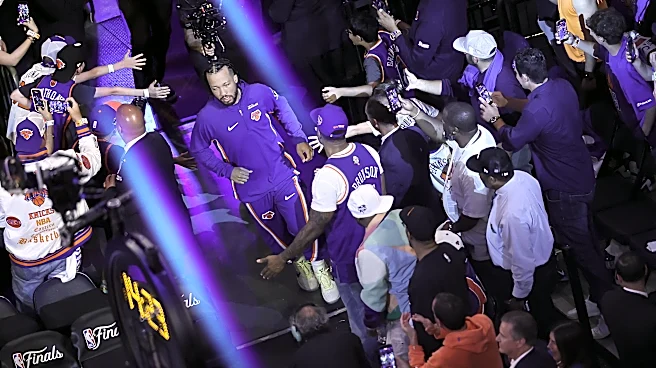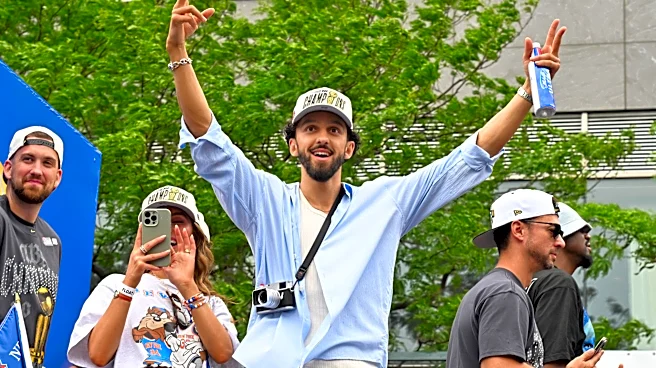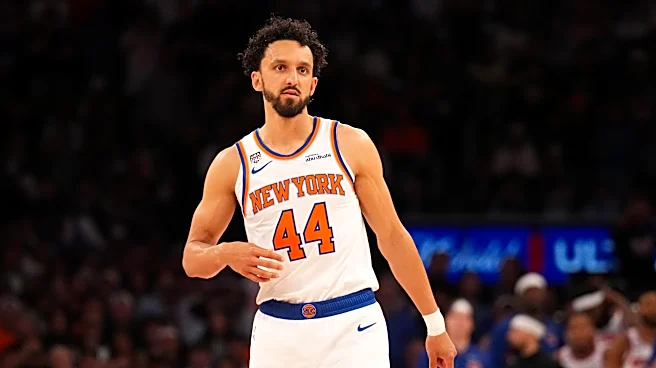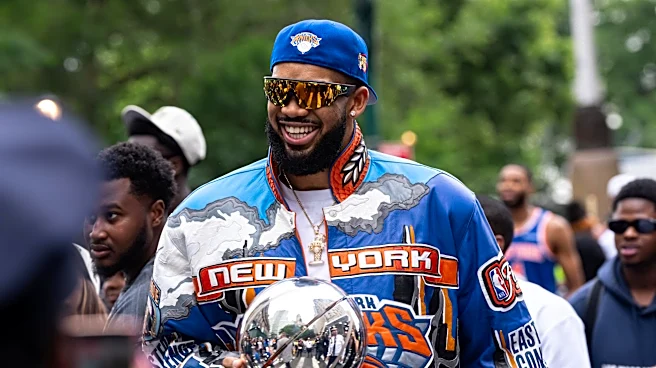





I don’t think there’s a more difficult Knick to evaluate than Karl-Anthony Towns. It’s not just the fact that the big man’s season looked completely different from game four of the Hawks series onwards. It’s also the fact that for much of the season, Towns’ impact on the team was hard to gauge. Even when Towns’ counting stats didn’t look the way most fans wanted it to, and even when the team wasn’t piling up results that people had expected, Towns was still analytically better than many believed.
But as we learned throughout the playoffs, analytics can’t be the end-all, be-all. So how good was Towns this season as a whole? Incredibly good.
Is that an overreaction considering some of his regular-season shortcomings? Maybe. Is there recency bias? You bet. But if you were to ask me to choose between a player who dominates in the regular season but has a drop off in the playoffs and a player who disappoints a bit during the regular season but dominates in the playoffs, I’m taking the latter. And I do so every single time. I get that the playoff riser is performing higher for a mere fraction of the games as the regular-season guy. But in sports, you take care of business in the postseason, and those performances will do the heavy lifting. As many have said before, “winning cures all”, and that’s exactly what Towns did.

I do want to clarify, though, that Towns’ regular season wasn’t bad. Or at least, again, not as bad as many thought. By a lot of metrics, he was playing some of the best defense in his career. And on the other end of the floor, he still put up solid numbers despite changing roles, having a new coach, and seeing limited opportunities at times. I do believe that players, for the most part, have agency. And Towns does deserve some blame for his offensive shortcomings and lack of aggression at times. But some of that blame needs to be placed on Mike Brown, Jalen Brunson, and the rest of the team.
Sure, Towns could’ve, and arguably should’ve, taken it upon himself to get the ball more. And when he did, Towns should’ve been more intentional in looking for his own shot. There absolutely were times when Towns was too passive and nonexistent in the offense. He did take himself out of some games. But there were also a lot of times when Brunson ignored him for his own shot. And other times when OG Anunoby, Mikal Bridges, and Josh Hart just missed him, or couldn’t make the requisite pass. There were also plenty of times when Brown saw the offense going away from Towns and refused to find ways to make him the focal point.
Yet Towns persevered. He responded. Maybe not in the way fans wanted. But the big man continued to look for ways to best serve his team, even when the going got tough. He revealed late in the regular season that he still wasn’t sure what his role was in the offense. And you could tell that Towns wasn’t necessarily enjoying his new roles as an offensive Swiss Army Knife, whose only, or at least primary, role wasn’t to score. It didn’t matter, though. Thankfully for the Knicks and their fans, the transparency never came at the cost of effort or passion. Even with the discomfort and unease of the situation, he didn’t waver. And then destiny came knocking and rewarded him and the Knicks for their mutual perseverance and trust.
When the fate of the season was hanging in the balance and when the Knicks needed him the most, he showed up. In game 4 of the first round, the Knicks found themselves down 2-1. Two more losses and the core of the eventual champions very well could’ve been disbanded. But Towns didn’t allow it to happen. Brunson, Brown, and Towns’ teammates deserve credit for entrusting their season and potentially their future to Towns. And Towns delivered performances that will live on in Knicks lore for decades.
Newly appointed as the offensive hub and point center of a system that emphasized his passing skills and the other players’ basketball IQ and cutting abilities, Towns shone like he never had in a Knicks jersey. And neither Towns nor the Knicks looked back. They rattled off 13 straight postseason wins and won 15 of their next 16 games thanks in large part to Towns’ new game. He was no longer a scoring first center. He wasn’t confined to the paint. And he wasn’t relegated to being a spot-up shooter.
For the first time in Towns’ career, he really put it all together. He was still an elite rebounder who was stretching defenses with his shooting threat like he always had. But now, he had become a smart, patient, and deadly passer. And he was now also playing not just passable, or average defense, but legitimately great defense.
And yes, he got in foul trouble against Joel Embiid and Victor Wembanyama. And yes, he struggled to have an offensive impact in games three and five of the Finals. But on defense, he legitimately made Wembanyama work more than maybe any other player in the league. Meanwhile, on the other end of the floor, his offensive impact far outweighed his counting stats. He continued to perfectly balance scoring and passing and routinely came up clutch. Brunson and Anunoby may have had the biggest moments, but a lot of those comebacks don’t happen without Towns on the floor.
Towns’ early season struggled were frustrating. He still struggles at times with foul trouble, silly turnovers, and a lack of aggression. But you really can’t ask for much more. Towns reinvented himself deep into his career for the betterment of his team. He adjusted to coach Brown’s system. He bought in defensively. Most importantly, he was arguably the best overall Knick during a dominant championship run that saw them go 16-3. The 2026 championship did a lot for multiple players’ legacies. Outside of Brunson, no other player and their legacy benefited more from that trophy than Towns.
–
(P&T will be doing player-by-player article tributes over the next few weeks to commemorate the special team that ended our long, half-century nightmare)