
Welcome to the 2025 edition of Ranking the Rockies, where we take a look back at every player to log playing time for the Rockies in 2025. The purpose of this list is to provide a snapshot of the player in context.
The “Ranking” is an organizing principle that’s drawn from Baseball Reference’s WAR (rWAR). It’s not something the staff debated. We’ll begin with the player with the lowest rWAR and end up with the player with the highest.
N0. 2, Jimmy Herget (3.0 rWAR)
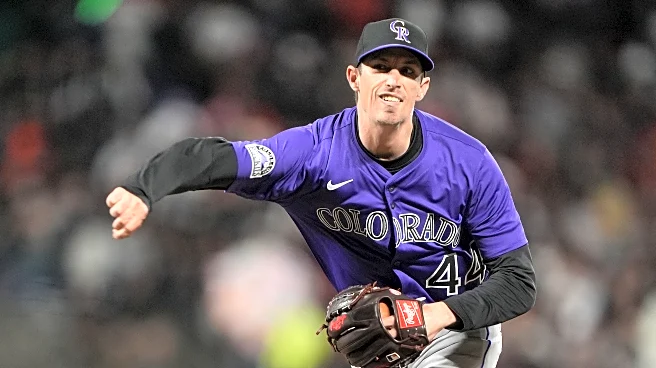
When the Rockies claimed Jimmy Herget off waivers in early November last offseason, I’m sure most of us didn’t think much of it. After all, it had become a yearly tradition for the team to acquire a veteran reliever off waivers, see what he could do, and then flip him at the deadline or non-tender him and move on after the season. Herget wasn’t a flashy arm and only had a couple of notable seasons under his belt. Surely, this was a temporary union that wouldn’t have much impact on the 2025 season.
Well, here we are, talking about the second most valuable Rockie in 2025.
After a solid spring training that saw Herget allow four runs on 10 hits over 12 1/3 innings, the 32-year-old earned a spot on the Opening Day roster alongside fellow older relievers Scott Alexander and Tyler Kinley. While the latter two struggled at times and ultimately didn’t finish the year in Colorado, Herget remained a fixture from the very beginning of the season.
Over his first month of games, Herget had a 2.40 ERA, having allowed just four runs on 12 hits over 15 innings of work. He’d hit a bump in the road in May with a 4.15 ERA over nine 13 innings but surged back with an incredible month of June, continuing that track through the rest of the season. His best month came in August when he posted a 1.65 ERA over 16 1/3 innings across 11 games. In fact, he posted a sub-3.00 ERA in every month except May.
In total, Herget tossed a career-high 83 1/3 innings over a career-high 59 games while tying a career-best 2.48 ERA and posting a 196 ERA+. His 81 strikeouts were also a career high, while the expanded workload led to 26 walks.
Herget was one of the most effective relievers in the game this season, despite not being flashy, and did so without recording a single save. He ranked third in innings pitched and had respectable numbers across the board compared to his peers. Due to the Rockies’ failures as a team, his season was under the radar, with how solid it turned out.
So how and why was he so good?
The Human Glitch truly lived up to his nickname, and it has baffled me. On paper, a pitcher like Herget doesn’t scream Coors Field, and yet he triumphed over hitters time and time again.
In 45 2/3 innings at home, Herget managed a quality 3.15 ERA with 47 strikeouts against 15 walks. Opponents slashed .247/.308/.385 against him and managed just five home runs. All things considered, Herget was quite effective in Denver, especially thanks to some quality defense behind him.
While he was good at home, he was even better on the road. In 37 2/3 innings over 31 games, Herget posted a sparkling 1.67 ERA, having allowed just eight total runs on 29 hits. He had 34 strikeouts against 11 walks while opponents hit a paltry .215/.298/.296 with just one home run. There was a natural inflation for pitching at home, but it was well within reason, making his road numbers that much better.
What made Herget so valuable was, in fact, his ability to work multiple innings. He worked over 31 games in which he recorded more than three outs, the most of any reliever in baseball this season. Whether it was high-leverage situations or low-leverage, Herget consistently came out of the pen and got work done in the middle innings or the late innings.
But again, I ask the question, how was he so good?
A quick look at his MLB Percentile Rankings per Statcast offers a few insights that help answer the question.

In most categories, he was above league average. Utilizing a mainly three-pitch mix of a curveball, slider, and sinker, Herget was able to attack the zone. In doing so, he was able to induce weaker contact and fool hitters with his herky-jerky pitching motion. A five-degree arm slot that borders on a side-arm throw, Herget was a master of deception and throwing off hitters’ timing. Sure, he doesn’t entice many hitters to chase, but they are having a hard enough time picking up and timing his pitches that all he has had to do is stay around the zone and things worked out.
His pitch movement wasn’t all that exciting either. His curveball didn’t have as much drop, but it managed to sweep across the zone more to the first-base side. Meanwhile, his sinker had more drop than the league average and his slider was fairly close to standard.

A matter of being able to spot his pitches, and work to the first base side on both lefties and righties made him successful. Working in the lower part of the strike zone and doing so consistently is a mold of pitching that the Rockies have been trying to preach for decades. He became a trustworthy tool for Bud Black and later Warren Schaeffer and a veteran leader for a young bullpen.
Somehow, Herget managed to find a level of success while working more than he has ever done before. When the Trade Deadline came and went, Herget remained while players like Jack Bird and Kinley were sent away. Then, with a fairly cheap contract for 2026 in store, the Rockies chose to tender him a contract.
As I’ve mentioned, there is no real clear-cut reason as to why he was so effective this season. By most metrics, he was slightly above average and, in a way, defied the odds. He certainly was bailed out of some situations and could have projected to be worse, but Herget was unfazed by anything that was asked of him. He simply was a bulldog on the mound and found a way to beat the odds in a way only the Human Glitch could.
Herget’s role for 2026 is still in flux. It was reported that the idea of his moving to the rotation could be in play. Though those plans are only in a preliminary stage as the Rockies try to mold their pitching staff and philosophy under their new coaching crew. Perhaps he could fill in as an opener for a couple of innings or he will simply remain in the bullpen as a stoic reliever with the rubber arm.
The fact remains that he will be counted on as a veteran mentor for the Rockies’ pitching staff. His ability to replicate his 2025 success without suffering the consequences of excess work will be a question mark for next season.
Somehow, though, I have a feeling he’ll find a way to make it work.
Please keep in mind our Purple Row Community Guidelines when you’re commenting. Thanks!