







There is a fundamental tension that comes with watching a team like Ohio State early in a college football season. You spend all offseason obsessing about the roster, breaking down what the season could be, and fantasizing about another national championship run, and by the time the season opener rolls around, you are ready to run through a brick wall.
You want to see immediate proof that all of the recruiting, portalling, winter workouts, spring practices, summer conditioning, and fall camp have
had their effect. You want to be assured that all the problems that doomed previous teams have been corrected. You want to believe that this will be a storybook season that sees your favorite team dominate from beginning to end.
But that’s just not how sports work. Despite all of your hopes and dreams coming into the season, you are also savvy enough to know that with every new season comes a new roster, new coaches, new schemes, and new problems. But that doesn’t stop you from wanting to see perfection immediately.
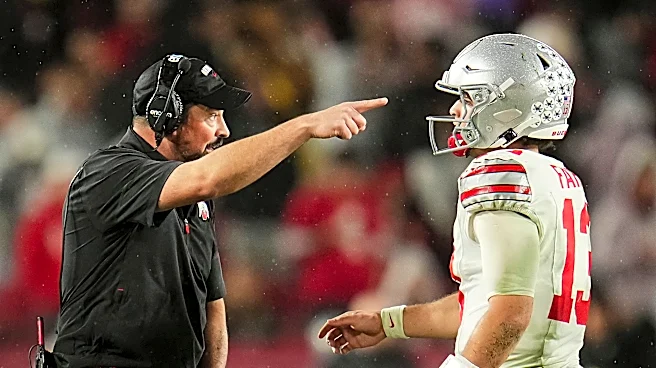
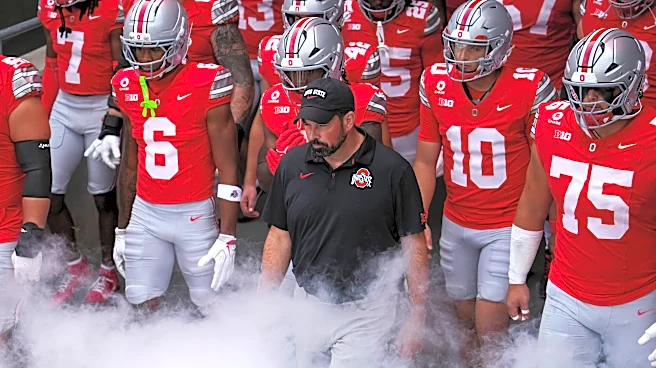
Ryan Day said something during his press conference this week that felt honest and a little raw, while also perfectly encapsulating the tension I have been struggling with early this season. While acknowledging that there were plays against Kent State where his offense was out of sync, the Ohio State head coach said, “That is going to happen in games, but we want to be perfect, and we’re going to need to be in order to get to where we need to be.”
I get it. I want the team to be perfect too. In fact, I would very much appreciate it if the Buckeyes could have everything completely figured out by the time I sit down to watch the first quarter of the first game every season. I would like the offensive line to generate four yards of push whenever Ohio State needs three. I would like the offense to convert every third-and-short, score touchdowns on every trip to the red zone, and never allow the quarterback to be touched. I would like the defense to eliminate explosive plays, get off the field on third down, and force approximately seven to 12 turnovers per game.
I can want those things all I want, but, as I said, that’s not really how sports work, especially modern college football.
Ohio State brought in 51 new players this offseason between transfers and true freshmen. That is nearly an entire NFL roster worth of new faces being incorporated into a program that is replacing starters, reshuffling responsibilities, and integrating a new offensive coordinator. That all takes time.
And as difficult as it can be for those of us watching from our couches to accept, there is no particular reason why the finished version of this team needs to exist in September.
College football has always been a sport of development. Teams that look unbeatable in September can become decidedly mortal by November, while others who stumble early can spend three months evolving into something completely different — we’ve seen it multiple times with 21st-century Ohio State championship teams. But in the 12-team College Football Playoff era, building toward the postseason has become even more important.
The goal is no longer to construct a pristine résumé from Labor Day through Thanksgiving and hope that one mistake doesn’t eliminate you from national-title contention. The expanded playoff provides considerably more runway, especially for teams like Ohio State, which should have enough opportunities and cachet to recover from an early stumble.
As we know painfully well, a September loss can hurt, and two would make the rest of the season extremely uncomfortable, but neither necessarily prevents a national power from becoming championship-caliber by December.
And that distinction matters when evaluating Ohio State through three games. There are absolutely things that should concern everyone invested in the team’s success. The short-yardage running game remains a problem. Third-down execution has been inconsistent. The red-zone offense has left far too many points on the field. The defensive line struggles to sack the quarterback. And what makes those issues particularly irritating is that none of them feels especially new.
So, I am not suggesting that we wave away every flaw, simply throw up our hands and say, “It’s OK, it’s still early. They’ll fix those problems,” because I am not wholly convinced that the coaching staff is capable of fully addressing some of the things plaguing the Buckeyes thus far. The problem is that three games into the season, it is nearly impossible to know which of these issues are early-season growing pains and which are chronic conditions that will follow the Buckeyes into November.
But I have to keep reminding myself that we are three games into a season that we hope will last 16 or 17. We have seen enough to identify the problems, but hopefully not enough to determine whether those problems are permanent.
There is value in wanting perfection; Day should demand it, his players should work toward it, and we, as fans, are perfectly entitled to be frustrated when a program with Ohio State’s talent and resources repeatedly falls short of it. But while perfection should be the goal, progress is what matters right now.
The Buckeyes don’t need to be the best version of themselves in September. They need September to help them become that team in November. Then they need November to prepare them for December, and, if everything goes according to plan, December needs to prepare them for January.
The objective isn’t to look like a national champion three games into the season; it’s to become one by the end of it.