


“Close, but not close enough” was the best way to describe Sunderland AFC’s relationship with the FA Cup during the 1950s.
Having spent boatloads of cash in trying to bring some of the biggest names in the game to Roker, the club were desperate to get their hands on some silverware in return for their investment, and during an era where the cup was arguably seen as the biggest prize of all, knockout football often became the main focus.
Certain members of the team have since mused that it became such
a priority that our league form slipped even when the title could’ve been within reach instead, and yet the most the Lads had to show for their efforts were concurrent semi-final appearances in 1955 and 1956.
It was often claimed that the expensively-assembled side of individuals — whilst boasting eye catching skills and capable of anything on their day — struggled to gel as a unit and was unable to produce any sort of consistency.
That was perhaps another reason why the FA Cup became the “holy grail”, and it was certainly the case that ties were sometimes viewed as the highlight of the season for supporters. Whether the opposition were familiar foes or unknown qualities from the lower divisions, crowds would still come in their droves and in 1950/1951 alone, Roker Park welcomed three 60,000+ cup gates in less than a month.
The campaign saw the Sunderland reach the sixth round — their best run since 1938 as holders of the trophy, and the two semi finals that came a couple of years later proved to be the furthest they got in the 1950s. Big numbers flocked in for showpiece games against Southampton, Norwich City and Wolverhampton Wanderers, but before that, the club needed to get past second division Coventry City in front of another healthy attendance.
The visit of the Sky Blues was only the second home draw since World War II, but they weren’t planning on rolling over for it and their preparations went down to the wire, with Coventry needing to wait as long as possible before naming their team due to a flu bug in the camp and future Sunderland striker Ken Chisholm being one of the men eventually deemed able to play.
The hosts also needed to get things in order, with rain and thawing frost making the pitch soft and boggy in parts, and in need of a healthy covering of peat moss in the goalmouths.

Coventry more than matched Sunderland in the first half, although both sides struggled with the conditions and greasy ball, which led to some awkward slips and fumbles.
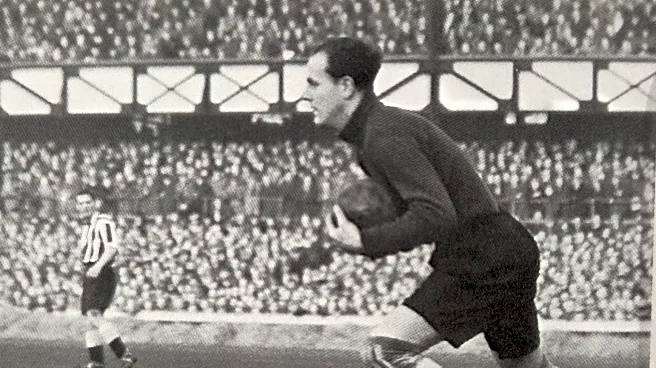
The two goalkeepers were often forced to punch crosses and shots away instead of attempting to catch them, whilst the referee — acknowledging the treacherous state of the surface — tried to overlook minor fouls in order to help keep the action flowing.
It all contributed to a frantic tempo and it was only after the break that Bill Murray’s men were able to gain an element of control and start putting their better technical ability to use.
Tommy Wright was a persistent threat and five minutes into the second half, he opened the scoring after beating two men on the wing, cutting inside and smashing in a powerful attempt on goal. Although blocked, it fell back to him on the rebound to convert off the underside of the bar and once in front, skipper Willie Watson was able to begin pulling the strings and force Coventry back.
With their defending becoming more ragged, it was hard for the visitors to get out of their own half and the desperation was never more apparent than with ten minutes to go, when a Dickie Davis header was handled by Terry Springthorpe in the penalty area.
Wright took the subsequent penalty and appeared to have struck it well, but the effort was still repelled by a magnificent save from Alf Wood. The stopper had been increasingly busy in the closing stages and deserved his moment of glory, although it wasn’t long until he was beaten again anyway, Arthur Wright doing the business this time as he drove the ball in from out wide.
There was a touch of fortune about the goal as Arthur Wright could’ve conceivably been looking to put the ball into a dangerous area, and it certainly took at least one deflection before finding its way over the line, but either way, the final score felt right on the balance of play.
Coventry had by no means showed themselves up, but the Black Cats had grown stronger as things went on and were now in the hat for the eagerly anticipated next round.
Saturday 6 January 1951
FA Cup Third Round
Roker Park
Attendance: 36,988
Sunderland 2 (T. Wright 50’, A. Wright 87’)
Coventry City 0
Sunderland: Mapson, Hedley, Hudgell; Watson, Walsh, A Wright; T Wright, Davis, Ford; Broadis, Duns