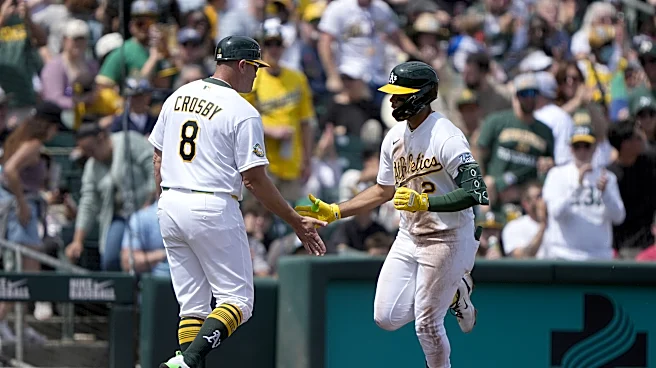






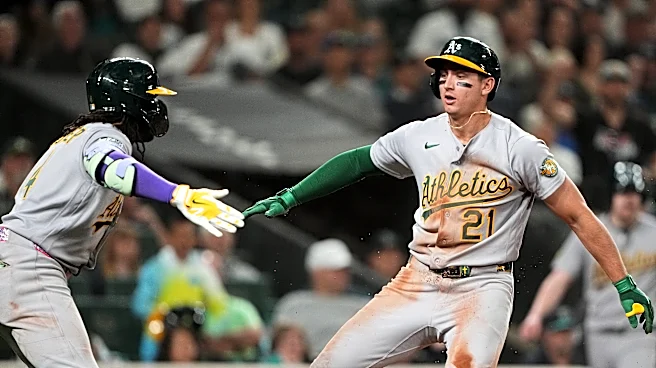
At one point early in his career Bobby Crosby was “all that” as a prospect. He seemed like he might be able to describe himself as “Crosby, Skills & Mash” — and he was even young. Now he plays a dual role as an A’s coach, serving as infield coach and 3B coach.
The first one, infield coach, is a largely invisible role. You work with players who struggle with their hands, or speed, or throwing, and much of the time as a coach you are limited by the inherent skill sets the player brings. You can’t magically
make someone faster or more consistent with their arm angle, though you try every trick to maximize strengths and minimize weaknesses.
Sometimes the work shows up in the metrics and sometimes players just struggle to improve. Crosby’s work is vindicated in his success helping Jacob Wilson improve from “bottom of the league” in key SS metrics to actually one of the top 2 in OAA and runs prevented so far in 2026. Wilson’s upward defensive trajectory, and Crosby’s influence, is highlighted in Martin Gallego’s piece this morning.
Where it’s hard to earn praise is as a third base coach. Like an umpire, a third base coach can get it right 9 time out of 10 and the 10th one is what fans will notice and remember. Just like fans of every team believe their manager to be uniquely terrible at making pitching decisions — even though the outcomes often reflect the pitchers more than the skippers — fans of every team complain how their third base coach makes mind-numbingly poor decisions on sending or not sending runners — “I mean just look at that play on June 11th as one of many”…well one…examples.
Little has been said on AN about Crosby’s decisions around “send” and “don’t send”. Why? Because in contrast to third base coaches who have preceded him, Crosby is doing such a good job that he is drawing little to no attention to himself.
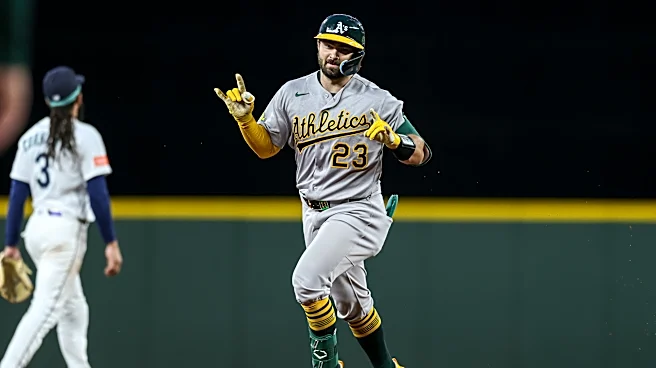
Last night offered a couple examples, where Tyler Soderstrom earned justified praise for his foul side dive that barely eluded Cal Raleigh’s sweeping tag as the A’s took a 4-3 lead on Max Muncy’s medium fly ball to RF. Perhaps easily lost in the hustle and bustle of that play was Crosby’s difficult decision to send Soderstrom, with the bases loaded and 0 outs when Muncy hit the ball, not all that deep and to a RFer, Dominic Canzone, who has a strong arm.
It was a gutsy “make them make the play” that could have backfired, and had it done so no doubt a spotlight would have shone on the third base coach. But as many times as we have seen the A’s fail to score after putting a couple guys in scoring position with 0 outs, with the #8 and #9 hitters coming up next, and with a fast and athletic runner at 3B, Crosby rolled the dice on forcing the action and it was the right call. Especially when Soderstrom made it.
Drawing that throw to the plate also allowed the back runners to move up, which was key when Lawrence Butler ripped a single to RF — to Canzone, whose strong arm had just been on display. By the time Crosby had to make a decision on whether to send the back runner, Jeff McNeil, the A’s had a 5-3 lead making it a bit safer to take a risk than it had been a moment ago.
Still, it was another difficult decision to make in the moment — remember that a third base coach, assessing a play as it unfolds in real time, has about a one second window to decide whether to put up a stop sign or keep the windmill going. As it turned out Canzone, rushing to make the play, bobbled the ball but it’s worth noting that by that time Crosby’s decision had already been made. It was going to be another aggressive send and a good one even though it might have gone either way with a clean pick up and accurate throw.
These are two examples of smart aggressiveness but Crosby, unlike some of his predecessors (Mike Gallego comes to mind) does not always err on the side of pushing the envelope. Several times he has held a runner that I thought he could have sent and maybe some of the times he should have while other times he was prudently conservative. The point is, he is neither overly inclined to hold or send and that’s a good thing.
Every third base will make many mistakes, and at least one or two “clear blunders” in a season. Why? Because there are 162 games and while you can hope to have a perfect week you cannot hope to have a perfect season. The inevitable ‘costly blunder’ Crosby will make at some point, in some game, does not take away from his overall work which has, to my eyes, been outstanding.
Let’s hope he has a lot of choices to make tonight because that means a lot of A’s are rounding third. And while we’re at it, perhaps he can find the magic touch to turn Max Muncy into more of a reliable 3Bman than a Miguel Andujar clone. It’s a challenging quest for sure, but this former Rookie of the Year might just be up for it.