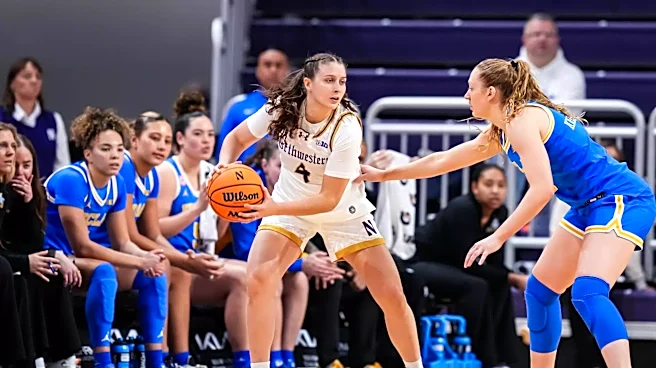






As one of three transfers for Northwestern’s 2025-26 season, Tate Lash was arguably the most prolific player among the newcomers. Lash brought a scoring pedigree to the team after averaging 11.4 points during her four years at Furman before playing her final year at Northwestern.
Despite some initial struggles adapting to the high major level, as Lash searched for her shooting rhythm early in the season, the ‘Cats’ former coach Joe McKeown kept his trust and started her. Weeks later, she figured out
her position as a third or fourth scoring option, putting up several double-digit performances. While Caroline Lau dove deeper into orchestrating the offense and pushing the tempo, Lash provided scoring out of the backcourt.
However, Lash’s stats in the final year of her collegiate career, 4.4 points and 2.1 rebounds per game, may seem disappointing. As Lash continued adjusting her game to match the Big Ten level, everything fell apart after McKeown sent her back to the bench following the first 14 games of the season.
Early Season Promise
For the first half of the season, Lash was one of Northwestern’s main scoring threats — something the Wildcats desperately lacked — and one of the factors that helped the team get off to an early 6-0 start in the non-conference schedule. Lash’s above-average height for a guard, combined with her physicality, enabled her aggressive drives to the hoop.
Her season-high 12 points came when the team traveled to Fort Myers, Fla., for the Elevance Health Fort Myers Tip-Off last November. Lash helped the Wildcats past Abilene Christian in a thrilling 62-59 victory. Alongside Casey Harter, Lash provided necessary support behind leading scorer Grace Sullivan for the win.
Despite her shooting slump, Lash remained a steadying hand in the backcourt. Her value early in the season was rooted in veteran experience and distributive IQ. She eventually recorded her 500th career assist in a home victory over Rutgers on Jan. 11, a milestone that underscored the paradox of her season: while Lash struggled to find her scoring touch at the Big Ten level, her ability to see the floor remained intact.
She finished the year averaging 2.1 assists per game, often acting as a secondary floor general when Lau faced pressure. Her near-double-double game (10 points, eight assists) against Missouri in November highlighted the versatility Coach McKeown likely envisioned when he dipped into the transfer portal.
The Second-Half Collapse
As a regular starter playing significant minutes, Lash helped shoulder the offensive load early. However, her presence significantly diminished in the second half of the season. After Northwestern lost at Washington on Dec. 29, Lash lost her starting role. Four games saw her play single-digit minutes and she recorded seven scoreless performances — a stark contrast to her four years at Furman, where double-digit scoring came regularly as a three-time All-Southern Conference team member.
The downfall might be attributed to her scoring inconsistency, which epitomizes Lash’s struggle in transitioning from the Southern Conference to one of the most physical leagues in the country. She found herself struggling to find a reliable release point against more athletic closeouts from the opposition, resulting in a disappointing 15.9% shooting clip from three-point range — just 7-of-44 on the year.
Lash’s inability to stretch the floor allowed defenses to sag off her, clogging driving lanes and bogging down the Wildcats’ offense when she couldn’t pull the trigger from deep.
The Bottom Line
Unfortunately, Lash’s season serves as a cautionary sign for newly appointed head coach Carla Berube as she dives into the transfer portal for targets. While Lash provided essential veteran leadership and helped the team navigate a respectable non-conference slate, she was never able to bridge the gap between being a high-volume mid-major star and a sustainable Power Five contributor. The physical demands, defensive intensity and perimeter shooting requirements of the Big Ten proved too steep a learning curve for Lash to overcome in one season. Her struggles highlight the importance of identifying not just talented transfers, but players whose skills translate seamlessly to elite conference play.