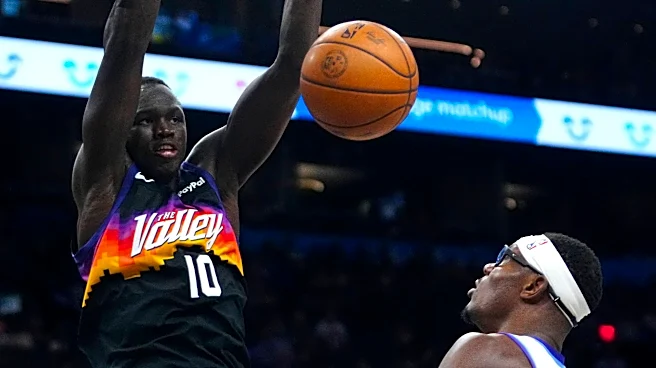

There’s a moment in every young player’s development where the conversation changes. It doesn’t happen because of one highlight or one box score. It happens when enough people, watching from enough angles, begin to agree on the same thing. John Voita’s piece on Bright Side captured that moment for Khaman Maluach, and it did so with a clarity that Suns fans have been waiting for.
The emotional thesis is simple. We’ve stopped asking if he’ll be good. We’ve started asking how much responsibility he should
get.
That shift matters. It’s the kind of shift that pulls a player out of the developmental shadows and into the center of roster conversations. And after Maluach’s four‑game stretch in Las Vegas — 19.5 points, 12.8 rebounds, eight blocks, eight made threes, and a 40% mark from deep — the question isn’t whether he’s ready for more.
It’s whether the Suns can afford to wait.
The praise wasn’t local. It was national.
Voita’s article didn’t just recap the numbers. It cataloged the chorus of voices around the league. CBS Sports called him “one of the best sophomores at the event.” Bleacher Report placed him on their First Team and highlighted the identical number of blocks and threes — a rare statistical symmetry that speaks to a two‑way profile few centers can claim.
This is the kind of praise that accelerates timelines. This is the kind of praise that forces conversations.
And it’s the kind of praise that makes tomorrow morning’s coffee chat a little louder than usual.
What does this mean for Phoenix?
Let’s be careful here. Careful to remind ourselves of the obvious: that Summer League roles don’t mirror regular‑season responsibilities. That’s true. But it’s also true that some performances demand reconsideration. Some players show enough growth that the old plan no longer fits the new reality.
Maluach didn’t just look improved. He looked structurally impactful. He looked like a player who changes what your offense can be.
And that brings us to the lineup question.
The 5‑out possibility Phoenix has never truly had
For years, the Suns have flirted with spacing but never fully committed to a true five‑out identity. They’ve had shooting. They’ve had skill. They’ve had guards who can bend defenses. What they haven’t had is a center who can both protect the rim and stretch the floor with real credibility.
Maluach’s emergence changes that.
A lineup of:
- Khaman Maluach
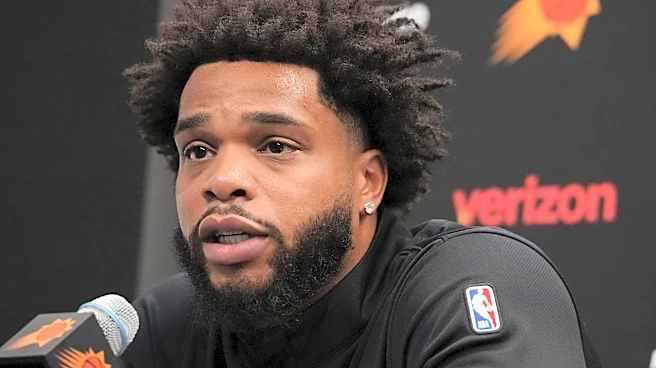
- Miles Bridges
- Dillon Brooks
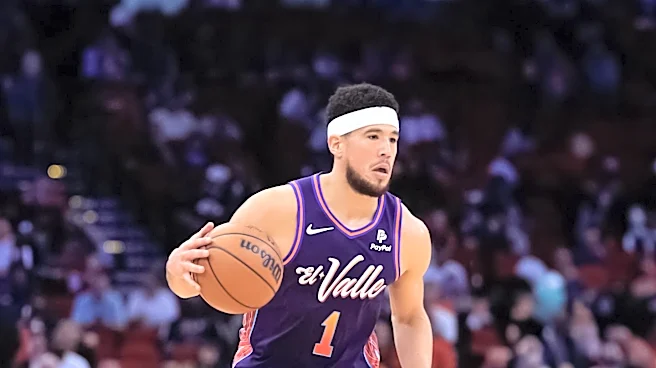
- Devin Booker
- Jalen Green (or Collin Gillespie as the connective wildcard? Green as 6th man is a completely different conversation)
This finally gives Phoenix a version of spacing that doesn’t compromise size or defense. Booker gets cleaner driving lanes. Bridges gets more second‑side opportunities. Brooks gets matchups he can bully. Green gets a runway. And Maluach becomes the hinge, the piece that allows the offense to breathe without sacrificing the back line.
This isn’t theoretical. It’s built on the numbers we just watched.
The 40% from three: what it really means
Summer League shooting can be noisy, but Maluach’s 40% wasn’t a fluke. It came on eight makes across four games, with attempts integrated into the offense rather than thrown up in desperation. Trail threes. Pick‑and‑pop looks. Spot‑ups created by ball movement.
The volume matters. The comfort matters. The repeatability matters.
If you extrapolate that into a regular‑season role — even a modest one — the implications are significant. A center taking three or four threes per game at a league‑average clip forces opposing bigs to defend in space. It pulls rim protectors out of the paint. It opens up the floor’s geometry in ways Phoenix hasn’t had access to.
And if he maintains anything close to the confidence he showed in Vegas, the Suns suddenly have a center who can anchor both ends of the court while stretching defenses thin.
That’s not a developmental luxury. That’s a rotation‑shaping skill.
So has his Summer League success forced the starting conversation?
Yes. Because the conversation isn’t about hype anymore. It’s about structure.
Voita’s piece captured the emotional turning point — the moment the fanbase collectively realized that Maluach’s growth isn’t just encouraging, it’s actionable. The Suns don’t need to rush him, but they also can’t ignore what he just proved. The team’s best version of itself might already be sitting on the bench, waiting for the door to open.
And if Phoenix wants to explore a true five‑out identity, if they want to maximize Booker’s prime, if they want to build a lineup that can defend, run, and space all at once, then the question isn’t whether Maluach should start.
The question is how soon the Suns decide to try it.
QUESTION FOR READERS:
Does Maluach start now?