

This is a guest post from Tanner Castora, who was at the UTEP/Michigan game this weekend.
There had never been a more important moment in the school’s history. In fact, the occasion was so grand, Disney turned it into a movie (Glory Road). In 1966, using the first all-black starting lineup in NCAA basketball history, Texas Western won the National Championship, defeating Kentucky 72-65.
A year later, Texas Western changed its name to the University of Texas at El Paso (UTEP).
And on Saturday, though
no championship was at stake, with a victory, the UTEP football program had a chance to lift the school into the national headlines once again.
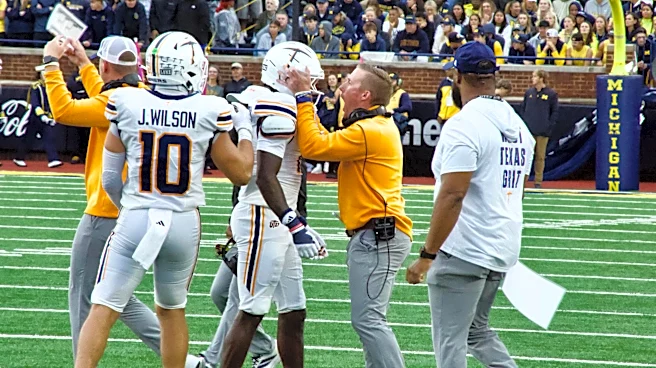
The Miners traveled to Ann Arbor to take on the winningest program in college football history: the Michigan Wolverines.
I was there in Ann Arbor, and after watching the Miners and talking with several people throughout the day, here are five things I learned about UTEP.

ONE — UTEP’s Record Payday
As I rounded towards the buffet line in the Michigan Press box, a man wearing a UTEP polo came walking my way. It was Mark Gisbertz, the Miners Associate AD, who soon introduced me to Jim Senter — the UTEP Vice President and Athletic Director.
I spoke with Jim and Mark for a good 25 minutes. It was fascinating to hear about their everyday obligations and the current world of college football from their perspective.
More than anything, I was curious to learn how they struck a 1.9 million dollar payday to play this game. Did they have some kind of prior connection with the Michigan athletic department?
The answer was no.
A few years back, Senter was basically cold calling AD’s around the country looking for non- conference games. Michigan showed interest. The game was originally supposed to be played in 2024 for a few hundred thousand dollars less. Things came up, and when the game was pushed back to 2026, Senter asked for more. His request was granted.
And so this past Saturday, UTEP’s 1.9 million payout was the highest of any school in 2026 (tied with Ohio State paying Kent State 1.9 million).
Also of note, Senter was a football coach at Idaho in the 80s/90s where he coached the D-line, linebackers and safeties. I get a strong sense UTEP is in good hands under his leadership.

TWO — Pro Bowl RB started in El Paso
Surely many of you reading this article mulled over who to select in your fantasy football draft just weeks ago. Perhaps one of you is starting Minnesota Vikings running back Aaron Jones.
If so, your team features a former UTEP Miner.
After attending Burges High School in El Paso, Jones chose to stay home. Arriving at UTEP as a freshman in 2013, by his senior season in 2016 he’d added 50 pounds of muscle and gotten faster in the process.
He’d go on to become a Pro Bowl back with the Green Bay Packers and is now with the Minnesota Vikings.
THREE – UTEP Quarterback E.J. Colson Can Play
As I strolled into Michigan Stadium, I walked past a fan decked out in UTEP garb. After striking up a conversation, I learned he had traveled all the way from California to be here. His son was a Miner wide receiver.
I asked if he could offer me any intel on the offense, and one thing he made clearer than most was that E.J. Colson JR. was a player.
Watching him live, I would back that sentiment. Sure, his numbers weren’t staggering — 7-of-9 for 86 yards, two touchdowns, and one interception — but the ability was evident.
Under duress most of the second half, he used agility to make defenders miss on many different occasions. He was a big reason why the Miners jumped to a shocking 14-7 lead over Michigan in the first half.
Maybe UTEP will have the funds to keep him in orange and blue for the years to come, but don’t be surprised if he garners some real attention from Power 4 schools this offseason.

FOUR — Fundraising Has Reached All-Time Levels
Perhaps the Miners will be able to afford Colson thanks in part to their Climb Higher campaign, now in its third year of existence.
Led by the Miner Athletic Club, the department has continued to reel in record-high numbers in the past few years.
Why so? Well, according to a handful of people I spoke to inside and outside of the department, they believe it centers around the school’s move from Conference USA to the Mountain West Conference.
Two decades ago, UTEP was a part of the Western Athletic Conference. Now in their first season as a member of the Mountain West, they will be reunited with a few old foes.
People seem to like it when their teams play opponents in their geographical region. Imagine that?

FIVE — History Hasn’t Been Kind
UTEP hasn’t exactly been the most prosperous college football program. Since 1988, they’ve made just 7 bowl games. And in those appearances, they’ve gone 0-7.
Scotty Walden, just 36 years old in his third season as head coach with the Miners, has his work cut out for him.

While Texas is a state packed full of high school talent, El Paso finds itself on the westernmost tip of the Lone Star State, straddling the border of Mexico. It’s actually a quicker drive to San Diego than it is to Houston (both hover around a 10-hour trip).
Location isn’t ideal, and with little history to build off of either, there isn’t a lot Walden and company can hang their hat on.
However, if the Miners play like they did in the first half against the Wolverines (they ultimately lost 52-17 after trailing by just three at halftime) the rest of this season, they may win more games than expected.
Speaking with Walden after the game’s conclusion, you can’t help but admire his enthusiasm. He certainly seems to believe success is possible for UTEP football, and with the momentum around the program’s move to the Mountain West, I’m not sure I’d bet against him.