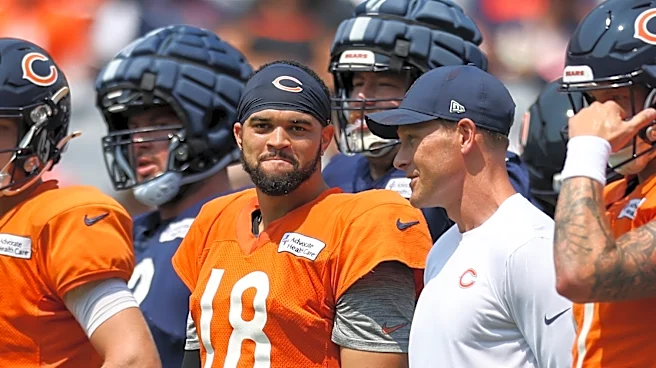




Chicago hopes to be a contender in 2026, and from Ryan Poles to Ben Johnson to Caleb Williams, the voices of the team are clear that the goal is a championship. But how likely is that? How quickly are championship teams built?
General Managers
Ten different general managers have been “responsible” for winning the last sixteen Super Bowls. On average, these general managers needed to have the job for just over five years before they were able to win the big one for the first time, but “average” is a tricky measure
when being applied to something so inherently rare. Likewise, while these GMs averaged only 3 years before their first playoff win on the job, there’s something…a little off about that measure, too. First, here’s a look at the GMs in question and how long it took them to reach certain markers.

So, what stands out with this list is the success of Reese, Belichick, Veach, and Schneider. They had the fastest path to the Super Bowl, and they set the tone for the idea that Ryan Poles should reasonably be able to deliver a championship soon. However, each of those results needs some significant qualification.
Reese (New York Giants): Jerry Reese took over the Giants in 2007 and oversaw the team that won in head coach Tom Coughlin’s fourth year. First-ballot Hall of Pretty Good quarterback Eli Manning was likewise in his fourth year. The team in question was coming off of back-to-back playoff runs, and the position was only open because Ernie Accorsi had retired.
Belichick (New England Patriots): Bill Belichick took over the Patriots after Pete Carroll was fired, and in doing so he also supplanted Bobby Grier. Grier had overseen a 44-36 record as the director of player personnel in a run that included three playoff appearances with two different coaches. Grier did not even leave the team until after the 2000 NFL Draft (when Tom Brady was acquired), and the team had only had one losing season in the prior six years.
Veach (Kansas City Chiefs): Brett Veach joined the Chiefs in 2013 alongside Andy Reid, and while he took over General Manager duties in 2017, that was only after John Dorsey had drafted Patrick Mahomes amid criticism and had overseen four consecutive winning seasons. Hence, Veach took over a team that already had a 43-21 record, the head coach who would win the Super Bowl for him, and the future 3-time MVP of the Super Bowl at quarterback.
Schneider (Seattle Seahawks): John Schneider is a difficult general manager to categorize for multiple reasons, the most important of which is that for the Seahawks’ first run to a Super Bowl, Pete Carroll had authority over personnel. If Carroll is instead considered the general manager for that first Super Bowl run, the question then becomes how to categorize Schneider’s management of the team after Carroll’s departure–is it a new tenure or an extension of the prior one? However credit is assigned, though, the Seahawks went from back-to-back seasons with double-digit losses under Tim Ruskell to an NFL title in just four years.
In other words, of the four executives on this list who managed a team to a title in under five years, only one actually took over a struggling team and turned it around that quickly. Clearly, limiting the discussion to general managers is problematic because the actual trend is that GMs either need more time or a strong foundation to build on in order to get their team to a title.
Franchises
Okay, if the better way of looking at things is by considering the franchise as being built into a winner, how long does it take for a franchise to go from being bad to the best? What about terrible to best? How often do bad teams really get turned into champions? Obviously this answer is complicated by the fact that in 2011 the fundamental way the draft fed into team building was permanently changed and also because free agency did not exist in a modern sense prior to 1993. However, for now, it’s simplest to simply look at two groups–the last ten Super Bowl champions and the last twenty Super Bowl champions.
The last ten teams to win the Super Bowl had an average winning record of 63% in the five seasons prior to their championship run (mean and median both, conveniently). The last twenty teams see the number drop a little, but not much (to 61%, still both mean and median). In other words, the typical Super Bowl champion of the modern era stacks multiple seasons with double digit wins before they achieve a title. Only five of the twenty championship runs were preceded by average five-season records below .500. Simply put, teams typically need to be stable contenders before they break through.

If a team is actually bad when it has back-to-back losing seasons, over the last twenty years the average length of time it takes a franchise to go from bad to best is 12.5 seasons, but that number is skewed heavily by the Denver Broncos winning a Super Bowl in 2016 but not having back-to-back losing seasons since 1972. In this case, the median of 10 seasons is probably more accurate. Narrowed to the last ten years, though, the average is that it takes 11.4 (mean) or 11.5 (median) seasons to go from confirmed losers to the best in the league. Only four teams went from bad to best in under five years (two in the last decade and two in the decade prior).
What about really bad teams? What about teams that go from back-to-back seasons with double-digit losses to titles? Then it takes even longer. Over the last 20 years, the average in these cases is 16 years (median 15 years), but that number comes with an asterisk. That’s because the Ravens never had double-digit losing seasons and two other teams, the Broncos (1972) and the Steelers (1970) suffered seasons with comparable losing percentages so long ago that there were only 14 games in the season. Interestingly, those same averages apply over the last 10 years as well, though, when none of those asterisks apply. Only three teams in the last 20 years were less than seven seasons removed from bottoming out as represented by back-to-back 10-plus-loss seasons.
Summary
If the Chicago Bears were to win a championship in 2026, they would match the fastest turnaround in the last 20 years, wherein the Tampa Bay Buccaneers won a Super Bowl after having only 32 wins in the prior five seasons (the same as Chicago) and only two seasons removed from back-to-back 10-loss seasons (also the same as Chicago). In general, though, the “bottom” the team struck in 2017 would normally suggest that the team would not have been vying for a Super Bowl until 2024 or 2028. However, the team then added four consecutive seasons with at least ten losses under two separate GMs. With very few exceptions, precedent suggests that the team needs to be more focused on building a sustained winner to earn the chance at a title. Of course, it’s even more unlikely that either Ben Johnson or Caleb Williams will be content with anything short of making history.