
The Seattle Seahawks are in the midst of some of the most intense periods of two of their most heated division rivalries. On Saturday, the Seahawks downed the San Francisco 49ers 41-6 in the Divisional Round, set to face the Los Angeles Rams in the NFC Championship Game. Seattle split the regular season series against both San Francisco and Los Angeles, making for two exciting heavyweight tilts in this year’s postseason.
That’s not the only thing on the line against the Rams on Sunday, though—this
is the biggest Seahawks game since 2014, being the first time the team has reached the NFC title game in the 11 years since then. In other words, the outcome of Sunday’s game will decide if Seattle will reach the Super Bowl for the fourth time.
In an effort to better understand the impact behind the Seahawks’ impending playoff bout, now is as good a time as any to look back on the franchise’s postseason history against division foes. Without further ado, let’s hop into the DeLorean and flash back to the good, the bad, and the ugly, beginning with 1983.
1983 AFC Wild Card: Seahawks 31, Broncos 7

Appropriately enough, Seattle’s very first playoff game was against a division opponent. Long before the Seahawks demolished the Denver Broncos in Super Bowl 48, they had their way with Denver 30 years earlier on wild card weekend.
Heading into the ‘83 season, Seattle had finished above .500 just twice under inaugural head coach Jack Patera, with no postseason appearances to show for it. In an effort to turn things around, the Seahawks fired Patera following an 0-2 start in 1982, eventually hiring former Rams and Bills head coach Chuck Knox in the ensuing off-season.
Though Knox had never advanced to the Super Bowl, he was still successful with his first two teams, reaching the playoffs seven times with Los Angeles and Buffalo between 1973 and 1981. With talented players like wide receiver Steve Largent, safety Kenny Easley, and rookie running back Curt Warner, the building blocks were in place for the team’s first trip to the postseason.
Meanwhile, the Broncos were similarly hungry for some playoff action with third-year head coach Dan Reeves and rookie quarterback John Elway. Since reaching Super Bowl 12 in the 1977 campaign, Denver had failed to advance in the playoffs every single year through a combination of early exits and losing seasons.
In addition to Elway, the Broncos also had some stars on defense, namely former Defensive Player of the Year linebacker Randy Gradishar and two-time All-Pro cornerback Louis Wright, both of whom played vital roles on that ‘77 Super Bowl team.
Both Seattle and Denver finished 9-7 in 1983, although the Seahawks had a superior division record (5-3 vs. 3-5), granting them the AFC’s fourth seed and the right to host the wild-card playoff at the Kingdome. Dave Krieg, who had started in each of Seattle’s last eight regular season games, was penned as the Seahawks’ starting QB. Steve DeBerg started under center for the Broncos, despite having sustained a separated shoulder that took him out of action earlier in the year.
Seattle never trailed in this one, with Krieg throwing a 14-yard touchdown pass to Largent on the opening drive. After punting back and forth, Denver tied it up with a 13-yard TD pass to Jesse Myles, which would tie the score at 7-7. Through the first quarter, this game did not necessarily have the makings of a blowout.
Upon some more exchanges of punts, the Seahawks pulled ahead in the second quarter with a 37-year field goal by Norm Johnson. Seattle would never relinquish this lead, scoring three more touchdowns by the end of the game.
However, this is not to say that the Broncos lacked scoring chances. Running back Gerald Willhite had a costly fumble in the second quarter, with Denver getting as close as the Seahawks’ four-yard line just prior. Instead of pulling ahead 14-10 or tying the game at 10-10, the Broncos passed up a chance to gain some points and remained behind at halftime.
Thanks in part due to Willhite’s fumble and a pair of interceptions by DeBerg and Elway, Seattle was able to widen its lead without much pushback, with Krieg throwing for two touchdowns and David Hughes rushing for another. With the win, the Seahawks had secured a spot in the Divisional Round.
1983 AFC Championship: Raiders 30, Seahawks 14

If the NFL did not prohibit teams from the same division from meeting in the Divisional Round prior to 1990, this game would have taken place earlier than the conference title match. Instead, the Seahawks traveled to Miami and upset a No. 2-seeded Dolphins squad led by a rookie Dan Marino, while the then-Los Angeles Raiders clobbered the Pittsburgh Steelers in the final postseason chapter of a classic AFC rivalry.
Sitting at 12-4, the Raiders were the AFC’s top seed in 1983, featuring a cast of future Hall of Famers like Cliff Branch, Marcus Allen, Howie Long, and Mike Haynes. Entering year two in the City of Angels, the team was eager to avenge its early playoff exit from the year prior.
In the strike-shortened 1982 season, Los Angeles finished 8-1 and was favored to represent the AFC in Super Bowl 17. Be that as it may, an upset by the New York Jets in the second round of the expanded postseason knocked out the Silver and Black earlier than expected. Even so, the Raiders were still on top of the conference in ‘83, just three years removed from their last Super Bowl championship.
At the illustrious Los Angeles Memorial Coliseum, Seattle aimed to complete a season sweep, having beaten L.A. in both of the teams’ regular season contests that year. After all, the Seahawks had just beaten the defending AFC champs to get to this point. Upsets are always on the table, nothing is out of the realm of possibility.
…just not today.
On the opening drive, Dave Krieg threw an interception at the Raiders’ 30-yard line, which was returned 44 yards to the Seattle 26. Los Angeles got within three yards of the goal line, being limited to just a field goal. This could have been worse, but it was still not ideal.
Neither side could get on the board again until the second quarter, when Raiders running back Frank Hawkins punched it in for a goal-line touchdown. The Seahawks were unable to get anything going, being shut out 20-0 at halftime thanks in part due to another interception by Krieg.
Following Krieg’s third INT of the day, Chuck Knox replaced the 25-year-old QB with veteran Jim Zorn in the third quarter. Zorn promptly threw an interception of his own, setting up yet another scoring drive for Los Angeles. Seattle’s deficit widened to 27-0 thanks to a 43-yard rush by Allen, who got the Raiders to the Seahawks’ three-yard line before catching a touchdown pass from Jim Plunkett immediately afterwards.
Seattle cut L.A.’s lead to 20 with a TD in the third quarter, attempting to claw back from a multi-score deficit. That being said, the team’s efforts would prove to be futile, as the offense could not hold up its end of the bargain. Bruce Scholtz’s interception gave the Seahawks another chance, which was then squandered by a holding penalty that brought Seattle back to the Raiders’ 37. A prime opportunity had been wasted, and the Seahawks were running out of time.
Seattle got a touchdown in garbage time to pull within 16, which was more of a morale boost than anything else. After clinching the AFC title, Los Angeles went on to destroy the team now known as the Washington Commanders 38-9 in Super Bowl XVIII, with Allen winning Super Bowl MVP honors.
In spite of the end result, the Seahawks put up a strong fight in the 1983 postseason, advancing all the way to the conference title game in just their first playoff appearance. Knox’s squad would be back soon, with a chance for redemption on the horizon.
1984 AFC Wild Card: Seahawks 13, Raiders 7

The ‘84 campaign was a bit of a role reversal for much the AFC West, with Denver claiming the division crown this time around. Seattle won eight consecutive games from Weeks 7 to 14, leading to a 12-4 finish during the regular season.
Conversely, L.A. lost three in a row between October and November, including a 17-14 loss to the Seahawks at the Kingdome in Week 12. The Raiders went on to finish 11-5, but it would not be enough to climb beyond third place in the division.
Seattle hosted Los Angeles at the Kingdome for wild card weekend, hoping for some payback after last year’s AFC Championship defeat. A win would grant the Seahawks the honor of eliminating the defending champions, in addition to their second consecutive playoff triumph at home.
The first quarter proved to be a stalemate, as neither squad came closer than the opposing 36-yard line. Following L.A. punter Ray Guy’s third punt of the day, Seattle drew first blood with Dave Krieg’s 26-yard touchdown pass to Daryl Turner. The Seahawks’ defense continued to keep Guy busy for the rest of the second quarter, pinning the Raiders as far back as their own 13-yard line at one point.
Seattle managed just three points in the third quarter, with Norm Johnson knocking the ball through the uprights from 35 yards out. Johnson then converted on a 44-yard try in the fourth, giving the Seahawks a 13-0 lead with just under 11 minutes to play.
Los Angeles gave its punter a break with a 46-yard touchdown pass later in the quarter, pulling within six points as the game approached the last five minutes of regulation. In spite of this, Seattle ate up much of the remaining time to leave just under a minute on the clock before punting it back to the Raiders’ six-yard line.
L.A. went as far as its own 15 before going back to the 10 following an illegal motion penalty. Jim Plunkett’s final pass of the game was intercepted by Kenny Easley, sealing the victory for the Seahawks. On to Miami for another date with Dan Marino and the Dolphins.
Unfortunately for Seattle, this version of Marino went on to be named league MVP, redeeming his team’s failure from the previous year with a 31-10 blowout at the Orange Bowl. Nevertheless, the Seahawks had successfully knocked the Raiders from their perch, putting an end to their rivals’ title defense.
2004 NFC Wild Card: Rams 27, Seahawks 20

Around the turn of the millennium, Seattle was starting fresh with a new head coach and a new stadium. Former Super Bowl champion head coach Mike Holmgren went to the Emerald City in 1999, with the then-named Seahawks Stadium opening three years later in 2002.
That same year, the Seahawks moved back to the NFC during a league-wide realignment, leaving the AFC behind after 25 years. This put Seattle into a division with the San Francisco 49ers, the Arizona Cardinals, and the then-St. Louis Rams. Despite finishing 7-9 in 2002, the Rams were among the best in the NFC West, having played in the Super Bowl twice over the last three years.
The Seahawks first challenged St. Louis for the division crown in 2003, with both teams sitting at 7-3 through Week 11. However, Seattle went 3-3 over the final six games of the season, which included a 27-22 loss to the Rams at the Edward Jones Dome in Week 15. St. Louis went 5-1 over its last six games to clinch the division title at 12-4.
A wild-card elimination by Holmgren’s old squad in Green Bay prevented a playoff meeting with the Rams in ‘03, but 2004 would bring about new opportunities. The Seahawks went 9-7 in ‘04, but it was still enough to capture the NFC West title anyhow. Seattle finished one game ahead of St. Louis, who was able to sneak into the postseason at 8-8 despite going 4-6 to end the year.
Even though the Seahawks had taken first in the division, they had dropped both of their regular season contests against the Rams, including a collapse at home in Week 5. A wild-card victory would save Seattle the embarrassment of losing three games against St. Louis that season, in addition to ending a 20-year playoff win drought stretching back to 1984.
Led by third-year quarterback Marc Bulger, the Rams jumped out to a 14-3 lead early in the second quarter. Seattle responded with 10 points on the game’s next two scoring drives to pull within one, highlighted by Matt Hasselbeck’s 19-yard touchdown pass to Bobby Engram.
St. Louis countered with a 38-yard field goal on the next possession, keeping the game a one-score battle. The Seahawks punched back with a 23-yard TD pass to Darrell Jackson, finally taking the lead after playing from behind for much of the game.
The Rams would tie things up with another field goal, giving the ball back to the home team with a little over eight minutes remaining in the fourth quarter. Unfortunately, Seattle’s next drive stalled out just behind midfield, failing to obtain much ground after a 22-yard gain by tight end Itula Mili.
St. Louis got the ball back inside the six-minute mark, eating up the clock on a series of rushes by former MVP running back Marshall Faulk. Between Faulk’s efforts and two long gains through the air, the Rams reached the red zone just ahead of the two-minute warning. Bulger completed the drive with a 17-yard pass to Cam Cleeland, forcing the Seahawks into a one-score deficit entering what was likely to be the last possession of regulation.
Seattle got into position to at least tie the game, with Mili, Jackson, and Engram each making catches of at least 12 yards late in the fourth quarter. This set up fourth and four at the St. Louis five-yard line, a do-or-die moment in the closing minutes of regulation. Unfortunately, the latter outcome occurred, as Hasselbeck’s final pass attempt to Engram was ruled incomplete.
The Seahawks’ postseason win drought continued for one more year, ultimately being vanquished against Washington in the 2005 Divisional Round. As for the Rams, they wound up on the receiving end of a 47-17 thrashing against the No. 2-seeded Atlanta Falcons in the ‘04 Divisional Round, banished from the postseason party for 13 years.
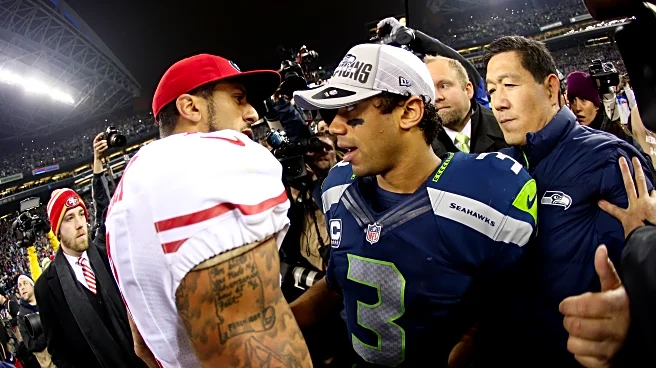
2013 NFC Championship: Seahawks 23, 49ers 17

Following some middling periods for both teams in the mid-late 2000s, the Seahawks and 49ers sat atop their division in the early 2010s. Tensions began to rise significantly in 2012, with Seattle (11-5) finishing a half-game behind San Francisco (11-4-1) for the NFC’s second playoff seed. The Seahawks were narrowly eliminated by the Falcons in that season’s Divisional Round, delaying the inevitable postseason meeting with the Niners for one more year.
As the calendar turned to 2013, the rivalry between these two teams—and their respective head coaches—continued to fester. Though Seattle finished 13-3 and led the division for much of the year, San Francisco was not far behind, ending the regular season at 12-4. This proved to be the difference in deciding the conference’s top playoff seed, assuring that any postseason encounters would take place at the then-named CenturyLink Field.
Seahawks head coach Pete Carroll helped to assemble the Legion of Boom, a suffocating defense headlined by stars like cornerback Richard Sherman and safeties Kam Chancellor and Earl Thomas III. On the other side of the ball, second-year quarterback Russell Wilson had a solid year, passing for over 3,300 yards en route to his second Pro Bowl selection.
Meanwhile, 49ers head coach Jim Harbaugh pulled his team out from the NFC West basement, a place that had become quite familiar to San Francisco prior to Harbaugh’s arrival. The Niners were struggling to find success with former No. 1 overall pick Alex Smith, despite also boasting the talents of running back Frank Gore and tight end Vernon Davis. In 2012, Harbaugh made a change under center, replacing Smith with Colin Kaepernick, who helped to lead the team to a berth in Super Bowl 47 at season’s end.
The 2013 playoffs would serve as the battleground for one of the league’s hottest rivalries at the time. San Francisco outdueled the Green Bay Packers on wild card weekend, eventually going on to upend the second-seeded Carolina Panthers in the Divisional Round. That same weekend, Seattle made quick work of the New Orleans Saints, leading by as many as 16 points in a 23-15 triumph. This set the stage for a long-awaited clash in the NFC title match—the conference’s top seed against the defending Super Bowl runners-up.
An early fumble by Wilson led to trouble for the Seahawks, although they were able to limit the 49ers to a field goal on the ensuing possession. Following three consecutive punts, San Francisco upped its lead to 10-0, buoyed by a 58-yard rush from Kaepernick. Seattle recovered some points on the next possession, with kicker Steven Hauschka converting on a 32-yard field goal try.
The Seahawks tied the score at 10-10 on their first drive of the second half, with Marshawn Lynch rushing for a 40-yard touchdown. In spite of Kaepernick’s fumble, the Niners were able to take back the lead shortly thereafter, with Anquan Boldin hauling in a 26-yard TD.
Nevertheless, the Legion of Boom held San Francisco’s offense in check the rest of the way, while Wilson and Co. got Seattle back in front with a touchdown and a field goal in the fourth quarter. Up 23-17, the Seahawks needed one final stop to lock down the conference championship.
Kaepernick went on a mission on the 49ers’ final drive, completing five passes for 56 yards and rushing for another four. Be that as it may, his final pass was tipped by Sherman and intercepted by Malcolm Smith, preserving Seattle’s victory.
You all know the rest—the Seahawks demolished the Denver Broncos 43-8 at MetLife Stadium in Super Bowl 48 for the franchise’s first championship. San Francisco would fail to return to the playoffs in 2014, with Harbaugh being fired at the end of the year.
2020 NFC Wild Card: Rams 30, Seahawks 20

Seattle remained in the playoff picture for much of the seven years following the 2013 championship run, missing the postseason just once in that time. That being said, the Seahawks had not made it beyond the Divisional Round since their title defense run in 2014, winning just three playoff games between 2015 and 2019.
As this was happening, the Rams—who had since moved back to Los Angeles by this point—had experienced a resurgence under head coach Sean McVay. Since McVay’s hiring in 2017, L.A. had shot to the top of the NFC West, winning back-to-back division titles in 2017 and 2018, qualifying for Super Bowl 53 in the latter season. During this time, the organization featured the talents of former Defensive Player of the Year Aaron Donald, as well as All-Pro cornerback Jalen Ramsey, just to name a few.
Much like the early 2000s, the 2020 season would give way to a tight division race, with the Rams sitting just one game behind Seattle at 4-1 despite the Seahawks’ 5-0 start to the year. After Seattle dropped two out of three coming out of its bye week, Los Angeles tied the Seahawks for first place with a head-to-head victory at the brand-new SoFi Stadium. The two remained tied through the following week as well, with both teams entering Week 12 at 7-3.
The rivals continued shuffling in the standings over the next few games, with Seattle pulling ahead for good by winning each of its last four games, including a revenge match against the Rams at Lumen Field in Week 16. On top of this loss, L.A. also dropped a stinker against the lowly New York Jets, who were 0-13 prior to beating the Rams.
With the Seahawks at No. 3 and Los Angeles securing the sixth seed, the second playoff chapter of a burgeoning rivalry was about to be written. This would be the teams’ first playoff meeting in 16 years, which also happened to be the last time Seattle lost at home in the postseason. Unlike that matchup, however, this game would not be played in front of fans due to restrictions imposed by the COVID-19 pandemic.
Lacking the support of the 12s, the Seahawks fell behind 13-3 as Rams cornerback Darious Williams picked off Russell Wilson for a 42-yard touchdown. Wilson threw a long TD pass to DK Metcalf on the next possession, but Jared Goff got one back for L.A. immediately afterwards.
Despite losing quarterback John Wolford to a neck injury early on, Los Angeles led for much of the first half, going into halftime with a 20-10 lead. Seattle kicker Jason Myers cut the deficit to seven with a 52-yard field goal to start the second half, which would prove to be the only points scored in the third quarter.
Six possessions later, the Rams’ 10-point lead was restored as kicker Matt Gay delivered on his third field goal attempt of the day. The Seahawks were unable to respond on the ensuing drive, falling behind by 17 after L.A. scored yet another touchdown near the end of the fourth quarter.
Seattle managed to get into the end zone once more, but could not climb out of a 10-point hole as the Rams prevailed, 30-20. This would be Wilson’s final playoff game with the Seahawks, as the team failed to make it back in 2021 before trading the veteran QB to Denver in the 2022 off-season.
2022 NFC Wild Card: 49ers 41, Seahawks 23

In the aftermath of the Russell Wilson trade, the Seahawks got the better end of the deal in the short term, qualifying for the postseason in Geno Smith’s first year in Seattle. It would be an uphill battle, though, as the NFC West was actively being dominated by the likes of the 49ers and Rams.
San Francisco had returned to contention under head coach Kyle Shanahan, who guided the team to the conference title game twice in three years between 2019 and 2021. In 2022, Shanahan—much like Jim Harbaugh a decade prior—made a switch at the quarterback position, going from Jimmy Garoppolo to Brock Purdy.
With Los Angeles hampered by injuries early on, the 49ers served as the Seahawks’ main roadblock in the division race. Seattle nearly matched its win total from 2021 in just 10 games, being tied with San Francisco atop the NFC West at 6-4.
In spite of the early closeness, these two foes ended the year on divergent paths—the Seahawks stumbled to a 9-8 record, barely clinching a playoff spot after going 3-4 down the stretch. The Niners, on the other hand, went 7-0 the rest of the way, cruising to a 13-4 record and the conference’s No. 2 seed.
Going into Levi’s Stadium for the wild-card round, Seattle was in for quite the ride. Not only did San Francisco win the division by four games after being tied with the Seahawks through the first 10, it also swept the regular season series against Seattle.
After falling behind 10-0 in the first quarter, the Seahawks found life in the second on a Kenneth Walker III touchdown. Legion of Boom veteran Bruce Irvin sacked Purdy for eight yards on the following possession, which helped to limit the 49ers to a field goal.
Seattle responded with a 50-yard TD pass to Metcalf, leading by one after Jason Myers’s successful PAT attempt. The first half ended with the teams trading field goals, resulting in the Seahawks leading 17-16 at halftime.
San Francisco opened the second half with a drive that lasted for over 50 percent of the third quarter, leading 23-17 on a 1-yard touchdown run by Purdy. Seattle’s next possession started out similarly, coming to an abrupt end after Smith fumbled at the Niners’ 19-yard line. Nick Bosa recovered the fumble for San Francisco, setting up another scoring drive that saw the 49ers take a 14-point lead upon a successful two-point try.
Things continued to unravel for the Seahawks, who were down by 24 points before Metcalf caught another TD in garbage time. San Francisco won by a final score of 41-23, wresting the momentum away from Seattle after Smith’s fumble late in the third quarter.
Despite the lopsided final score, this game was pretty close until everything fell apart for the Seahawks in the fourth quarter. Even so, this was an ugly loss, especially against the Niners of all teams. This would be the final postseason game of Pete Carroll’s 14-year tenure as Seattle’s head coach, as the Seahawks missed the playoffs in 2023.
2025 NFC Divisional: Seahawks 41, 49ers 6

Over the three years since that brutal playoff loss vs. San Francisco, Seattle had evolved into a juggernaut on the field. After one more year with Geno Smith in 2024, the Seahawks traded Smith to the Las Vegas Raiders, where he was reunited with his former head coach in Pete Carroll.
Carroll’s successor, Mike Macdonald, had been busy building a dynamic group on defense—the Dark Side. Seattle’s vaunted defense featured the talents of linebackers DeMarcus Lawrence and Ernest Jones IV, as well as defensive end Leonard Williams, who helped to limit opposing offenses to a league-low 17.2 points per game. The Seahawks were pretty good on offense as well, boasting an improved Sam Darnold at QB and a little-known player named Jaxon Smith-Njigba, who may or may not have led the NFL in receiving yards.
Following a four-point loss to the 49ers at home in Week 1, Seattle went on a tear, going 14-2 over the remainder of the regular season. This included a 13-3 defeat of San Francisco at Levi’s Stadium in the NFC West title game, a game in which Brock Purdy was limited to just 127 yards passing and an interception.
The Niners were battling injuries for the entire season, with George Kittle, Nick Bosa, and Fred Warner all spending time on injured reserve, among others. Nevertheless, Kyle Shanahan still helped to bring San Francisco back into the playoff fold, getting his team within two games of the division title at season’s end.
The 49ers began the 2025 postseason by dethroning the defending champion Philadelphia Eagles in the wild-card round, winning 23-19 on a Christian McCaffrey touchdown catch late in the fourth quarter. Awaiting San Francisco in the Divisional Round were the Seahawks, who were hungry to avenge their latest playoff defeat from three years earlier.
Seattle rapidly asserted control of the game, with trade deadline acquisition Rashid Shaheed returning the opening kickoff for a 95-yard touchdown. After Niners fullback Kyle Juszczyk fumbled the ball out of bounds, Jason Myers increased the Seahawks’ lead to 10-0.
A few plays later, Seattle was back on offense again, as Julian Love recovered a fumble by San Francisco tight end Jake Tonges. This culminated in Smith-Njigba’s first postseason TD, bumping the Seahawks’ lead to 17. 49ers kicker Eddy Piñeiro would cut the lead to 11 with a pair of field goals, but Seattle did not relent.
Kenneth Walker III ran for a seven-yard touchdown, his first of three on the night. Walker scored nearly all of the Seahawks’ points the rest of the way, with Myers sneaking in another field goal between K9’s first and second rushing TDs. Seattle coasted to a triumphant 41-6 victory, the franchise’s largest margin of victory in a playoff game since Super Bowl XLVIII.
Macdonald’s first playoff win as the Seahawks’ head coach was seismic, sending the team to the NFC Championship for the first time since 2014. Now, he’s on to the franchise’s biggest game in 11 years, with a Super Bowl berth on the line.
Evidently, Seattle is no stranger to facing division rivals in high-stakes postseason battles, having last done so on Saturday. The long, winding road the team has traveled has led to this very moment—chapter three of both the 2025 Seahawks-Rams series and the all-time playoff series between the two. Not all of it has been pretty, but it is a journey that has been worth witnessing.
Now that you know a bit more about Seattle’s postseason history, I ask you: how will the Seahawks fare vs. the Rams on Sunday?