





In a rare feat of quality media content, ESPN’s Matt Miller posted a comprehensive seven-round mock draft for the upcoming NFL Draft. There were no trades in Miller’s mock, which means Houston has eight selections across seven rounds to complement the already robust roster.
Miller selected multiple players from my Texans’ Draft Needs Big Board and chose several players even I was unfamiliar with.
Below are the eight selections; I’ve included Miller’s analysis for the first three rounds plus my thoughts
on the selection and what it means for the Texans.
Round 1, Pick 28: Blake Miller, OT, Clemson
Miller’s breakdown: Signing 30-year-old Braden Smith to a two-year contract solves Houston’s right tackle need for the moment, but the Texans’ plan to build a young (and inexpensive) offensive line around C.J. Stroud is still in place. Miller started 54 college games at right tackle and improved every season, allowing only two sacks in 2025. With 34-inch arms and a strong base to block from, Miller profiles as a solid starter with higher-end potential as he develops his run-blocking talents.
Analysis: Blake Miller is a sound and experienced offensive tackle whose size and quickness unlock his potential at the next level. I completed a Draft Profile on Blake Miller earlier in the process and believe his inconsistency lies in his lack of strength against physical defensive ends. This would be a “reach” for me considering Miller projects as a third-string right tackle on Texans’ depth chart behind Braden Smith and Trent Brown. I also don’t believe Miller has the versatility to play well on the left side.
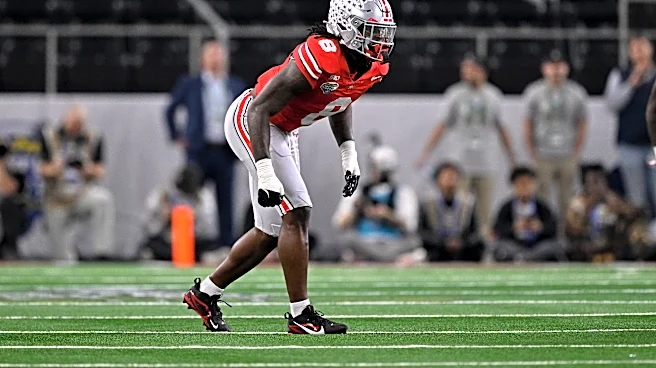
Round 2, Pick 38: Kayden McDonald, DT, Ohio State
Miller’s breakdown: McDonald is an ascending prospect whose best football is ahead of him. He had high-end production from the middle of the line, posting three sacks last season on only 223 passing downs. He would primarily anchor the middle of the line for Houston’s powerful defense, but McDonald has the all-around potential to become an elite 1-technique or nose tackle.
Analysis: If the McDonald and Miller picks were flipped, I would not be surprised come the real NFL Draft. McDonald is quickly rising up the defensive tackle big boards for his elite run-stopping. His immense 326-pound frame paired with his high-end lateral quickness allows him to dominate offensive linemen at the point of attack. He excels in maintaining leverage against combo blocks by sinking his hips and wedging himself in between the shoulders of opposing blockers. While he doesn’t present a high ceiling in the pass rush game, his immediate impact against the run would open up many possibilities on the Texans’ front seven.
Round 2, Pick 59: Emmanuel Pregnon, G, Oregon
Miller’s breakdown: Houston signed 32-year-old Wyatt Teller but can find plenty of long-term guard options in this draft. Pregnon has starter-level strength at 6-foot-4 and 312 pounds and brings an impressive ability to redirect defenders in the run game. He’s among the toughest, most physical players in the class.
Analysis: My eyes lit up when Pregnon fell to the Texans. It was the kind of shock that makes you look up from your phone just in time to realize you’re drifting across three lanes of traffic. According to ESPN Analytics, there’s an extremely limited chance Pregnon is around at 59.

The issue with Pregnon here is that the Texans now have 11 offensive linemen and only carry nine on a 53-man roster. They’d have to release two legitimate options to make room for Pregnon who is ready to start right away. He’s also 25 already, which means he’s a one-contract player for Houston.
That said, he’s an ELITE guard prospect who will be mentioned tomorrow in my seven-round mock draft… stay tuned.
Round 3, Pick 69. Jake Golday, LB, Cincinnati
Miller’s breakdown: There are big decisions coming for the Texans at linebacker, with Henry To’oTo’o and Azeez Al-Shaair in contract seasons. Golday has dream-level size and length at 6-foot-5, 239 pounds with explosive quickness in the downhill run game.
Analysis: A personal favorite from this class, who I once again doubt is available at pick 69.
Golday is a white man’s Arvell Reese. He played as a box Safety at Central Arkansas for two seasons before moving to Cincinnati. Golday also played in the slot, as a pass rusher, and a stand-up linebacker. Golday had an elite PFF grade with only 9% missed tackles and dominated in space when forced to run.
If he comes to Houston, he’ll be a joker in an already stacked deck with his ability to play multiple roles on defense. The intention would be for him to immediately rotate with E.J. Speed at linebacker and evolve into the team’s future starting WILL linebacker.
Round 4, Pick 106: Nicholas Singleton, RB, Penn State
Analysis: Singleton is a “slingshot” running back. He’s a one-speed, straight-ahead, downhill running back. He has four years of production including a 1,000-yard freshman season. His calling card was the 102 receptions out of the backfield, but he plateaued as a runner and pass catcher in a deflated Nittany Lion offense his senior season. The lack of vision, patience, and change of direction severely limit his scheme versatility.
Easily my least favorite pick in the class, Singleton would struggle to find a role outside of third down pass-catching and blocking responsibilities.
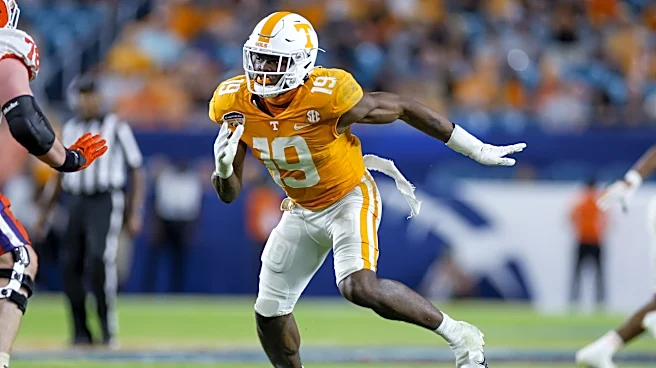
Round 5, Pick 141: Joshua Josephs, Edge, Tennessee
Analysis: By far the most unrealistic pick in the draft, Josephs is a third-round pick at the latest. If he’s able to find his way onto the roster, Houston would slate him as a rotational end for pure pass rush reps. The 6’3 edge is only fourth percentile in weight, which rules him out from early down snaps until he bulks up. Once he adds to his frame, he can develop into a starting defensive end to take over for Danielle Hunter.
Note: I do believe Houston will add a defensive end to develop behind Hunter during the draft, but if it’s going to be Josephs, it’s going to be earlier than this.
Round 5, Pick 167: Robert Spears-Jennings, S, Oklahoma
Analysis: Four-year contributor and two-year starter in Norman, RSJ represents a defensive back utility option who packs a punch at the point of attack. He played in the slot, as a strong safety, and in two-high safety looks across OU’s defense. His athletic profile offers significant potential. He’s 6’2”, 210-pounds with 90th percentile hand size, 92nd percentile wingspan, ran a 4.32 40-yard dash (99th percentile) and a 77th percentile broad jump. He tends to tip-toe into tackles when not confident in his angle, but he’s an immediate special teams ace with the potential to eventually rotate in as a downhill safety.
Round 7, Pick 243: Eric McAlister, WR, TCU
Analysis: McAlister is another traits-based roll of the dice common this late in the draft. Miller most likely selected McAlister to Houston due to the team’s proclivity for big-bodied pass catchers. He’s 6’4, he’s a long-striding WR who sticks to go-routes, curls, and slants. A body-catcher with a severely limited route tree, McAlister struggles to separate and accelerate after turning. He reminds me of a poor man’s DK Metcalf and would fill in as a long-term replacement for Xavier Hutchinson.
OVERALL ANALYSIS:
This would be a stellar haul and while the needle did not move much in the offensive weapons department, the trenches received unprecedented upgrades in both talent and potential. There would be some serious competitions to be had in the offensive line room with all of these new additions, but that cannot be considered a bad thing given the past decade of offensive line woes in Houston. Houston would land five projected starters (Miller, McDonald, Pregnon, Golday, and Josephs) within two years, which is an unquestionable success.