




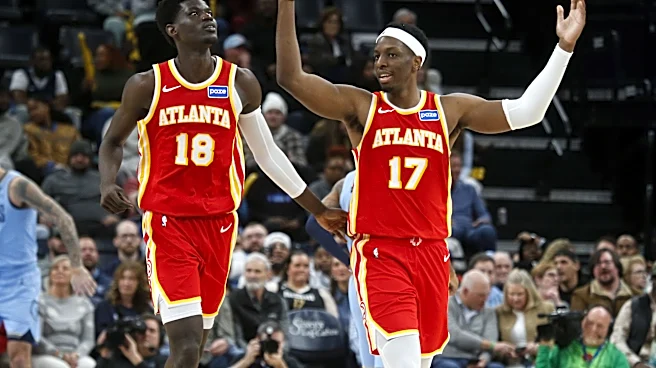

The Hawks faced a crisis just five games into the season. The star point guard — one of the highest usage players in the league — went down with a knee injury that eventually saw him miss the better part of two months of action.
How would they find enough offense to compete down such a central player?
Well, they found a way.
They would never be able to replicate Trae Young’s mastery of the spread pick-and-roll attack. Instead, they innovated with who they had.
Now that the dust has settled, the Hawks
finished 46-36 with the 14th best offensive rating (115.0) despite Young only playing 10 games for the team.
Certainly, it helps to have the rise of a first time All-Star, but in reality, many players have come together in a pass-heavy offense to pick up the slack. This year’s offense has been predicated on constant screening from everyone on the floor, quick decisions with the ball, and spreading the court to its dimensional limits.
As a result, the Hawks have finished with the ninth most assists in a season in NBA history (2,471) as well as the ninth highest assist to field goal ratio in NBA history (.691).
But how have they done managed these records? Let’s take a closer look at some of the defining actions that have powered this offense in a new era of Hawks basketball.
Jalen Johnson leading the break
Who else but the All-Star?
Despite losing Trae Young first to injury and later to trade, the team maintained a breakneck pace for the entire season, finishing fifth in the NBA with 102.5 possessions per 48 minutes.
And at the head of it all is an all-around master of attacking a defense in retreat.
This is one of the best players in transition in the entire NBA, full stop. He finished fifth in the league this year with 283 fastbreak points scored (trailing his teammate Nickeil Alexander-Walker who had 312!).
But he’s equally as good as a threat to score as he is in setting up his teammates for transition looks with his downhill pressure and passing.
After rebounds, he always keeps his eyes up, ready to hit streakers down the court for easy opportunities. Maybe the Atlanta Falcons should give him a call:
But really, when there’s a 6-foot-9 215-pound freight train coming at you, defenders think twice before trying to sacrifice their bodies towards slowing him down:
Johnson is the biggest reason behind the Hawks’ up and down attack. And on a team with multiple decentralized ball handlers, there’s no one player that needs to bring the ball up the court. Pretty much everyone but trailing bigs can grab and go off a make or miss.
It’s incredibly beneficial that Jalen Johnson is one of the league’s best defensive rebounders. He finished third in the league in total defensive rebounds behind just Karl-Anthony Towns and Nikola Jokic and eighth in the league among qualified players in defensive rebounding percentage (the number of defensive rebounds grabbed as a percentage of available defensive rebounds) at 27.8%.
This ability empowers him to grab and go, putting pressure on transition defenses trying to organize themselves. And with his elite passing ability for his position, he can always make the right play to find gaps in the defense.
I mean, just look how easily one pass beats all five Pistons defenders here:
Nickeil Alexander-Walker using pin downs and flare screens
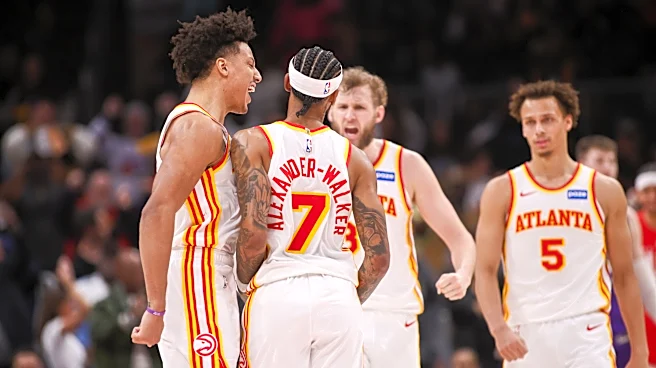
Nickeil Alexander-Walker is likely to win Most Improved Player no matter which popular betting and odds-making sites you look at. His growth as a scorer (essentially doubling his output without sacrificing neither his efficiency nor his hustle on defense) is beyond remarkable.
With his season over, he averaged 20.8 points per game on a 46/40/90 triple slash (field goal percentage, three-point percentage, and free throw percentage respectively). Compare that to his previous season where he averaged 9.4 points per game on a true shooting percentage three points lower than this year (58% versus 61% in 2025-26).
Alexander-Walker hit a franchise record 251 threes, fourth most in the NBA this year, often by virtue of his tireless movement off the ball.
With a screen-the-screener action unfolding on the opposite side of the floor, ‘NAW’ floors it to use an Okongwu pin down screen. This is one of many movement triples to open the scoring in a recent game against the Magic:
And he’s probably most dangerous after he’s touched the ball. Defenders simply can’t nap for even a millisecond.
Here, he uses a Jonathan Kuminga screen and a give and screen from Dyson Daniels to put Keon Ellis in the ringer. This wasn’t a designed play, but it ended up being a flare off of a dribble-handoff, a byproduct of Daniels and Alexander-Walker’s chemistry from having played so many on-court minutes together.
You can guess how this one ended:
Alexander-Walker doesn’t have the best passing vision in the world, but he can create easy reads from his activity and driving aggressiveness. He zooms around another pin down here and draws Jarrett Allen from his corner man Okongwu.
One extra pass springs Zaccharie Risacher for a triple:
But he’s also simply grown as a scorer off drives this year. He finished the year in the top 50 in sheer number of drives, and while he didn’t shoot an amazing percentage on these drives, they still put constant pressure on the defense.
The Hawks have simply needed both the rim pressure and the spacing out to all areas of the three-point line. And Alexander-Walker has been so central towards these aims all season long.
Dyson Daniels screening, dribble-handoffs and short rolls
Dyson Daniels is often maligned as a ‘negative’ offensive player, but that sentiment couldn’t be further from the truth.
Just disregard the three-point shooting percentage, Daniels is absolutely an essential cog in what makes this multi-faceted offense go. For one, per pbpstats, when Daniels is on the floor, the Hawks have a 119 offensive rating. When he’s off the floor, that figure drops to 112 — a swing of +7 points per 100 possessions.
For two, he fills in the gaps for a team that plays an unconventional offensive system. The Hawks’ main center rotation this season (Okongwu, Porzingis, Landale, but even Gueye and Newell at times) are all stretch bigs. That allows Daniels to cut into the paint or hang in the dunker spot as a functional center on offense without mucking up the spacing.
The key to this is his screening. While he’s grown into more of an on-ball player this season — handling the ball and distributing (a career-high 8.4 assists per 100 possessions) — it’s the effort he gives off the ball that unlocks everything.
We all know what a conventional pick-and-roll looks like, right? Guard uses the screen from a big and makes the right decision to shoot, drive, or hit the roller in the case of a defensive blitz.
Daniels and Johnson still linked up plenty this season that way:
But when your ‘big’ is a plus-ball handler for his position and your guard is wing-sized, you can ‘invert’ this action. Here, Johnson and Daniels flow into a pick-and-roll where Johnson hits the short rolling Daniels. They have to improvise from there, but it still results in a bucket:
Or the duo can turn a dribble-handoff into this ‘inverted pick-and-roll’ action with spacing around them that lets Johnson get to his spot:
Screening is often the duty of big men, but Daniels flips this on its head, especially when teams put their centers on him. With the prevalence of switching screen actions around the league, Daniels can often get slow-footed centers switched onto Alexander-Walker or Johnson to force a mismatch.
These are the benefits of having a 6-foot-7 athletic point guard who is unselfish enough to sacrifice his body.
Below, Daniels gives to Johnson then flip his screen. That forces Marvin Bagley III — the center in this lineup originally on Daniels — to switch onto Johnson. It’s free eats from there:
And they don’t even need to rely on the All-Star to take advantage of these opportunities. Daniels can even spring Gabe Vincent with a bruising screen on Payton Pritchard:
Yes, Daniels shot below 20% from three this season and he’s averaging fewer than 12 points per game despite playing over 33 minutes per game. But his utility on offense is absolutely indispensable.
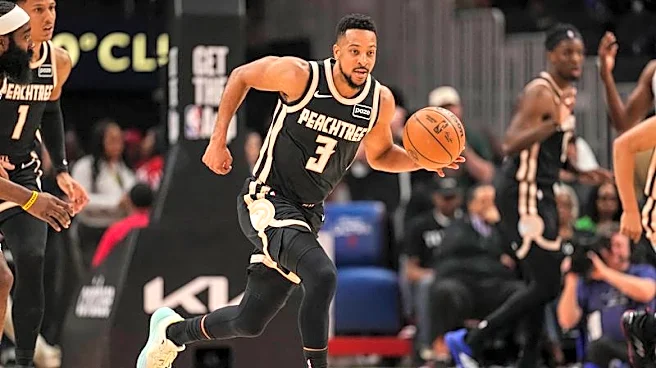
For me, the three players listed above are the trio that the offense now centers upon. Yes, Onyeka Okongwu turning into one of the best stretch-5s in the league has opened up space underneath for everyone. Key in-season pickups like CJ McCollum and Jonathan Kuminga have given the Hawks extra punch.
But the Johnson-NAW-Daniels triumvirate are the biggest cogs in the engine. And with all three of them locked up contractually for multiple years, these will be the biggest building blocks of a new offense in Atlanta going into the future.