


One of the more interesting tactical changes for the Penguins came in their March 30th key game against the Islanders. The Pens would win 8-3 on the road, go beat Detroit 5-1 the next night and never look back on their way to a comfortably qualifying for playoff berth. It was a critical time in the season, and one that might be interesting to remember that both Sidney Crosby and Bryan Rust were a little dinged up at the time, and Evgeni Malkin was out of the lineup completely.
That left the Pens a little
unsettled with their lines. It would turn out more than OK since Anthony Mantha and Rickard Rakell each scored three goals a piece in those two games with Justin Brazeau kicking in a goal and four points to help muscle Pittsburgh to huge wins through their depth scoring and secondary options.
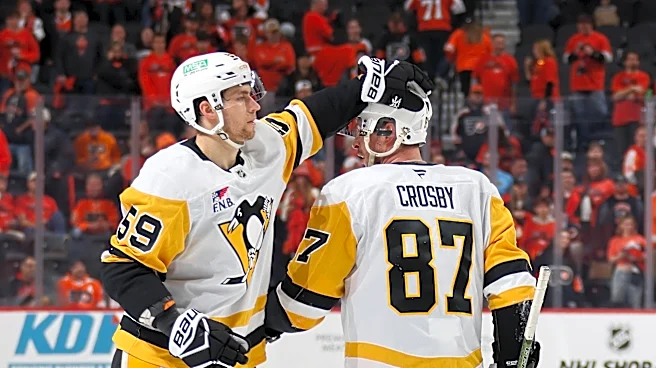
The bigger move from that night is that it was the first time that Egor Chinakhov played on Crosby’s line with Rust. That moves allowed the team to kick Rakell over to center and push Tommy Novak (who only had one point in the 10 games prior to March 30th) to the third line and better orient the team.
Before that, Chinakhov and Crosby had only played about 27 minutes together over 23 games – starting at the end of March they would play 68 minutes together in the final seven games of the regular season and carry over for the start postseason together, where they were gradually split during Game 2.
For the regular season at least, the results were encouraging. Crosby produced one goal and added six assists at even strength in his last seven games of the season, and 10 points in total. That was similar to his production post-injury and pre-Chinakhov (1G+4A in five games). Chinakhov did his part with 3G+5A at even strength in his final eight contests of the year.
Overall in 2025-26, Crosby and Chinakhov had a 4.93 expected goals/60 together, and an even higher 5.68 actual goals, owing to the finishing ability and skill on display. The line in general was lax defensively with chances added, but did manage nice actual results (a 7-3 5v5 score while united late in the year) in the still small sample. Given that Crosby (and likely Rust) weren’t at 100% late in the year, the idea that the trio would improve further with more time to gain chemistry and cohesion seems likely.
Aside from the obvious attributes of having a wicked shot and incredible speed, the Pens think they see enough good things from Chinakhov away from the puck.
“I don’t think he gets enough credit for the way he works away from the puck,” coach Dan Muse said in April. “He’s done a really good job there in terms of the tracking, the getting back, he’s got some detail to his game. He’s changing at the right time, he’s driving wide, he’s drawn a number of penalties. I think the scoring is obvious with him, but there’s some things I’ve learned about him since he’s been here that maybe I didn’t know as much, but really like.”
In a lot of ways, the deployment of Chinakhov is a win/win for the Penguins. If he’s tried with Crosby, that unlocks more speed and rush attacks for the first line. If they go back to Chinakhov and Malkin on a line then they have a dynamic second line to push the play once the Crosby shift is over. It’s hard to go wrong when both options hold positive outcomes.
Like last season, keeping a Chinakhov-Crosby-Rust first line could help with a positive trickle-down for the rest of the team. Novak has had periods of highs and lows playing center. Rakell might not be a pure, full-time NHL caliber center, but he’s proven to be good in spots. Ben Kindel has been making strides but could benefit from another year on the ‘third’ line where there would be less pressure and less competition. Elevating Chinakhov could help the squad by having the option to rotate Rakell in at center with players like Malkin, Novak and Andrei Kuzmenko rounding it out.
Lines don’t have to be carved into stone, which presents the best of all scenarios. Chinakhov could rotate into playing with Crosby and Rust for a time, and then if circumstance points to switching things up to keep the team fresh they always have the option to put Rakell back on the top line where performance is a known quantity and see if the second line with Chinakhov can recapture the up tempo magic they had last season.
How the first line will be composed is an area to keep an eye on, and a pleasant one at that. Late last season, when it counted the most, the Pens pulled some levers to get Chinakhov playing with Crosby and Rust. That probably won’t be the last time that trio gets the chance to play together and possibly form a productive trio for Pittsburgh moving forward.