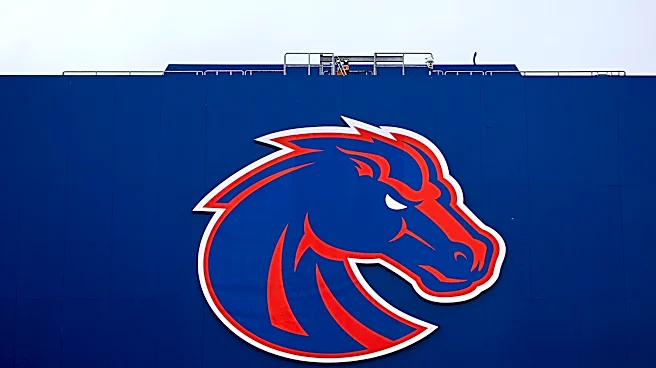

Get to Know Your Foe rolls on with a stop in the neighboring state of Idaho and the home of the bluest turf in football, Boise State.
Despite their relatively new history as an FBS program, the Boise State Broncos are one of the most successful programs in the country. They hold the fifth-highest winning percentage amongst FBS teams dating back to their acceptance as an NCAA program in 1970. Since becoming an FBS team in the 1996 season, Boise State has had just two losing seasons.
Boise State has
one of the greatest success stories in college football. Boise State University originally began as a junior college—named Boise Junior College—founded in 1932. It played its first season of football a year later in 1933. The college dropped the junior and became Boise College after it began handing out bachelor’s and master’s degrees in 1965, then four years later, it became the third state university in Idaho, now named Boise State College. The college then became a full university in 1974.
But back to football. The Broncos twirled around in the world of JUCO football for the first 40+ years of its existence. As with any collegiate program at the time, one of the most challenging problems was finding teams to play. The Broncos took on other small college teams in state, including the University of Idaho’s freshman team in 1934 and the “Boise All-Stars,” a collection of former college players, in 1939. After not being able to field a team between 1942 and 1945 due to World War II, the Broncos returned to the gridiron in 1946. After a so-so 3-4-2 1946 season, Lyle Smith took over the program and instantly got results. The Broncos went 9-0 and finished ranked 393rd of 500 college teams in the Litkenhaus Ratings. Smith and the Broncos didn’t stop there. Smith ended up going undefeated again in 1948 and 1949. The 1949 season ended with the Broncos’ first title, the Intermountain Collegiate Athletic Conference championship, and a victory over Taft College in the Potato Bowl.
Smith’s dominance at Boise had to be put on pause during the 1950 season after he was recalled to the Navy during the outbreak of the Korean War. George Blankley would take over as the head coach for the remaining seven games, keeping the Broncos’ undefeated record in tact. The Broncos would be invited to play in the Junior Rose Bowl against Long Beach, where their run of 37 consecutive victories came to an end in a 33-13 loss. The Broncos’ run of 37 straight regular-season victories came to an end as well in the second week of the 1951 season, losing to Bremerton, Washington’s own—and my alma mater—Olympic College, 18-6. Go Rangers! The Broncos would still go on to win the ICAC again and secure another Potato Bowl victory.
Lyle Smith would return from his military service in 1952 and continued his run of dominance, extending his winning streak to 37 games before losing to Pasadena in the Bronco Bowl at the end of the 1952 season, 28-13. But it was Smith’s 1958 season that was his magnum opus. The Broncos crushed everybody on their schedule, with their closest game being a 29-20 win over Everett Community College. They finished the regular season with another 9-0 record and a point differential of +322 to earn the right to host the NJCAA Championship Game against Tyler Junior College. The Broncos blanked Tyler 22-0 to win their first national championship. Smith would remain in charge of the football program until 1967, finishing with a record of 150-25-6. He then transitioned into the school’s athletic director, helping oversee Boise State’s leap into the NCAA in 1970. Smith also served as Boise’s basketball coach in 1946 and 1947.
After two years as an NAIA independent, Boise State played their first season in the NCAA under Tony Knap. As a member of the Big Sky Conference and the NCAA’s College Division, the Broncos went 8-3 and 2-2 in conference to finish third. The Broncos played and won their first bowl game, the Camellia Bowl, the following season after going 10-2. In 1973, the NCAA changed the College Division to Division II and introduced an eight-team postseason tournament. The Broncos were one of the eight inaugural teams to make it to the tournament after a 9-2 regular season. Despite blowing out South Dakota 51-10 in the opening round, the Broncos fell 38-34 to Louisiana Tech in the semi-finals. The Broncos returned to the dance the next two seasons but lost in the opening round both times. Knap then left Boise State to coach the UNLV Rebels in 1976.
Jim Criner, a former UCLA assistant coach, was then hired to lead the Broncos. He helped lead the Broncos, along with the Big Sky Conference, into the new Division I-AA, now known as the FCS. In 1980, the Broncos returned to the playoffs. The Broncos took down Grambling State 14-9 in the first game to set up a date with Eastern Kentucky for the championship. Boise State got out to a 21-10 lead with a one-yard touchdown from Cedric Minter to open the second half. However, Eastern Kentucky came roaring back. Trailing 29-24 with just over a minute to go, David Booze hauled in a 60-yard touchdown to put Eastern Kentucky up 29-24. Only 43 seconds away from heartbreak, the Broncos put together one of the greatest drives in program history, marching 80 yards and capping off the miracle drive with a 14-yard touchdown pass from Joe Aliotti to Duane Dlouhy with 12 seconds to go, securing the Division I-AA championship.
Their attempt at a repeat fell short, losing in a rematch to Eastern Kentucky 23-17. Criner would stick around for one more season before leaving for Iowa State. Lyle Setencich took over for four seasons but never got the Broncos back to the playoffs. Skip Hall coached the Broncos from 1987 to 1992 and made two playoff appearances. Pokey Allen would be the Broncos’ final coach at the Division I-AA level from 1993 to 1995. In 1994, his Broncos went 10-1 in the regular season to earn their first playoff appearances in four years. The Broncos dispatched Appalachian State and Marshall to meet Youngstown State in the title game, where they would fall short 28-14.
The Broncos departed from the Big Sky Conference and made the leap to Division I-A, joining the Big West Conference, in 1996. While Pokey Allen fell victim to cancer, Tom Mason took over as the interim for the Broncos’ maiden voyage in Division I-A. Boise State struggled, winning just two games and not gaining their first win over a Division I-A opponent until the penultimate game of the season over New Mexico State. Allen returned for that game, a 33-32 thriller, and coached the Broncos in their final game of the season against rival Idaho. Sadly, Allen passed away a month later.
The 1997 and 1998 seasons were steps forward as the Broncos went 5-6 and 6-5, respectively. The 1997 season proved to be the final losing season to this date in Boise State history. Under the direction of Dirk Koetter in his second season, the Broncos took home the Big West title after a 9-3 campaign and a 5-1 conference record. The successful season earned the Broncos a spot in the Humanitarian Bowl, played at their own home stadium. The Broncos took down the Louisville Cardinals 34-31 for the program’s first bowl win at the Division I-A level. They repeated the following season, beating UTEP 38-23 to cap off another 10-win season. Koetter left the Broncos to go coach Arizona State, passing the reigns to Dan Hawkins. The Broncos also decided to leave the Big West and joined the Western Athletic Conference (WAC), beginning play in the 2002 season. Under Hawkins, the Broncos would make four straight bowl appearances from 2002 to 2005, winning two of them. Between 2002 and 2004, the Broncos went a combined 36-3 overall and a perfect 24-0 in the WAC. In total, Boise State won their first 29 WAC games before they lost to Fresno State 27-7 during the 2005 season.
Hawkins could join the likes of his predecessors and use Boise State to launch himself into his next career, which for him was the head coaching job at Colorado. The Broncos would promote their offensive coordinator to take the torch, a familiar name in Chris Petersen. What many couldn’t predict is the next level of success that Petersen would elevate Boise State to. After a 3-0 start to the season, the Broncos found themselves inside the top 25, and they just kept climbing. The Broncos finished the 2006 season a perfect 12-0 but finished eighth in the BCS rankings. It still set them up for a chance to prove themselves beyond what their schedule said against the seventh-ranked Oklahoma Sooners in the Fiesta Bowl. The Sooners were over a touchdown favorite in the game.
Boise State came flying out of the gate with a pair of touchdowns in the first eight minutes of the game to take an early 14-0 lead. The Sooners answered with 10 unanswered to make it 14-10. But just before half, Jared Zabransky hit Drisan James for a 32-yard touchdown to take a 21-10 halftime lead. The Broncos extended the lead in the third quarter with a pick-six to take a commanding 28-10 lead. Oklahoma wouldn’t go down so easily. The Sooners scored an eight-yard touchdown from Adrian Peterson and knocked home a field goal to open the fourth quarter to make it a one-possession game again. With the game on the line late, the Sooners scored a touchdown and got the two-point conversion to tie the game at 28. Just seconds later, the Sooners took the lead after Zabransky lofted a pass to nobody but defensive back Marcus Walker for a go-ahead pick six.
Despite all the momentum on the Sooners sideline, the Broncos went to work with under a minute to go. On a 4th and 18 from midfield with 18 seconds to go, the Broncos ran a perfect hook-and-ladder play that not only got Boise State the first down but also opened up enough space for Jerard Rabb to score the game-tying touchdown. In overtime, the Broncos would surrender a 25-yard touchdown on the opening play to Peterson. It would again come down to a key fourth down, this time from the Oklahoma five-yard line. Out of a wildcat formation, Vinny Perretta rolled right and lofted a pass perfectly to Derek Schouman for a touchdown. Rather than kick the extra point to play double overtime, Petersen and the Broncos elected to put the game on the line right then and there, going for the two-point conversion. In one of the most famous plays in college football history, the Broncos drew up a fake screen pass to the right side and a behind-the-back handoff to Ian Johnson that completely confused the Sooner defense and gave the underdog Broncos an upset in the Fiesta Bowl. Arguably the greatest win in Boise State history.
Petersen led the Broncos until 2013, finishing with a record of 92-12 and 5-2 in bowl games, including another Fiesta Bowl win in 2009. The Broncos were again undefeated in 2009 but finished sixth in the BCS rankings. They took down TCU in that Fiesta Bowl, 17-10.
After all of Boise State’s success in those undefeated seasons, the Broncos began to look outside of the WAC, as clearly going undefeated still wouldn’t be enough to get Boise State into national championship contention. The Broncos settled on the Mountain West and began play in 2011. The conference had their foe from the 2009 Fiesta Bowl, TCU, as well as Wyoming, San Diego State, Air Force, Colorado State, UNLV, and New Mexico at the time of joining the conference. The Mountain West would pick up other schools from their old conference over the following years after the WAC stopped sponsoring football.
Following the departure of Petersen for Washington at the end of the 2013 season, Bryan Harsin was hired away from Arkansas State. Under Harsin, the Broncos would return to the Fiesta Bowl yet again in his first season after going 10-2 and winning the Mountain West Championship over Fresno State. The Broncos took down the Arizona Wildcats out of the Pac-12, 38-30. Harsin led the Broncos from 2014 to 2020, going 69-19 with three bowl wins, but never topped the high of his opening season Fiesta Bowl victory. He would leave for Auburn after the shortened 2020 season.
Andy Avalos, the former defensive coordinator at Oregon, stepped in after Harsin’s departure. The Broncos would finish with their worst record since 1998 in 2021, but that is still good enough to be 7-5. A wild stat that just shows how damn good Boise State was since making the leap to FBS football. One of their wins was still a big one, defeating #10 BYU in Provo, Utah, 26-17. The Broncos bounced back with a strong 2022 campaign, going 9-3. They would fall short in the Mountain West Championship game against Fresno State but did narrowly defeat North Texas in the Frisco Bowl. Avalos left the Broncos during the 2023 season to take the defensive coordinator job at TCU, leaving Spencer Danielson to coach the final four games of the season. The Broncos took home another Mountain West title but lost the LA Bowl to UCLA.
Danielson stayed on as the full-time coach for the 2024 season and brought Boise State to its best season of the College Football Playoff era. Led by superstar running back Ashton Jeanty, the Broncos bulldozed the competition, going 11-1 with their lone loss being a narrow 37-34 loss at Oregon. They defeated UNLV in the Mountain West championship and, as the fourth highest-ranked conference champion, earned a bye in the College Football Playoff. The Broncos would lose in the Fiesta Bowl to Penn State. While Jeanty narrowly lost the Heisman to two-way player Travis Hunter, he still put up one of the greatest seasons in college football history. He ran for an FBS-leading 2601 yards and scored a total of 30 touchdowns.
In their final season in the Mountain West in 2025, the Broncos went out on top, taking down UNLV once again for their seventh Mountain West title since joining in 2011.
The Broncos rivalries mainly stem from the teams they encountered in the WAC and Mountain West, such as Fresno State and Nevada. Fresno State and Boise State play for the Milk Can trophy, with Boise State leading the all-time series 17-10 but Fresno State being the current owner after defeating the Broncos 30-7 last season. Their rivalry with Nevada spans across multiple classifications: Division II, FCS, and FBS.
Boise State and Idaho are also in-state rivals but haven’t met since 2010. They do also play for a trophy starting in 2001, the Governor’s Trophy, but since its inception, the Broncos have won every game. The two are scheduled to meet in 2031.
With Washington State and Boise State now in the same conference, the unofficially named Snake River Rivalry is primed to become a big rivalry for both schools. The two schools have met seven times going back to 1997. The Cougars won the first four meetings before the Broncos took them down in Boise in 2016. WSU got their revenge the following year with a miraculous comeback in a 47-44 overtime thriller. The two met again in 2024 as part of the Mountain West scheduling agreement with Washington State and Oregon State. The Broncos came out victorious in Boise 45-24. We will get our first glimpse of the new in-conference rivalry on October 24th in Pullman.