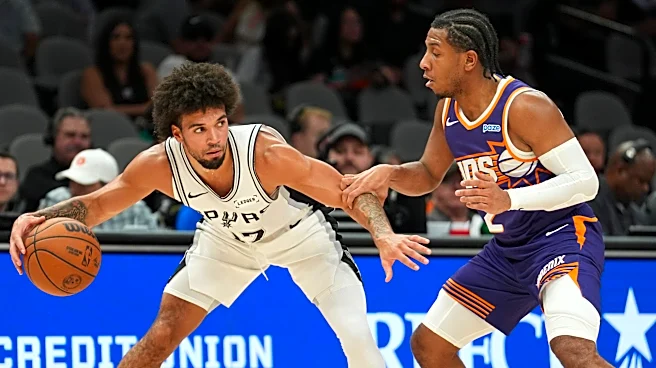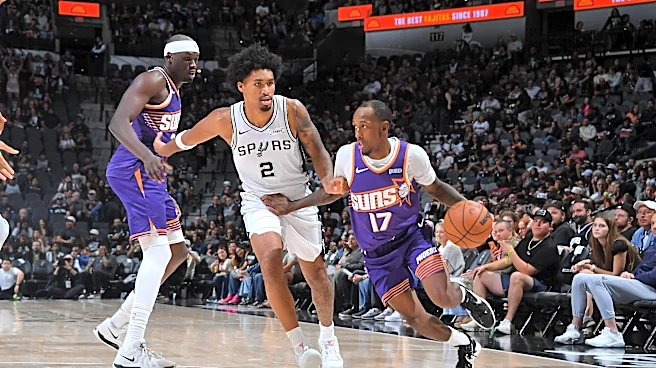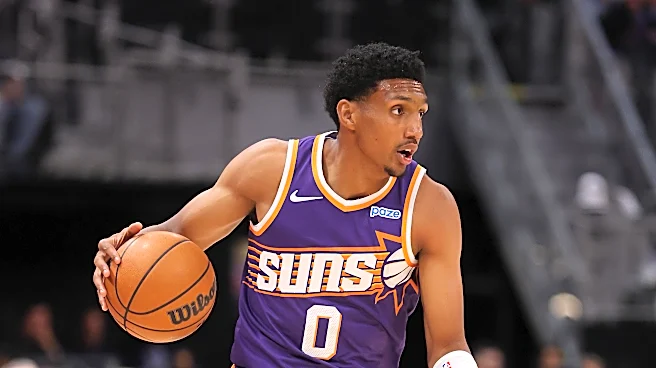


In the Suns’ loss to the San Antonio Spurs in their fourth preseason game, one that featured San Antonio’s starters playing into the third quarter while Phoenix rested its entire starting unit, there was plenty of opportunity to evaluate where certain players stand in their development.
Understanding that many of these players were operating outside the roles they’ll eventually be asked to fill during the regular season is important context. But it’s also an opportunity to see what happens when they’re
given a little more meat on their plate. And one player who didn’t eat? Second-year wing Rasheer Fleming. The final stat line was 4-of-10 from the field, including 0-of-4 from deep, for 8 points. He added 4 rebounds, 1 steal, 3 fouls, and 3 turnovers.
This is the part of the process that reminds us development isn’t linear. Simply putting in time and effort in the gym doesn’t guarantee that results will immediately follow. And what I saw from Fleming on Wednesday was a reminder that he’s a second-year, second-round pick still trying to figure out who and what he is as an NBA player. Part of that process involves learning to rely less on thinking and more on instinct. And that’s what stood out to me. He was thinking a little too much, and hesitation is dangerous in the NBA.
It’s funny because we’ve often referred to Fleming as a second-round pick who was selected first in the second round, practically treating him like a first-round selection. But when we evaluate where he currently stands developmentally, we tend to fall back on the fact that he’s a second-round pick, don’t we? There were 30 opportunities for teams to select him before the Suns made their choice, and those teams opted to go in another direction.
That doesn’t mean Fleming can’t eventually become a rotational player or perhaps something even greater for this organization. But at this moment, there’s work to be done. And it’s work that I’m confident he’ll continue putting in.
So what specifically concerned me on Wednesday? Again, it was the thinking.
Fleming is long, athletic, and physically imposing. Those are tremendous attributes to possess as a basketball player, but instincts and reaction time are incredibly underrated aspects of the game, and they’re difficult to quantify when evaluating a player. Experience, repetition, and opportunity can help a player become more comfortable recognizing situations and reacting accordingly, but there’s also a natural element to those instincts that isn’t necessarily something you can teach.
And there were several possessions Wednesday night where Fleming appeared caught between decisions.
He’d receive the ball beyond the arc and seemingly hesitate between taking the open three-pointer or attacking the basket because his defender wasn’t directly in front of him. There was a positional advantage available, but rather than immediately recognizing and exploiting it, he appeared to be deliberating over which option to take.
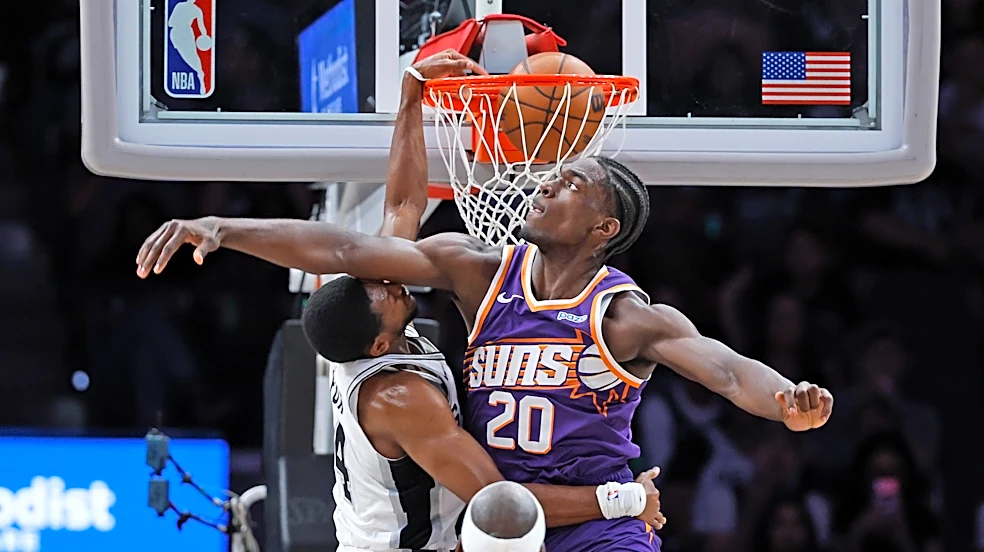
We saw Ryan Dunn operate in a completely different manner during the same game. When Dunn received the basketball on the perimeter, he put his head down and attacked. He had already determined how he wanted to generate offense, utilizing his athleticism to get downhill rather than settling for a three-point attempt. Fleming appeared caught somewhere in between. And perhaps watching Dunn operate with that level of decisiveness only further highlighted what Fleming wasn’t doing.
When an opportunity like Wednesday night presents itself, you shouldn’t have to watch several minutes of basketball before realizing Fleming is on the floor. If that’s happening, it means he’s not making much of an impact on the game.
I’m not going to become overly concerned about a handful of possessions where his defensive positioning wasn’t ideal, especially considering he was competing against San Antonio’s starters. And I do credit Fleming for taking on the point of attack defensively against Stephon Castle on multiple occasions. But those possessions also highlighted areas where his positioning and awareness still need improvement.
His head was constantly on a swivel, seemingly anticipating contact or a screen coming from somewhere. When you’re repeatedly looking over your shoulder, trying to determine whether a screen is approaching, you risk losing sight of the player directly in front of you. Against a team like San Antonio, whose guards possess tremendous quickness, that’s all it takes. One brief glance to the left to see whether a screen is coming, and suddenly your assignment has an opportunity to get downhill.
That’s where Fleming needs to trust his teammates to communicate when screens are approaching, allowing him to focus on the player directly in front of him rather than attempting to account for everything happening around him.
Does any of this mean Fleming has reached a dead end in his development? Hell no. It’s another step in his evolution as a player, and hopefully not a preview of what he’ll ultimately become. I genuinely believe what several people within the organization have suggested: Fleming doesn’t fully realize how good he can be yet. A significant part of reaching that potential will come from trusting his instincts, becoming more comfortable with his responsibilities, and learning to process the game at the speed it demands.