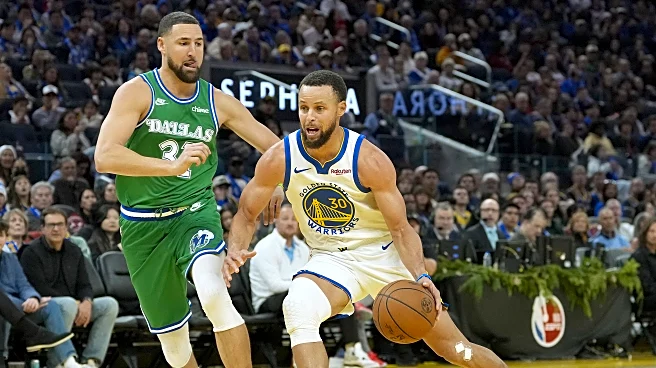

The Mavericks (12-20) went to Golden State for a West Coast showdown against the Warriors (16-15) on Thursday, where the league looked to reunite the Splash Bros for a Christmas Day clash. The Mavs fell
126-116. Dallas was led by Cooper Flaggs’ 27 points, six rebounds, and five assists, on 67% from the field and only a single turnover. Brandon Williams also had an efficient 26 points on 9-for-12 shooting. PJ Washington and Naji Marshall each had 14 points in the losing effort. For the Warriors, it was a team effort, with seven players finishing in double digits, led by Stephen Curry with 23 points. The story of the game was Anthony Davis going down early in the second quarter with a groin injury. Davis did not return.
The Mavericks started slowly as they tried to play through Anthony Davis, but he missed his first two shots, allowing Golden State to steal the lead. The first quarter was sloppy as Golden State scored seven of its first 11 points at the free-throw line, while the Mavs were lucky to keep up with a couple of lucky turnovers. Davis continued to struggle early, giving up a dunk and starting 1-for-4 from the free-throw line. After Davis and Flagg subbed out, the Max Christie show began, scoring six points on step-back mid-range jumpers.
Christie, along with a Daniel Gafford post hook, helped the Mavs stay within a possession with two minutes to go in the period. The quarter ended in a disaster for Dallas, as Jimmy Butler earned a trip to the line with 1.7 seconds left and the Mavericks lost their challenge on the play early in the game. Al Horford hit four 3-pointers to bring the Warriors up 40-28 after one. The Mavericks’ front line failed them early in a game against a .500 team that had no height.
The second quarter started as bad as the first, as the Mavericks could not generate any open looks, and the Warriors got open shot after open shot. Naji started the scoring with a running layup after two ugly offensive possessions to start, and then forced a turnover on Steph Curry. The quarter was going great until Anthony Davis and Daniel Gafford used their combined powers to ruin Christmas. First, Anthony Davis hurt his groin on a transition runout. The Davis injury was crushing, forcing the Mavericks to play Gafford even more. The Warriors did what the Nuggets did on Tuesday, forcing Gafford into every action defensively.
Then Cooper Flagg started to get going. With a couple of tough shots, but the Warriors’ continued pursuit of Gafford made things too easy for them offensively. Gafford finished the half with a -17 plus/minus, including giving up 8-for-10 combined shooting against Horford and Trayce Jackson-Davis in his 10 total first-half minutes. Cooper Flagg and Naji Marshall kept them in it late with some scoring surges, but ultimately finished the first half down 58-71.
The mess continued in the third. The Mavs gave up two wide-open layups before Cooper Flagg got his first score of the half. The Mavs flirted with cutting the lead to single digits. At one point, Brandon Williams had a 5-point spurt to bring the Mavs within nine, but Dallas continued to give up rotations on defense for easy Warriors layups.
The fourth quarter started with a good play as Klay found Flagg for a poster before giving up a layup on a turnover on the next possession. Cooper Flagg tried to take over early in the period but could not get a bucket to go after the first dunk of the quarter. After 90 seconds of no scoring, Curry finally got to the line, followed by Thompson’s mid-range shot and a Flagg layup. The Mavericks were hanging around but could not get close. Out of the timeout, the Mavs got a turnover and converted it for a Williams layup. The Mavs got it down to five before Daniel Gafford checked in and ruined all the momentum, again.
After fouling on a 3-pointer against a guy a foot shorter who was pump-faking, Gafford gave up another shot before getting put back on the bench. The Mavs did their best to stay afloat with strong drives to the bucket. Finally, Curry hit his second three of the game to put the Warriors up 115-104 with three minutes left, and the game was all but over. P.J. Washington kept rotating away from the basket while being the biggest guy on the floor. Whether Washington did it by accident or it was a Kidd decision to switch everything, it all but sealed the game’s outcome. The Warriors strolled to the finish line with a 126-116 win.
The Mavs are back in Center Hell
Aside from Anthony Davis’ injury, the biggest reason the Mavericks were so awful was the play of Daniel Gafford. In the first half, his minutes alone nearly erased the team’s chance to control the game, as he posted a staggering –17 plus/minus before halftime despite scoring six points and grabbing three rebounds. His offensive numbers were meaningless compared to the damage he did defensively. In his first five minutes of the game, Gafford gave up a personal 12–0 run to Horford, who went 4-for-5 from three as Boston repeatedly abused him in simple pick-and-pop action.
It didn’t improve in the second quarter, when Jackson-Davis went 4-for-5 at the rim, beating Gafford down the floor and on the glass for easy put-backs, his only meaningful contributions of the night. Gafford played just five more minutes the rest of the game, finishing with one rebound and two turnovers.
With Dereck Lively out for the year and Davis’ status uncertain due to his groin injury, it is simply unacceptable that the Mavericks do not have a single big man they can trust in crunch time of a prime-time game. Including Dwight Powell and two-way center Moussa Cisse, the Mavericks are carrying five centers who account for over 50% of the salary cap, yet have collectively provided fewer than 20 games played from almost all of them this season. Not only is the availability disastrous, but none of these players have proven they can consistently stay healthy, rebound, protect the rim, and finish around the basket at a level required for a team trying to win now. At some point, injuries stop being bad luck and start being roster failure. The Mavericks need to trade this entire group, reset the position, and find a reliable big man who can actually be on the floor when the game matters.
What is next for Anthony Davis?
The biggest story coming out of the loss was Anthony Davis exiting in the second quarter with a groin injury. The injury occurred in transition, as Davis pulled up while the ball was being passed to him on a fast break, which is rarely a reassuring sign for a player with his injury history. He was ruled out by halftime. Before leaving the game, Davis struggled to make an impact, finishing with three points and three rebounds on 1-for-4 shooting from the field and 1-for-4 from the free throw line.
The timing is especially frustrating given that Davis had just completed his most consistent stretch of the season, appearing in nearly every game since Thanksgiving and scoring fewer than 20 points only twice in that span. Even so, the broader picture remains unchanged. Davis’ season has been inconsistent and injury-riddled, with fluctuating efficiency and inconsistent defensive engagement. There were recent signs of progress as his role began to stabilize alongside Cooper Flagg, but once again, availability threatens to derail any continuity the Mavericks were starting to build.
Beyond the on-court impact, Davis’ absence highlights a larger structural issue. He occupies roughly 35 percent of the salary cap on a roster already pressed up against the second apron, leaving Dallas with virtually no flexibility to compensate for missed production. When Davis is unavailable, the Mavericks cannot meaningfully adjust through trades or free agency, and the margin for error at the center position disappears entirely. This is the inherent risk of a top-heavy cap structure, where the most expensive player must be on the floor to justify the rest of the roster around him.
The situation also raises long-term questions that the front office cannot ignore. A year ago on Christmas, Luka Dončić suffered a calf injury and was traded just over a month later. While the circumstances differ, the Mavericks again find themselves at a crossroads, this time with a clear financial and developmental pivot point in Cooper Flagg. Flagg’s rookie-scale contract provides rare cap relief and long-term upside in an otherwise restrictive cap environment. If Davis’ injury proves significant, Dallas must at least consider whether continuing to build around a high-cost center with ongoing availability concerns aligns with the roster’s direction. At some point, the conversation shifts from bad luck to sustainability, and the Mavericks may be approaching that line sooner than expected.