

For most Atlanta Braves fans, the emergence of Víctor Mederos seemed to come out of nowhere. In a season plagued with pitching injuries, Mederos ended up a welcome addition to the bullpen that likely even the Front Office did not expect. Of course, the Braves probably had some thoughts about how to make him useful when they acquired him, but what they actually got was a guy on a low HR/FB heater who delivered a bunch of value with poor peripherals.
How Acquired
It may seem as though Víctor Mederos just appeared.
There was not much discussion of him in the traditional media or among fans near the start of the season. This makes sense because he acquired in a minor deal that would normally be brushed over or forgotten: a trade with the Angels in the first week of April, where Atlanta got Mederos and the Angels got $250,000 in international signing bonus money.
Many times, these types of trades are for players that are purely depth moves. It seemed like Mederos was ging to be depth, too, until he was given his shot due to injuries and the stars aligned in his (and the Braves’) favor.
What were the expectations?
The main expectation was likely that he was purely depth in case of injury. Mederos was never much of a prospect, and had been absolutely awful at the big league level across parts of three seasons with the Angels. We’re talking a 209 ERA-, 169 FIP-, and 154 xFIP- over 25 1/3 innings, which included three starts. Those numbers are so bad, it’s kind of amazing the Angels even gave him a shot in multiple different stints, but it’s the Angels.
His stats were also not great in the minors, but pitching in the Pacific Coast League is a dangerous enterprise these days. He did end up with an ERA well below his FIP and xFIP in 16 starts there in 2025, so maybe that was a reason the Braves wanted to figure stuff out. Or, they just wanted depth.
Steamer had him projected as a replacement level reliever; ZiPS had him as an 0.3 WAR in half a season swingman guy. That’s a depth piece that could provide some length and maybe have a bit of upside, so you can see why the Braves made the move. There just wasn’t a reason to expect much.
2026 Results
Mederos had a crazy season. At the top line, it featured an 81 ERA-, 74 FIP-, and 112 xFIP-. His HR/FB rate was 2.2 percent — as in, one homer in his 30 relief appearances and 34 1/3 innings completed.
He was up for a few days in May, where he made one appearance that was pretty much a sneak preview of what was to come. That outing featured an 0/1 K/BB ratio in two innings, but faced the minimum. He was then recalled in early July, and hung out in the bullpen through the end of the season, as well as during the playoffs.
His one appearance during the playoffs was basically the universe forcibly snapping things back in to place. He appeared in one game (in the NLDS), faced four batters, walked one, gave up a homer to one, and the other two batters were an out and a non-out in the air. The homer put the Braves in a 2-0 hole, and they lost the game 5-3.
What went right?
The eye-popping 2.2 percent HR/FB sticks out as the most blessed thing for a fly ball pitcher. That said, it wasn’t all just extreme longball avoidance.
To the extent managing contact is a thing, Mederos managed it. All of his barrel rate, exit velocity, hard hit rate, etc. etc. stuff was phenomenal. Of the four pitches he commonly threw, he had an xwOBA-against below .300 on three of them (and a mark above .400 on his sinker). On top of that, he had an above-average z-whiff rate and o-whiff rate, and he got a lot of chase. Basically, he got hitters to swing at stuff they shouldn’t, and when they made contact with it, it didn’t do much. He also came out firing, with a 97 mph fastball.
This combination, along with him not getting punished by stray dingers, and the fact that the Braves were okay using him in higher leverage, meant that he accrued 1.48 WPA on the year, along with a 9/2 shutdown/meltdown ratio. For a guy with scary peripherals, it really couldn’t have worked out much better.
His highest WPA game of the year? Well, it would be the Victor Mederos game, except that was a different game. Instead, it was a game where the Braves brought him into the seventh, with two out and the tying run on third. There were… many complaints, because the Braves were once again giving high leverage to someone fresh rather than someone within the circle of trust. Well, Mederos did what he did all season: he laughed in the face of leverage. He finished that game, facing nine batters altogether. He stranded the runner on third, he had a 1-2-3 inning (two flyouts), and then he worked around a seeing-eye single. Seven outs, a 1/1 K/BB ratio, some good fielding, and a bunch of WPA slathered on Mederos.
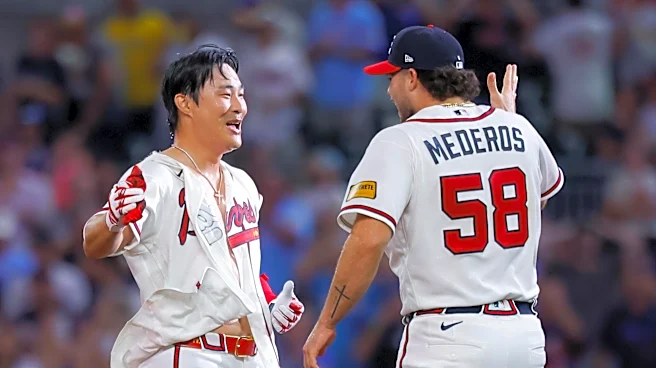
But, there was also the Victor Mederos game. On July 17, the Braves were blowing out the Rangers, such that their substitutions led to Mederos taking a PA with two on, even though pitchers pretty much never bat anymore. He did this:
What went wrong?
In the end, Mederos was fun, and the lack of homers while he pitched made his time pitching very valuable, but… he didn’t actually pitch all that well.
For one, he somehow managed to take high chase and whiff rates, and managed a strikeout rate just five percent above league average. And then, the real problem was that his walk rate was six percent above league average.
Why did this happen, and why did this reflect so poorly on his peripherals? Because he just didn’t throw in the zone very often. Of the 464 pitchers who completed at least 30 innings in 2026, only 21 threw the ball in the zone less often. In the short term, this led to what we saw: lots of chase, lots of miss, and poor contact. But, it also led to walks, and the reason those walks didn’t come home to roost in a painful way was because of the low HR/FB.
For the most part, Mederos didn’t suffer the vagaries of fate despite his peripherals. Occasionally, he did. On July 22, he was asked to pitch the ninth in a blowout, and left after just one out (a flyout, of course), a walk, and a bunch of BABIP stuff that required Raisel Iglesias to be inserted into the game. The Braves had a six-run lead at the start of the frame, and won a one-run game in the end. On September 13, he came in with a three-run deficit and left with a seven-run deficit, with one walk and again, a bunch of BABIP. And, of course, there was August 8, the day of his lone regular season homer surrendered, which doubled the Braves’ deficit in the seventh. The Braves went on to lose that game by a run.
As noted above, the real kicker, though, was that Mederos’ homer-avoidance evaporated right when the Braves decided to use him in a playoff game. Not a cool rugpull on the part of the baseball gods.
Does any of this really dampen the fun of his season, especially considering he was just supposed to be a depth guy acquired for a bit of international bonus pool money? Probably not. But, it’s clear that he’s going to have to do something different if he wants to keep being a useful arm going forward. He could alter his pitch shapes, none of which currently stand out, or look to tighten up his command so that his four-seamer and splitter are far more likely to be strikes. There are lots of avenues to proceed down for Mederos, and fortunately for him, he got the nice surface stats that might encourage a longer look.
2027 Outlook
There is no funky contract situation with Mederos: he barely has any service time, and the Braves control him through 2031. He won’t even hit arbitration until 2029 under the current regime, though that might change with the ultimately agreed-upon CBA in some way. That said, he is out of options, so the Braves will have to carry him to retain him, unless they can somehow get him through waivers (and with his 2026, that doesn’t seem too likely).
He currently projects as a middle reliever — basically one of five guaranteed bullpen roles that we’re currently aware of (Dylan Lee, Evan Phillips, Robert Suarez, Dylan Dodd, and Mederos; guys like Ray Kerr and Didier Fuentes may not necessarily be relievers). With that said, his projections haven’t really budged from last year — Steamer has him as a replacement-level arm, and ZiPS sees him as a low-value swingman — likely as a result of his 2026 peripherals not really suggesting he made enough improvement.
Put that together, and the outlook for Mederos is to serve as middle relief. If he can get even a fraction of the fortune he got in 2026 in terms of HR/FB stuff — or, if he improves his ability to hit the zone and convert his chases and whiffs into strikeouts — he’ll probably stick around. But, the Braves also have little compunction about shuffling ineffective relievers off the roster, so if he’s just 2026 Mederos without the low HR/FB, he might indeed be lost on waivers when the Braves think they’ve found a better option to hurl middle relief.