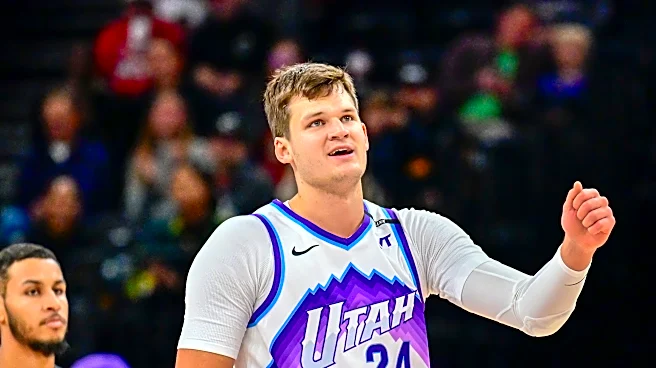






The Walker Kessler saga is officially over, and so is his tenure in Utah. The Utah Jazz are sending Walker Kessler to the Los Angeles Lakers in a sign-and-trade for unprotected first-round picks in 2031 and 2033, plus the right to swap first-round picks in 2028 and 2030.
The Lakers are paying Kessler $130 million over 4 years, which is about $32.5 million AAV. Additionally, his contract includes a player option on the fourth year, and a 15% trade kicker.
Kessler turns 25 years old in late July, and has averaged 9.5 points, 9.3 rebounds, 2.4 blocks and 1.2 assists in 25.3 minutes per game for his career, shooting 68.1% from the field. Ironically, Kessler arrived in Utah in the package for Rudy Gobert as the No. 22 overall pick in the 2022 draft. This Gobert trade has now amounted to six first-round picks, and three swaps (4 of the picks are still outstanding).
In his 4 seasons with Utah, he has been a great rebounder, rim protector, and lob threat around the rim. He flashed a hint of 3-point shooting early in the past season, making 6/8 before going out with shoulder surgery. However, any outside shooting is only theoretical, as he is a career 54.5% free throw shooter.
Los Angeles’ Perspective
Looking at the Lakers’ side of things, this fills a massive hole on their roster at the center position, which they tried to patch with Mark Williams and Deandre Ayton with little success. Kessler is the dominant rim protector, elite offensive rebounder, and finisher that a Dončić/Austin Reaves-led offense needs. Ayton will now have a much smaller role, off the bench, which better suits his skillset.
On the other hand, the Lakers have no tradable first-round picks over the next seven years, and have committed $475 million to Luka Dončić, Austin Reaves, and Walker Kessler. Kessler is undoubtedly a great fit, but they are paying a steep price for a player that hasn’t proven himself on a high-stakes NBA stage.
Kessler has struggled with confidence finishing around the rim and playing through contact, especially in his sophomore year, which can’t happen on the Lakers. Los Angeles scrutiny will be on an entirely new level. Whether he’s fully grown past that is unclear, and it’s a real question when you’ve traded your remaining first-round picks for him.
Another concern worth considering is Kessler’s durability. He has only played 63 games in the past two seasons, and is coming off a surgery which repaired a torn labrum in his left shoulder. The labrum has been a years-long issue going back to his Auburn days that required surgery after repeated subluxing. I’m sure the Lakers looked into Walker’s medical records, but his health will be something to continue to monitor.
How much can a team giving that much money to those three players, without any flexibility, really win? We will see how they continue to round out their roster this offseason, but so far they have lost LeBron James, Marcus Smart, Luke Kennard, and likely won’t be able to re-sign Rui Hachimura.
A Luka Dončić team needs shooting, perimeter defense, and solid bigs. Now they have a solid big in Kessler, but no flexibility to improve their shooting or perimeter defense.
Utah’s Perspective
For the Jazz, this is a bitter-sweet deal. On one hand, they recoup a lot of the draft capital they traded for Jaren Jackson Jr. and have more cap flexibility in the future. Utah already has significant money tied up in Lauri Markkanen and Jaren Jackson Jr, so signing Kessler to a $130 million deal would have squeezed their books even further.
Not paying Kessler gives the Jazz more flexibility to chase free agents this offseason, and to re-sign Keyonte George next summer. The picks they got in return are also valuable assets that could be used in a trade or win-now move.
However, as of today, this trade makes Utah a worse basketball team. Jusuf Nurkic is now the starting center unless more moves are made. JJJ could play some center minutes, but is a more natural powerforward. He plays best next to a rim-protecting center, which is what made his pairing with Walker Kessler so enticing. Now we never get to see what those two could have been together on defense.
While paying Kessler this contract would have been expensive, it’s surprising Utah didn’t just match the contract which was being reported all week.
I was personally bracing myself for the Jazz to match a Kessler contract worth $35+ million AAV, making it surprising that the Jazz didn’t just pay him the $32.5 million. The front office must have determined that these first-round picks are more valuable than Walker Kessler on that contract.
The Jazz have spent the last four seasons tanking for high lottery picks and collecting assets. After the JJJ trade and drafting Darryn Peterson, Utah seemed to be turning the page and making win-now moves. This Kessler deal doesn’t fit that narrative, but maybe it turns into a greater opportunity in the near future.
For a moment this offseason, it really seemed like Utah was building something rare. A frontcourt pairing of JJJ and Walker Kessler along with a dynamic offense is everything the Jazz needed to turn this rebuild around. It’s too bad we didn’t get to see this team play out.
As Kessler leaves, so does a big part of Utah’s defense, replaced by two first-round picks that won’t convey until the next decade. Utah got good value, but is that value worth downgrading the team? As of right now, it’s too early to determine who has won the trade. Whether this trade ages well for the Jazz will depend on what they do next.