




It’s an understatement to say it’s early in the season, but Arizona women’s basketball showed some unique things in their season opener against Stanford. Some of those things were key in the dominant victory. Will they continue as the season progresses?
Breanna Williams looks like the real deal
Forward Breanna Williams didn’t get a lot of opportunities at Maryland. She didn’t play at all her first year in College Park and saw action in just 10.3 minutes per game last season. If the two exhibitions and the season opener paint an accurate picture,
she won’t have trouble getting on the floor for Arizona.
Williams debuted with a double-double of 22 points and 11 rebounds in Arizona’s first exhibition, but the opponent was an NAIA squad. It was still impressive that she put her stat line together in just 13.5 minutes on the floor. She followed that with a more reserved eight points and two rebounds in 11.5 minutes against Cal State Monterey Bay in the Wildcats’ final exhibition.
Williams once again came off the bench for the Wildcats in the opening game against the Cardinal. It was tough to take her off the floor once she got on it.
Williams set a career high with 23 points in 24 minutes of play. She added nine rebounds, two assists, and two steals. Four of her nine rebounds came on the offensive end, regularly getting Arizona new possessions. She hit 9 of 13 shots from the floor. On a day when several of her teammates struggled at the free throw line, she also hit 5 of 6 from the stripe.
Williams may be pushing for a starting spot.
Is Arizona an offensive rebounding team?
It’s been a long time since Arizona has been a good rebounding team. It’s been even longer since the Wildcats have been a good offensive rebounding team. Offensive boards were not valued by previous head coach Adia Barnes and current leader Becky Burke appeared to have a similar viewpoint last year. Getting back on defense had a higher value for both coaches. That may have a new wrinkle.
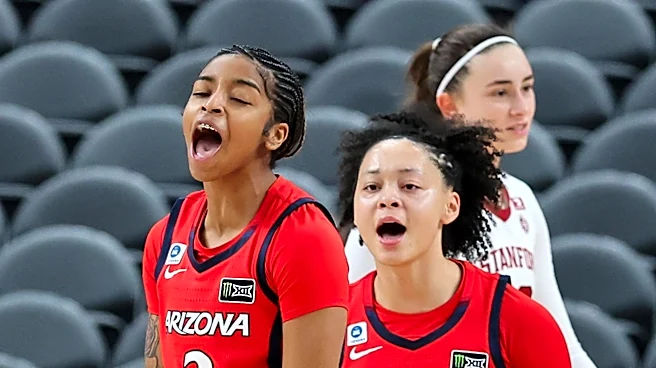
Despite turning the Cardinal over 30 times on Monday, the Wildcats seemed to put a lot of value on the offensive glass. Stanford started three players who stand between 6-foot-1 and 6-foot-5. Its backcourt has 5-foot-6 Shay Ijiwoye, but even the shortest of the Cardinal’s guards has a bit of height on Arizona’s Puff Morris. It didn’t matter.
Arizona slightly out-rebounded Stanford 37-35. Most impressive was that roughly half the Wildcats’ boards came on the offensive end. They pulled down 18 offensive rebounds compared to 12 for the Cardinal. Those 18 o-boards led to a 22-13 advantage in second-chance points.
Williams led the team with four offensive rebounds. Gerda Raulušaitytė had three. Six different players had at least one.
The Wildcats have scoring depth
While a coaches tend to play a lot of their roster in early games, that’s usually because they are playing overmatched opponents from mid-major leagues. Arizona didn’t do that this season. Whatever drop-off Stanford has had in the past two years, they are a Power 4 team with several highly regarded players. The game was also an important one for Burke’s team to win.
Despite those factors, Burke went deep into her bench. Part of that was necessitated by the foul trouble for Sumayah Sugapong and Makayla Presser-Palmer, but it came even before the two starters picked up their fourth fouls in the third quarter.
Burke played 10 of the 13 players on her roster. All but two played double-digit minutes. All but one scored.
When Arizona scored 92 and 117 points in its exhibitions, it was easy to write that off to the level of competition. It’s not as easy to dismiss the 84 points the Wildcats scored on Monday, especially since they were the result of getting five players in double figures.
Arizona has not averaged over 70 ppg since the 2022-23 season. Last year, the Wildcats averaged 64 ppg during conference play when they faced all of their Power 4 opponents. Starting with over 80 against Power 4 players is promising.
The freshmen are critical
Burke started Presser-Palmer and fellow freshman Jasleen Green. Simba Finley came off the bench and played 21 minutes. All had positive impacts.
Green and Finley were two of the five players who scored in double figures. Presser-Palmer was quietly effective and her length was important for an undersized Arizona roster.
They have things to work on. Presser-Palmer fouled out in 21 minutes. Finley is loathe to pass to the ball. Neither of those things stood in the way of the rookies having big contributions in the victory. They will need to continue having those impacts while working on their weaknesses if Arizona is going to reach its potential.
Fouls are a problem
Stanford head coach Kate Paye was asked about Arizona’s fouls after the game. She acknowledged that one of the things the Cardinal went over was the Wildcats’ tendency to foul. While that’s typical of many defensive-oriented teams, it became especially significant in the third quarter.
Presser-Palmer picked up her fourth foul with 6:17 on the clock in the third quarter. Sumayah Sugapong, who averaged 3.2 fouls per game and 4.5 fouls per 40 minutes last season, had her fourth not long after.
Sugapong picked up three of her fouls between the 3:45 and 2:37 marks in the third. The TV commentators remarked that it looked like Stanford was intentionally going at her to try to pick up fouls. Paye’s postgame remarks seemed to back that up.
The Wildcats also had issues with fouls in the first half. Morris had to go to the bench with her second with 4:52 to go in the first quarter. It illustrated the importance of the addition of Dionna Gray. The experienced point guard was able to come into the game and steady things while the starter was out of the game.