



You don’t need me to tell you that a major talking point during the Ruben Amorim era was United’s back three formation. It was always obvious that the back three system didn’t quite suit United. While the team was struggling with the system, those who wanted to defend Amorim would often point out that the team also stunk in a back four system under Erik Ten Hag.
Those people weren’t wrong. Erik Ten Hag often deployed a 4-2-3-1 formation that would shift into a 4-1-4-1 shape out of possession. United
were pretty poor defensively, especially over the last 12 months of Ten Hag’s tenure and it played a big role into why he was sacked.
But focusing on the formation is missing the forest for the trees. The formation isn’t as important so much as how you’re choosing to play from that formation.
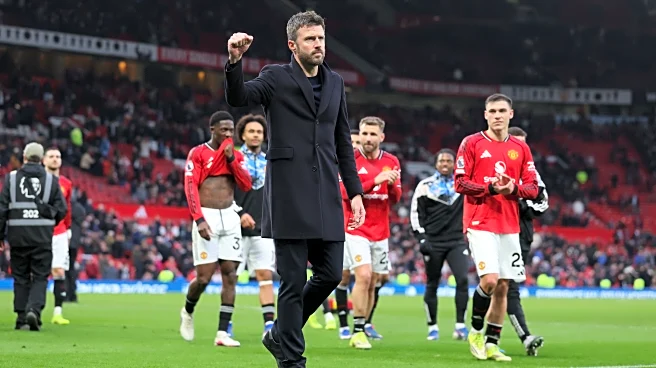
In his three games in charge, Michael Carrick has reverted United back to a 4-2-3-1 formation. But his 4-2-3-1 has almost nothing in common with the shape the team struggled with under Ten Hag. If we’re looking for similarities, it was Ruben Amorim who was most similar to Ten Hag.
The formations may have been different, but Ten Hag and Amorim both utilized duel based approach that relied on individuals to win their 1v1 duels. Everyone had their own responsibilities and therefore if someone lost a 1v1 duel the rest of the system could break down.
United pressed with a very man-to-man approach, meaning their shape could often get distorted by simply having a player make a run to drag their market out of position. A great example of this was the December 2023 match against Newcastle when the Magpies were constantly making runs to drag United’s midfielders and defenders out of their natural positions.

In the early Ten Hag era United would press high up the pitch and send midfielder Christian Eriksen further forward to man-mark a midfielder. This left Casemiro alone in midfield. If the press broke, it was Casemiro’s job to engage in a 1v1 duel and clean up the mess.

When Casemiro didn’t win that 1v1 duel, it almost always lead to a situation where the opponent got a free run at United’s back line and were able to generate an attempt at United’s goal.

Casemiro wasn’t the only one tasked with winning 1v1 duels. This happens in all 10 outfield positions across the pitch, and it continued under Ruben Amorim. Center backs had to follow men into midfield, creating gaps in the back line. Fullbacks had to push out wide, creating large distances in the line, or they had to tuck inside leaving men open at the back post. Every time someone lost a duel it put someone else in a compromising position. With players scrambling to cover for their teammates, inevitably, someone would be left open.
What Michael Carrick has done has instilled a system where United focus on defending as a team. They move as a unit. If someone gets beat, there’s always help nearby. Many times they allow the ball to go into certain positions knowing that when it gets closer to a more dangerous area, there will be help there.
This was a large part in how the team defended Erling Haaland in the Manchester Derby. Even when Halaand thought he was open, there was always actually someone there.

Here, Fulham have a man open on the edge of the box. Had United been in a man-marking scheme, Kobbie Mainoo would have to cheat over to pick the man up, leaving the middle of the pitch wide open. Instead, he’s able to keep his eye on the middle of the pitch, while Matheus Cunha is supposed to cut off the passing.

Cunha fails to block off the passing lane allowing the pass to get through, but it’s ok because Shaw and Mainoo are able to quickly swarm the ball, not giving the player anywhere to go.

Unfortunately for United this time Shaw committed a senseless foul. Fulham would strike a decent free kick that forced a save out of Senne Lammens.
There are elements of Total Football in how United defends under Carrick. Unfortunately for him, there isn’t one quick buzzword that sums it up neatly. It would be wrong to say United press high up the pitch, but it would also be wrong to say they just retreat into their shape and sit in a low block.
The term “press” is short for the word pressure. A high press is a term to describe a team that applies pressure high up the pitch. United under Carrick don’t do that. But they don’t just sit back and do nothing either.
When United lose the ball, rather than counter-pressing to try and win the ball back while also risking being out of position if they fail, United focus their immediate runs on getting back into position. What they don’t do is immediately drop off. They’ll give you space at the back, but they keep their block compact to reduce the space you have in the middle of the field and cut off passing lanes to those midfielders.

If a team wants of their center backs to carry the ball forward, United will let them do that pretty freely. The idea here is that center backs are not your most dangerous players, they’re not going to hurt you. If a center back carries the ball forward it allows the defensive block to get even more compact, further restricting your ability to get the ball to your good players. It makes it much easier to defend them.

If you don’t want to carry the ball forward, United will let the center backs have the ball in the back line. Their focus is cutting off the passing lanes to the midfielders.

Even though there’s no pressure on the ball carrier, teams don’t like to just stand around. They like to keep the ball moving. If there’s nowhere forward to go with the ball, they’ll settle and eventually pass backwards. When that happens, don’t just stand there and watch, they push their block up.

They’re still not pressuring their opponent per say, but they’re not sitting back either. And as they keep restricting the space, they ultimately turn up the mental pressure in their opponents’ minds.

This has already paid dividends for United. Their first goal against Arsenal was scored when Bruno Fernandes and Bryan Mbeumo slowly increased the pressure on Arsenal’s back line, leading Martin Zubimendi to cough up the ball.

A week earlier against City, United forced a similar mistake from the sure-footed Rodri that they should have done better to convert into a good scoring chance.

These are notable chances as City and Arsenal are the two best teams in the league at playing out the back and through a press. More than that, Zubimendi and Rodri are the two lynchpins in these teams in this area of the pitch. These are two of the best players in the league at doing exactly what they were doing in these scenarios. It’s too much of a coincidence for both to make such uncharacteristic errors a week apart from each other. The more likely scenario is that United are doing something that is playing a role in causing these mistakes.
Per Opta, United were creating 7.15 high turnovers a game under Amorim this season. That’s fallen to 6 under Carrick but the amount converted to shots is down from just 16.08 percent to 14.3 percent. United have already scored two goals from high turnovers in three games under Carrick, a third of their total on the year.
The goal under Carrick has been to keep everything in front of everyone and stay compact. They keep their shape by defending space more than the man. In the following scenario United have fallen into a compact 4-4-1 block as Bryan Mbeumo is covering for Amad was slow to get back. Luke Shaw is tucked in very narrow.

Fulham start moving the ball to the right. When that happens Shaw immediately moves out wide to pick up the wide man. Fulham’s open midfielder tries to run into space vacated by Shaw, but he’s followed by Kobbie Mainoo. When one of the defenders tries to fill Mainoo’s space, Cunha falls in line. Everything remains covered.

The primary idea in Total Football was that outfield players should be able to play anywhere on the pitch, this way players would be able to seamlessly take over the role of any player in the team. The goal was to create a fluid system where as soon as one player vacated his position, someone else could easily fill in for him.
There are elements of that in how Carrick’s United defend. Players protect space and then close down the closest man, but are quickly forced to cover for their teammates.
Here, Fulham playmaker Alex Iwobi has dropped deep to get on the ball – a common occurrence the last three games as United’s compact shape forces playmakers to look for the ball much deeper on the pitch. He’s able to work a pass into Samuel Chukwueze who is between several United defenders.

As soon as the ball is played, Casemiro, Mainoo, and Harry Maguire move to close him down, meanwhile Amad takes a step inside towards Emile Smith Rowe. Chukwueze plays it first time to Smith Rowe, causing Casemiro to turn towards him. When Smith Rowe plays it straight back to Iwobi, Casemiro isn’t facing the ball, but Amad is, so Amad breaks forward and fills the spot formerly held by Casemiro. Casemiro stays on top of Smith Rowe while Harry Maguire stays with Chuckwueze.

When Iwobi plays it out wide, Diogo Dalot is quick to fill in the spot originally held by Amad. With Dalot coming wide, Smith Rowe breaks towards the touchline, but Casemiro stays right with him.

This gives left back Antonee Robinson very few options, so he chooses to cut back inside towards the middle. His problem is all those United defenders are still right there. They collapse on him and he’s forced to give the ball back out wide to Smith Rowe who is on the touchline.

Alex Iwobi is deep, Emilie Smith Rowe is on the touch line. This is exactly where United want Fulham’s dangerous players to have the ball – in the least dangerous areas.
Carrick’s focus has been remember that the number one goal of defending is simply not to concede a goal. There are numerous ways to accomplish that and winning the ball back is only one of them.
It’s not about staying with certain players. It’s not about not allowing the ball to get into certain spaces. It’s about not letting certain players get the ball in certain spaces. If you want to get a “non-dangerous” player on the ball in a dangerous space, United are going to let you do that. They’re not worried about that player hurting you and they’ll deal with it when they have to. What they’re going to focus on is denying the dangerous players the ability to hurt them. If your playmaker wants the ball, he’s going to need to go to less dangerous spaces to get it.
It hasn’t been perfect. United are still prone to spells where they drop far to deep and allow too much possession outside their own box. Following Casemiro’s opener on Sunday it took United over 25 minutes before they recorded another shot. The first five minutes of the second half saw them under siege outside their own box.
Here Fulham are carrying the ball up the pitch against United’s 4-4-2 shape.

Fulham push the ball out wide to center back Joachim Andersen, a player United are happy to have the ball in that spot. But as Anderson carries forward, Bryan Mbeumo falls very deep, essentially into a wing back position, giving Anderson tons of space.

With all that space Anderson lofts a hopeful ball to the back post when the one thing you always hope doesn’t happen happens – someone makes a mistake. Harry Maguire misjudges the flight of the ball allowing it to fall to Raul Jimenez’s feet. But then what’s been happening under Carrick happens again. A teammate is there to help.
Senne Lammens springs off his line. Maguire recovers enough to cut off all of Jimenez’s shooting angles other than the one that Lammens has covered.

Carrick’s United defends by manipulating space. That might mean there are fewer tackles made and fewer passes blocked. They might have less possession and allow their opponent to make a lot more passes. That doesn’t mean it’s not working or the team isn’t in control of things.
United are conceding roughly the same number of shots under Carrick (11.67) as they were under Amorim (11.3) but the shot quality (xG per shot) has gone from 0.11 under Amorim to 0.08 under Carrick. For all the possession United’s opponents have had (61 percent average under Carrick), over the past three games United have allowed a total of 1.14 xG from open play (0.38 per game). In that time they’ve conceded just one goal from open play (a banger) plus one own goal.
Now factor in that two of these three games have come against the top two teams in the division. United’s defense under Carrick has been rock solid.
There are still things that need to be worked out. But the early signs are switching from an out-of-possession style requiring players to constantly be running hard and winning individual duels to one that allows them to save energy and help each other out is doing wonders for this team.