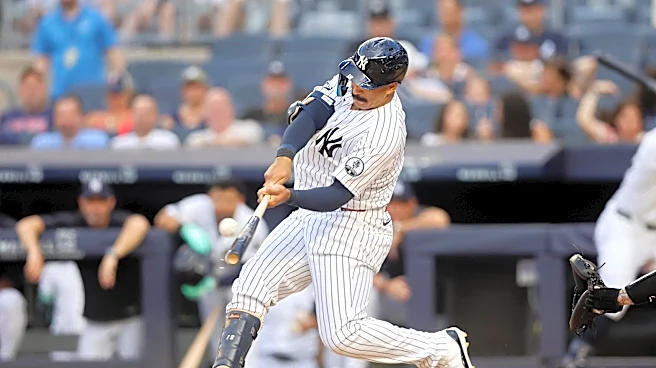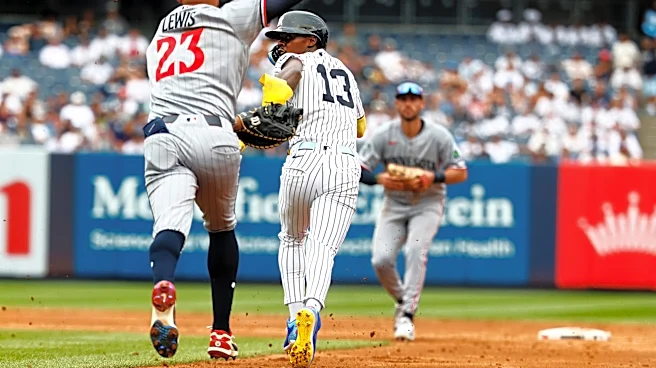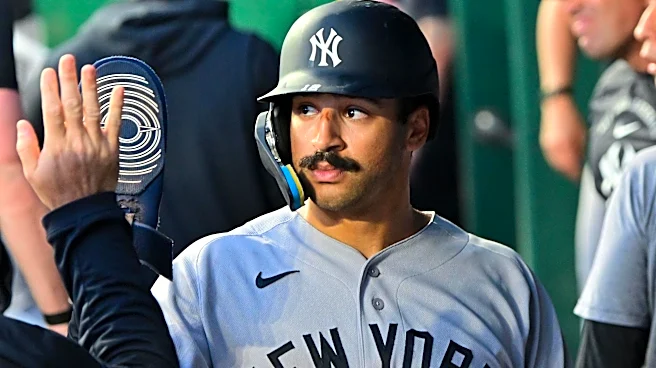




The last two weeks have been downright depressing in Yankeeland; that much is obvious. Pretty much every facet of the game has been agonizing to watch, and even though several of these games have been winnable towards the end, only one of them have ended in the win column over the last 10 games. While injuries are a big factor, it’s also just maddening regression from the 26 guys on the roster. If you removed the contributions of Aaron Judge and Max Fried from the team’s first two months, they’d
still probably have the best record in the AL through mid-June. Their struggles are much more predicated on the guys on the roster stumbling over themselves.
The team is doing a lot less of a lot of things right now. They aren’t slugging. They aren’t making basic defensive plays. The rotation has only put up a zero twice to start the game in the last nine games. Some of this can be explained, though. The slugging drop-off makes sense with Aaron Judge and Giancarlo Stanton sidelined, along with a slump by Ben Rice. The defensive miscues make more sense with how players are being played out of position out of necessity. The rotation is experiencing natural regression from a strong start and is without Max Fried or Carlos Rodón.
Something that can’t be as easily explained is the other big part of a formidable Yankees offense vanishing, their ability to draw walks. That and hitting the long ball carry a whole lot of weight for an offense that’s usually among the game’s elite. Since mid-June, the team has gone from one of the best at taking the free pass to one of the worst:
Walk Rate:
Through June 16th: 11.3 percent (first in MLB)
Since June 17th: 7.1 percent (26th)
Sure, Judge and Trent Grisham are big reasons why the team has the league’s best walk rate, but even with their absence, the team should still be pretty good at it. Even if you remove their plate appearances from the sample, something that would not be a clear representative of the data, they drop to sixth in walk rate through mid-June at 10.3 percent.
The raw numbers tell the story of a team that, overall, is walking less across the board, but maybe not as much as you’d think given the drop off.
BB% since June 17, change from pre-June 17th:
Ryan McMahon: 7.8 percent to 11.8 percent (+4.0)
José Caballero: 5.6 percent to 7.3 percent (+1.7)
Amed Rosario: 6.2 percent to 7.3 percent (+1.1)
Cody Bellinger: 13.5 percent to 13.4 percent (-0.1)
Anthony Volpe: 12.6 percent to 12.3 percent (-0.3)
Jasson Domínguez: 4.9 percent to 2.9 percent (-2.0)
Ben Rice: 13.3 percent to 8.5 percent (-4.8)
Paul Goldschmidt: 8.3 percent to 3.4 percent (-4.9)
Jazz Chisholm Jr.: 11.5 percent to 5.5 percent (-6.0)
Spencer Jones*: 13.2 percent to 6.8 percent (-6.4)
Austin Wells*: 13.6 percent to 0.0 percent (-13.6)
The asterisks for Jones and Wells are for their inconsistent playing time, but I want to key in on Wells, whose descent offensively has been both bewildering and incredibly tragic for both his psyche and the organization. Even when he was objectively bad the first few months of the season, he showed improved plate discipline. He was striking out less and walking more. Through May 30th, Wells had a 13.5 BB%, but has since not drawn a single walk in 45 plate appearances. You really have to wonder at this point if those headaches he had is something closer to an Anthony Rizzo situation with how far he’s even dropped off from his pre-IL stint’s plate discipline.
The three players who’ve improved their walk rates are McMahon, Caballero, and Rosario, but the latter two are still decently below average in that regard (MLB average is 9.0 percent). Bellinger and Volpe are still well above average themselves, but the problems start after them.
Rice’s decline is pretty stunning. You would expect a guy like him to actually walk more with Judge out as the premier threat, but teams are just not scared of him right now. Maybe how mortal he’s looked lately is contributing to it? It could also be that his chase rate has ballooned from 23.3 percent to nearly 30 percent. Goldschmidt and Chisholm don’t necessarily come to mind when you think about walks, but both were drawing them at a decent rate before a recent fall-off. Goldy’s faced a ton of lefties of late, likely prompting more aggressive swing decisions, while Chisholm’s is harder to quantify.
Looking deeper, the decrease in walk rate is inversely correlated with a spike in strikeout rate. They were striking out more than league average before this recent stretch, but it’s been even more so:
Strikeout Rate:
Through June 16th: 22.8 percent (20th in MLB)
Since June 17th: 26.6 percent (27th)
K-BB% is more of a pitcher’s stat, but to give you some context, we’ll use it on the offense. Through mid-June, pitchers against the Yankees had an 11.5 K-BB%, which is like Jeffrey Springs. Since then? It’s 19.5 percent, which is similar to Yoshinobu Yamamoto. That’s self-explanatory.
The more contact-oriented hitters on the team are making less contact, especially Bellinger, who’s up to a 22.4 K% over the last three weeks. He’s never been someone afraid to chase to spoil a two-strike offering or serve a single to left field, but this isn’t helping. His chase and whiff rates are both up five percent in the last three weeks.
You’d think with Judge and Grisham out, the Yankees would be seeing a lot more pitches in the strike zone. After all, there’s a lot less firepower to be worried about, right? I guess not.
Batting Zone%:
Through June 16th: 41.5 percent
Since June 17th: 41.7 percent
Negligible. This isn’t, though:
Chase%:
Through June 16th: 30.3 percent (sixth lowest in MLB)
Since June 17th: 35.5 percent (fifth highest)
That’s probably what it drills down to. They’re pressing. They feel the pressure of the situation and are flailing at more pitches, being more aggressive. The team’s overall swing percentage has increased from 44.6 percent to 48.4 percent, going from one of the most passive teams to one of the most aggressive. Aggressiveness on hittable pitches is good. That’s a major reason why the offense shook off a slump in the first two weeks, as they started swinging at hittable pitches more. This time, they’re eating out of the pitcher’s hands. It’s not a winning formula.
It also doesn’t help that the pitching staff has them trailing before they can even pick up the bat. Here’s some stats from the last nine games:
- The Yankees have not scored first once
- The rotation allowed a run in the first seven times
- They trailed before coming to bat five times
- They’ve allowed 4+ runs in the first three innings five times
The only two times the game was scoreless after one inning were on June 28th against Boston and July 1st against Detroit. In those games, the offense was dead silent for eight innings, trailed 2-0 after eight, forced extra innings, and lost in extras despite both being very winnable.
All told, nobody is contributing and that blows, but what the team could really use right now as they head into a do-or-die four-game set at Tropicana Field is to breathe, be more selective, and take the advice of Passion Pit: