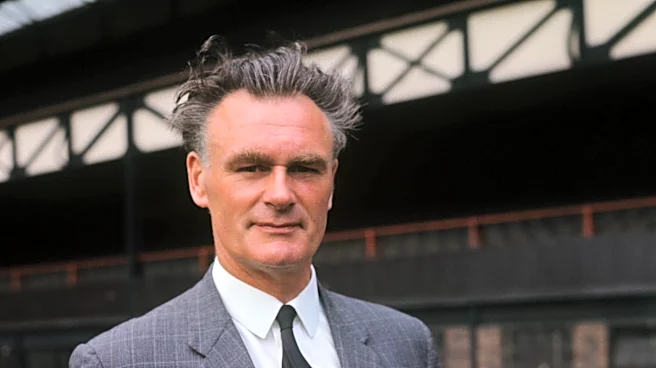











It was described as “the biggest shock of the soccer season”. Sunderland were just forty-five days away from their First Division opener when, apparently out of the blue, the ‘Bomber’ duly dropped the bombshell that he was resigning to take up the manager’s post at Sheffield Wednesday.
Brown had taken over following the ‘Mr Smith’ (illegal payments) scandal that rocked the club in 1957. The fallout from this debacle had far-reaching effects on the club and ultimately led to our first ever relegation
in 1957/58 (coincidentally alongside Sheffield Wednesday).
Brown had overseen the complete root-and-branch overhaul of the club, as he was given unprecedented authority by the board. From playing staff and coaches, training facilities, and the implementation of a country-wide scouting network to identify the brightest and best young players in the region and, indeed, the country, the club, led by Brown, set its sights on developing a team of skill, character and resilience, as well as unquestionable integrity.
He was recognised as one of the most forward-thinking coaches in the country when he came to Sunderland, and his methods were lauded by the Football Association, whose secretary, the renowned Stanley Rous, had persuaded Brown to return to the game after he retired from playing. The FA regularly employed him to deliver coaching seminars and courses.
It had taken six hard seasons, including two heart-breaking end-of-season near misses, before promotion was achieved in 1963/64.
In that time, Brown had described himself as “one of the most hated men on Wearside”, as things did not go well in the first three seasons, with demanding fans looking for instant success and an unforgiving local press that seemed only too willing to join in the protests.

Many football people and his own players believed that Sunderland, led by Brown, would go on to establish themselves successfully in the First Division following promotion in 1964.
Len Ashurst, who was brought to Sunderland by Brown in 1957, was fairly typical of the Bomber’s former players. In his autobiography, Left-Back in Time, he asserted: “Under respective managers Don Revie and Alan Brown, Sunderland and Leeds were expected to push on and take the First Division by storm after winning promotion in 1964. Leeds did exactly that, sweeping all before them both domestically and abroad. Sunderland, however, went into almost terminal self-induced decline. The reason was our manager, Alan Brown, bitterly and, incredibly, departed the club a few weeks after the glorious promotion season had ended.”
Captain Charlie Hurley was as shocked as anybody by the news. He was as close as any player to Brown and had no idea this was going to happen. He remembered it as “very sad, a sad day for me and I know a sad day for all the youngsters he had given a chance to”.
Why, at the height of his achievement with Sunderland, and on the cusp of a bright new era with the team – nay, the club – that he rebuilt from scratch, would Alan Brown resign?
At the time, Brown would only say to the press: “I have achieved what I set out to do. Now I must find another challenge.”
Sheffield Wednesday had just finished sixth in the top tier. They were, however, beset by a scandal of their own. A match-fixing scandal had been uncovered by The Sunday People, which eventually saw David ‘Bronco’ Layne, Peter Swan and Tony Kay imprisoned for four months. Thirty-three players across the country were eventually prosecuted. Swan and Kay were England internationals at the time and paid a heavy price, as they also lost their places in an England team that would go on to win the World Cup less than two years later.
Viv Buckingham, the Wednesday manager, had suddenly resigned when the story broke.
Brown had previously been employed by the Owls and had a good relationship with their hierarchy.
His experience steering Sunderland through the Mr Smith scandal, together with his personal attributes of honesty, integrity and hard work, as well as his previous relationship with Wednesday, made the job a good fit for Alan Brown. However, it still does not really explain why he made the decision to move just as Sunderland were about to embark on their long-awaited return to the top tier.
To understand this, we probably need to understand the character of Alan Winston Brown and appreciate some of the occurrences – some now known and others merely alleged – that surround this bizarre situation.
Esteemed and experienced North East journalist John Gibson once wrote that Sunderland manager Alan ‘Bomber’ Brown was “the most difficult and complex character I have had to write about”.
Brian Clough said of Brown: “The Sunderland manager’s approach was a shock to my system. He stood as straight as a Buckingham Palace Guardsman and when he delivered a bollocking – my God, did you know you had been bollocked! There were occasions when I was downright scared of the man. He detested shabby clothing and insisted his players always had a regular trim. There was never a sign of long hair at Roker Park. He ran Sunderland from top to bottom. I recognised this from the start. What he said mattered and people responded. He was ‘the Boss’ in every sense of the word and I said to myself even then, if I ever become a manager – this is the way the job should be done.”
Arthur Hopcraft, in his fine book The Football Man, observed: “Brown does not joke about football. He calls it one of the biggest things to happen in creation – bigger than any ‘ism’ you can name.” Hopcraft concluded: “There are many honest men in football, but Brown is fiercely attached to protecting the integrity of the game as its central factor. It is more important to him than brilliance. Success without it is merely deceit.”
Alan Brown gave plenty of indication of the kind of character he was in his own words and deeds.
“I get an hour’s work out of an hour’s time. I think I am known for that.” Few who worked with him would challenge this.
He told a journalist who was questioning his approach and lamenting the lack of charismatic individuals in his team: “People say there is a shortage of characters in football nowadays. But when they say that, they usually mean bad characters!”
“I ask – no, demand – the highest code of conduct from my players,” he told another journalist.
This theme emerges repeatedly from players and colleagues. Of the 1963/64 team, Brown told Hopcraft that he felt he had established a standard of self-discipline among them that made frequent instruction unnecessary.
“Look, if I am not back here at two o’clock this afternoon, I guarantee you the training session would begin. It would go on longer than the one I would give them, and it would be purposeful. That’s one of the rarest things in football.”
On a short tour to a foreign country, Brown was asked if a couple of his players might visit one of the local schools to do a little coaching with the children. Brown replied: “No, you can have all seventeen and myself.”
One key fact that may be very relevant to his resignation was that he was on record as saying: “It is important to me that I am considered absolutely trustworthy.”

We get an impression of a character with a cast-iron will and uncompromising honesty – a man of integrity. Others would say a strange man at times, a hard bastard, rigid and inflexible, ruthless.
Perhaps a balanced view, looking back, would say that Alan Winston Brown was a man who might not have been easy to like, but was widely respected.
So what led this principled man to resign?
What is fairly well known is that Alan Brown had asked the board if he could buy the club house in Cleadon where he was living, near the training ground. Most of the senior players in that promoted team had been given the option of purchasing their rented houses at the original price the club had paid for the properties, with the players covering the legal costs. The board refused Brown’s request.
Charlie Hurley was shocked to learn that Brown had not been paid the £1,000 bonus that all the players had received for winning promotion. In fact, the manager got no additional reward for the achievement other than a collection made by his players after they realised he was not receiving the bonus. Brown apparently asked the board for the bonus, believing he deserved it. The board refused.
Another issue is a little harder to pin down, but circumstantial evidence appears to support the theory that Brown had spoken to the board about a transfer budget and had not been given a satisfactory response. Signings did arrive during the 1964/65 season as injuries mounted, but as the new campaign approached Brown apparently expected to manage without any new additions beyond youngsters coming through.
The board figures highly in these events. It is telling that chairman Syd Collings was reportedly informed of Brown’s resignation on 8 July while attending the British Golf Championship at St Andrews, where he expressed shock at the development.
Brown had apparently spoken to the board as far back as 29 April, four days after the season had finished, to inform them he had been approached by Sheffield Wednesday. It is more than likely that the club house and bonus issues were already before the board. It is also hard to imagine, given Brown’s character, that he would not have raised the issue of a transfer budget at the end of the season.
It is a known fact that Brown met with the board again on 6 July and requested to be released from the remaining two years of his contract. After failing to persuade him to stay, they reluctantly agreed. It is difficult to imagine that Syd Collings was genuinely unaware of Brown’s intentions when, two days later, he was expressing his shock publicly.
Were the board playing brinkmanship with Brown over the issues he had raised? He appears to have given them ample time to consider his requests. We will probably never know for certain. If they were, it backfired badly. Given everything we know about Brown, such manoeuvring would not have sat well with him and may well have been enough to convince him to seek his next challenge. If he did not feel trusted, perhaps there was only one course of action.
It is hard not to feel that this was another key sliding doors moment in Sunderland’s history. Had the board agreed to Brown’s requests and he stayed, he appeared to be at the height of his powers, with a team of players who were fully behind their manager.
For the team, it was a difficult turn of events. Their mentor and guide had gone. George Mulhall mused years later: “Brown was a decent manager. He knew what he was talking about. Those who followed him were not as good and the team suffered as a result.”
Brown moved to Sheffield and restored stability. In his second season, he guided the club to Wembley and an FA Cup Final appearance.
It is hard not to agree with Len Ashurst, who remained convinced that, had Brown stayed as Sunderland manager, “the team would have been knocking on the door of Europe along with Leeds a few years down the line”.
We never got the chance to find out.