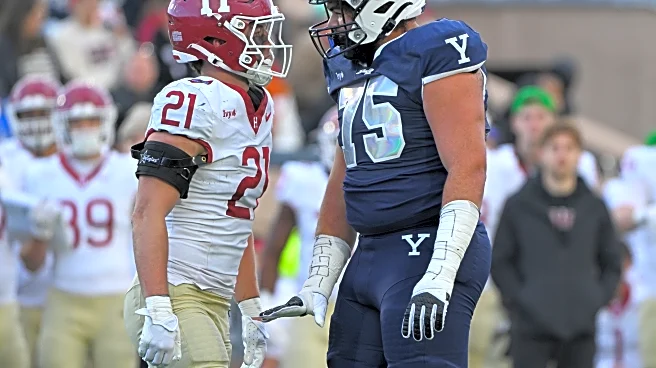

Bennett joined the Yale Bulldogs in the 2022 cycle after playing prep football in Atlanta; he was unrated by the scouting services. After redshirting his first year, in 2023 some injuries along the line pressed several young linemen into early playing time midseason, Bennett included, and he started the last six games as a redshirt freshman. I watched a few of those games for verification but they’re not included in the film or statistical analysis in this article since the line at that time was in a pretty
raw state. 2023 was also the first year for new OL coach Wheeler after Al Netter, the position coach for the previous five years and who’d helped get Yale an Ivy League title in 2022, left for Stanford.
In 2024, Bennett became the starting right tackle, playing every meaningful snap in all ten games (Ivy League teams are part of the FCS, but unlike most FCS leagues they don’t start until week 4 of the regular season, don’t have a conference championship game, and until 2025 didn’t participate in the FCS playoffs; instead they play a seven-game round robin within the conference plus three non-cons, which for Yale are typically local rivals like Holy Cross and Lehigh plus an overmatched small regional college).
As a redshirt junior in 2025, Bennett returned to his starting right tackle role and again played every meaningful snap. The Bulldogs won the Ivy League that year and took the conference’s first ever bid to the playoffs, defeating Youngstown State in the first round after falling behind 35-7 at halftime in a remarkable and odds-defying comeback, then fell to eventual champion Montana State in the second round (the final score was respectable, though to be honest I thought MSU had it well in hand, and having recently reviewed that team I felt uncharacteristic self-inflicted wounds by the Bobcats offense were the real story … curiously it was almost an exact mirror of the 2024 Yale vs Harvard game, just with the sides reversed).
When the transfer window opened in early January Bennett entered his name, and he committed to Oregon a week later (Yale’s longtime head coach, Tony Reno, announced that he would step down for health reasons and the offensive coordinator, Kevin Cahill, would take over as the new head coach for the 2026 season, but this didn’t happen until February). Bennett has one year of eligibility to play one remaining.
I acquired and charted the offensive film of all 22 games of Yale’s 2024 and 2025 seasons. While the tape on Bennett is quite extensive, the production quality and camerawork varies – the fully inclusive shots of the complete presnap setup, play development, and replay angles which I prefer for video documentation in my articles are frequently absent, and as such these clip compilations will be shorter than usual. I’ve tried to make up for this by simply providing more of them — the source material was certainly rich enough for it — so it evens out to a standard reading length.
The major comparative advantage Yale’s offense had against its opponents was in its skill players — several of whom came in with Bennett in the key 2022 class — particularly its wide receivers in open space. Cahill’s careerlong gameplan from when he was at Lehigh and ever since arriving at New Haven in 2018 was to establish the run with a workhorse back, which they had in conference leader Josh Pitsenberger in 2024 and 2025, and use short-yardage opportunities and/or the space in the defense created by concentrating on the run to make quick perimeter throws and let the wide receivers win in space. There was virtually nothing over the middle and almost no progression passing if they could help it – they wanted the ball out quick and to leverage the big athletic advantage their receivers had over the opposing DBs.
The rushing attack was an essential part of that, and in most games was between 55% to 58% of total meaningful playcalls, but explosive rushing was relatively rare at only about 12% frequency and came about mostly because of defensive miscues – rushing was more like a hammer to dull the defense’s wits and set up the real way of moving the ball, which was explosive passing on quick throws made easy by the way they’d affected the defense. The upshot is that a large part of the most productive plays, by design, didn’t really involve the offensive line needing to sustain blocks, which is important context for focusing on the setup and behind-the-chains plays when they did. Here are some examples:
(Reminder – you can use the button in the right corner to control playback speed)
- :00 – Dartmouth’s defensive front had Yale shut down both years, with broken tackles in space the only way the Bulldogs could move the ball. The defense is playing conservatively here and Yale instantly throws into the big cushion, something they’d do whenever they had the opportunity. Note the ball is out before the line is even engaged.
- :11 – Columbia has been the league’s doormat for most of the last decade, here they’re way overleveraged on the cutback. The H-back is one-arming a block and Bennett gets knocked over by a TE washing down the line but the back still makes it through the gap clean because every LB is out of position, and the DBs whiff.
- :24 – By this point in watching tape I recognized this as three-down territory as soon as they got 5 yards on 1st down; Yale was going to run an RPO on 2nd down then pound it twice if need be on 3rd and 4th. They’re running shortside, too compressed for an explosive, the center whiffs downfield anyway, and Bennett has the backside block (more on that later), but they got what they wanted.
- :35 – This is a pre-determined throw, it’s why there’s such a strong rub on the route. The tackles aren’t providing a long-term pocket and don’t need to, there’s only one throw in this pattern. The comeback against YSU was filled with these, 5 for 8 on 3rd down and 3 for 3 on 4th down, with an average of 9.1 yards to go on those 11 plays. They should have all bought lottery tickets.
The defenses that were successful against Yale needed to stymie the run without overcommitting resources so they could get the Bulldogs into long-yardage passing situations, and once they had them there make the QB stay in the pocket and read his progressions instead of hitting a quick throw to confront the protection with a serious pass rush. This was a pretty effective strategy – Yale’s passing success rate collapsed from 60% to 75% in 1st down or various short to medium yardage situations, or rushing at close to 80% in short yardage, all the way down to 31% passing success in 3rd & long situations.
Bennett’s pass protection film is a mixed bag in these key situations. Some of the tape shows solid fundamentals in terms of weight balance and keeping his power with good footwork; here are a few examples:
- :00 – Bennett is the right tackle in jersey #75, as in all clips. The DE has a good get-off and is trying to convert that speed to power in a bullrush, but Bennett’s footwork is good here, keeping his balance centered and moving with many rapid small steps. Contrast this to the left side, who are lunging and losing.
- :21 – Three-man rush with an E-T stunt, and the RG is napping a bit. Bennett does a good job forcing the exchange then blocking two guys at once — he has the size for it — giving the QB a chance to escape.
- :40 – The OLB here tries an inside then outside move, Bennett stays moving with him with his weight balanced and frame interposed throughout. The bad throw is on the QB, he should have taken a deeper drop and anticipated the route from the LB’s leverage instead of rushing his mechanics when he finally spotted the opportunity.
- :57 – Good drop against the outside rusher on the blitz. Note his back is flat, his hands don’t fire until the rusher comes to him, and how the drop continues as Bennett turns and engages so his weight is over his feet and his frame is between the rusher and QB at all times.
The bare majority (50.28%) of Bennett’s contested pass protection reps I felt were best described as “okay” … I could see there was some sort of technical issue starting to crop up and I couldn’t enthusiastically approve of the rep (especially considering the “degree of difficulty” problem, more on that later), but it wasn’t bad enough to have really negatively affected the play by the time the ball was out and earned a negative grade either. Projecting exactly what these mean for translating to Power conference play is a major challenge – so few linemen have made this kind of leap and gotten immediate playing time that I’m unable to construct a workable data model for precise predictions.
Here’s a representative sample of these reps:
- :00 – Compare this rep to the immediately preceding one, there are some subtle but real differences. Bennett’s weight is balanced but it’s a much shorter drop, his hands aren’t lunging but they aren’t patient either, and just at the end when the QB is releasing the ball his feet freeze and he starts straining. Bennett loses his anchor but recovers it.
- :16 – Here Bennett isn’t dropping at all, he shuffles a bit at the line and then lunges at the end. He’s getting driven back into the plant space with no anchor and the QB has to dance back, but it’s a quick throw on a wide open comeback so it’s not really a problem this time.
- :22 – The real problem here is the bonkers blitz pickup strategy, the center and RB are going the wrong way. Bennett is on his own and hardly the issue with the QB taking the hit, but he sure is playing high and giving a lot of ground – his weight is behind his feet when the end makes contact and he never really re-anchors, it’s just that the backer gets there first, and the QB makes a courageous throw.
- :38 – Yale found the only way they could run on MSU was out of this super wide spread which lightened the box, but the downside was it meant half-field reads only. Bennett’s short set and escort of the outside rusher (very Harkey-esque) is only enough for a quick throw so the QB has to go to the RB dumpoff instead of a wideout.
I tallied a 26.32% error rate in pass protection for Bennett over 2024 and 2025 combined, with an improvement of about 1.9 points between the two years. This is my first time charting an Ivy League offensive line, but in the dozen full-season FCS charting projects from other leagues I’ve found that about a 20% error rate is the FCS median in my charting system with a standard deviation of 5.5 percentage points. Bennett’s grades were in-line with the rest of the Yale offensive tackles (five played) except for a freshman who was pressed into action at left tackle in the 2025 postseason due to an injury who had an even higher error rate.
The best inference I can make is that Yale’s line play was standard for the conference — and Bennett’s play was in turn standard for Yale’s tackles — but Ivy League line play is about the same step below the rest of FCS standards as the FCS is from FBS standards (median in the FBS is 15% with a 5.1 point st.dev). So while nothing I saw made me think that Bennett’s play was substandard or out of sync for his particular development pipeline, the amount of progress he would need to make this offseason in getting up to FBS speed, let alone historical Oregon standards of single digit error rates, would exceed anything I’ve ever observed.
There are a number of issues for Bennett to work on in pass protection. The most significant is physical development of his core and base – when he’s been beaten quickly enough for pressure to get through and sack the quarterback, the most common factor is physically losing his anchor. Some examples:
- :00 – Bennett just doesn’t flex his body to get low and engage with power, the end knocks him aside.
- :09 – Here the end rides Bennett deep then cuts across him inside, Bennett is up on his toes and not able to bear down on the end to keep him from doing that.
- :31 – They’re in 12-personnel here, the TE and H-back to Bennett’s right get the DE and LB, while Bennett is reaching in for the DT on the run component of an RPO play. Bennett makes poor shoulder contact with the DT and is physically overpowered; the DT has so much free time in the backfield that he can wrap up the RB, realize he doesn’t have the ball, and then move on to sack the QB.
- :47 – Yale is using a seven-man protection against MSU’s standard four-man rush and still getting crunched. Bennett is playing far too high and being shoved back progressively, when the QB bails away from the LT’s pressure, Bennett’s man has no opposition in getting the sack.
In dealing with bullrushes and outside moves, Bennett’s technical issues are typical ones – bending at the waist instead of the knees with a flat back, lunging instead of keeping his weight centered, setting short and turning instead of keeping his frame between the rusher and the QB. Nothing exotic, they’re just too frequent. Some examples:
- :00 – Playing high, not bending at the knees and exploding upwards into the block, so he’s getting put on skates.
- :10 – Setting too short and turning before engaging, the rusher is past Bennett while his weight is behind his feet. That’s how you lose to an outside speed rush every time.
- :24 – Another seven-man protection against a four-man rush. Bennett waist-bends and reaches without anchoring, the DE swipes his hands down and because of the weight imbalance that pulls his body out of the way and gives the DE a path to the QB.
- :31 – Too much rotation, too early, Bennett’s frame isn’t obstructing the upfield arm of the end and he can reach out for the QB to affect the throw. The QB dances back and dumps it off short of the sticks for a failed conversion.
The entire Yale offensive line over the two years I watched their tape showed substantial issues in blitz and stunt identification, and I often thought their strategies in blitz and simulated pressure pickups were irrational. Bennett graded out a bit better than the rest of the line in one sense here: I thought he recognized the need to handoff his initial block to pick up a stunting defender more readily than most of the other 11 Bulldog linemen I charted in this time, but I still think that his pass protection grades on stunt, blitz, and sim reps could use some work. Here are a few examples:
- :00 – The DB is an obvious creeper but Bennett doesn’t pick him up or point him out to the rest of the line for adjustment (the QB doesn’t throw the wheel either, they both miss it). Bennett is locked onto the DE and lunges at him which doesn’t work, letting him through inside. This exact same set of issues happened on 2nd and 3rd downs on the previous drive and killed that one too.
- :15 – The line is just baffled by this blitz from depth, Bennett and the RG allow the DE to split them while they’re trying to figure out what’s happening and the DB is still five yards off, but then Bennett still doesn’t get the DB so he blocks a total of zero defenders on this sack.
- :23 – The first problem here is how deeply the RG is getting hammered but the second is Bennett chasing the end when he stunts over him to the inside, that should be a cue to drop back and take the DT off the RG’s hands. But these two never got a good sense of communication (Bennett played next to four different RGs and this was the most awkward); they stay locked on their initial blocks and everybody loses contact. The QB gets free but the line gave up a sack on the previous down so the scramble on 3rd & 18 doesn’t help.
- :32 – The defense doesn’t buy the slide protection at all and this pickup doesn’t work, everybody should be one defender over. Even the guy Bennett does block he’s not controlling because he bounces off instead of getting in front of him.
Where there’s a spike in the data is dealing with pass rushers’ inside moves – Bennett lost control of these at 8.6 percentage points over baseline. Here’s a representative sample:
- :00 – The end gives Bennett a little shimmy to the outside and that throws him, he leans his weight that way and he’s done because his feet freeze. When the end makes his actual inside move Bennett just reaches his arms for the defender without his frame in the way, which will never work.
- :10 – This is a good deep drop but then Bennett can’t anchor at the end of it (very World-esque) and the OLB just reaches in for the QB’s throw with his arm right in the lane. He misses the swat by a single frame on the tape.
- :23 – The big outside step by the OLB gets Bennett to take a wide drop, and then the OLB cuts inside much faster than Bennett can recover from the misdirection.
- :35 – Just way too high, no control either way the end had moved. He goes inside and it’s all Bennett can do to squeeze him a bit against the RG.
The throughline I see for both these inside move issues (as well as many other general pass protection reps) and for properly sustaining run blocks is Bennett keeping his feet moving throughout the rep so he can maintain his balance and power, compared to the reps when his feet freeze after about 1.5 to 2 seconds. The pattern I notice when he stops moving his feet is that he also surrenders his “low man” advantage and starts playing high, lifting up on his toes and straining with an arched back. This can kind of work against a bullrush — it’s hard to go straight through him like that, and he generally has a height advantage at 6’5” — but it makes it very easy for a defender to disengage laterally into the pocket or rush lane because Bennett’s frame is no longer in the way.
Here’s a blended compilation of pass and rush reps showing this issue:
- :00 – Look at Bennett’s back and arms – while he started the contact low, he’s gone up high and arched his back, and he doesn’t have inside hand control on the defender’s chestplate. That leaves him off balance and vulnerable to being ripped down.
- :10 – This looks like a Greco-Roman wrestling throw, all the engagement is with Bennett’s upper body twist, not blocking with a grounding from his base.
- :20 – Bennett’s doing well as long as the DE is pushing deeper, but as soon as he reverses, Bennett doesn’t shift his weight to maintain control, he goes up on one foot and completely loses his anchor.
- :29 – The first two seconds of this run block from Bennett are excellent, but then his feet just come to a dead stop and he arches his back halfway over. The run isn’t actually going in this direction but if that’s where the back cut to, in this posture the end is free to lean into any running lane or just drive Bennett back by getting low.
There was a strong skew in the run-blocking data, because on more than a 2:1 basis Yale ran to the left rather than the right. I don’t think this preference had to do with favoring the blocking to that side of the line, because it persisted across both years when they had a major overhaul on the left side in 2025 as well as throughout several injury substitutions including a completely inexperienced freshman in their first playoff game at left tackle. It also persisted regardless of A-, B-, C-gap or wider as the aiming point, man vs zone blocking, or where the tight end(s) lined up. Instead I think it was about trying to set themselves up on the left hash for subsequent passing plays so they could put their passing strength on the QB’s right (now, I’m not sure why that was, there aren’t any performance data indicating they played better that way, but it was a consistent choice when they wound up spotted between the hashes).
The upshot is that on the majority of rushing reps, Bennett has a backside block which was in a sense irrelevant to the play as it actually developed. I grade on process, not outcome, so I still counted it as a postitive or negative rep depending on how successfully Bennett (or anyone else I was grading, I did the full cohort analysis) executed his block and controlled the relevant defender, but this offensive tendency meant that plays with good tape in which Bennett had the key block to springing the run — good, bad, or ugly — were sparse.
By far the best area of Bennett’s blocking are plays when he doesn’t need to make a change of direction and can use his full force the same way from the snap all the way through. On run plays most of the time that’s taking defenders who are slanting inside (in Bennett’s case as the right tackle, to the offense’s left) and using his outside leverage to wash them down, but he’s also shown on a variety of other plays that once a defender’s feet start moving the way Bennett wants them to he’s in good shape to keep them going that way. Some examples:
- :00 – The d-line is in Tite, and the end on Bennett’s side wants to get outside to contain the QB keep. Bennett comes off the snap and plays right through him, flipping him over and gaining outside leverage to force him back in.
- :06 – This turns into a bit of a hash because the RG doesn’t climb to his backer and both the pullers get wrong-armed, but the back keeps his feet through the mess and muscle runs it, and Bennett joins in, turning his block into a pile push and continuing to churning his legs right alongside.
- :23 – I don’t think this is the right read by the QB but it doesn’t really matter since the OLB can’t do anything with it, and Bennett has cleared that DT all the way out of the picture hitting him from the outside right off the snap and just keeping it up.
- :30 – Here’s a stretch run, Bennett begins inside the OLB and never relents shoving him out until they hit the sideline.
But the base set of run plays in Yale’s offense was midline and wide zone, and in 2025 the new quarterback (the head coach’s son, who’d transferred back home from backing up LaNorris Sellers at South Carolina) was very reluctant to keep the ball on read-option plays. That meant most of Bennett’s run blocking required one of two things: first, getting inside leverage on the edge defender and turning him away from the ballcarrier, or second, climbing to the second level and controlling the backer.
Overall, Bennett’s run-blocking grades on my tally sheet came out similarly to his pass-protection grades, a 25.90% error rate. However the subcomponent areas of his run blocking have more spikes and valleys to them, with better than average marks for plays with outside leverage and a hot-and-cold performance against edge defenders, getting proper inside leverage, and controlling second-level defenders.
Here are some examples of successful reps getting inside leverage:
- :00 – Low contact, explode up, turn the defender away from the play, and then when he tries to go downfield to chase the back, Bennett’s feet keep working to stay interposed and in control.
- :11 – Similar contact and turn, the end is doing a better job here ripping away early and gets a bit of a step, Bennett has to chase him but avoids a holding flag by staying in contact and running with the defender the whole way – if his lower half stuck still and he used his arms on the outside of the defender’s frame to restrict like that it’s probably a flag.
- :25 – Great wide base here and lots of leg drive, turning the defender fully around with his back to Bennett’s endzone.
- :31 – This split flow should look familiar to Oregon fans. The YSU edges won a lot of reps against Yale tackles but this is a good form with his right hand inside on the chestplate for control.
And some examples of unsucessful reps at inside leverage:
- :00 – The difference in technique should be very clear, high engagement not low, frozen feet without leg drive, straining against the defender to push at him instead of working him around. When the defender is done setting the edge just monitoring the play and wants to rip free to pursue the back downfield he does so easily.
- :09 – Bennett’s assignment is to reach the 3-tech on the counter motion and gets smoked. Because the back is going the other way (following the pulling LG to the strongside) all isn’t lost, Bennett could get his shoulder into the DT’s torso and power him into the LG’s vacated space. But he’s too high to do that either, and the DT gets right through to the back for a big TFL.
- :21 – This is pretty well blocked, if the QB had read it correctly and handed off it’s a touchdown, but he keeps it and Bennett wasn’t ready for that – he was trying to just knock the end down instead of control him, and falls over when the end pulls free.
- :28 – Bennett’s striking too early, he needs to take another step downfield to get better leverage first and then engage. As it is when the end wants to rip across him inside to the B-gap the only way Bennett has to stop it is his arms, not his frame, and that’s not enough.
The biggest surprise in reviewing Bennett’s tape was that he was almost always the largest person on the field, but balance and positioning problems let defenders frequently play bigger than him on what should have been easy plays. Some examples:
- :00 – Based on the WR blocks I don’t think this was intended to be a B-gap run but rather a sprint to the sideline with Bennett getting outside leverage on the end and sealing him in. But he loses his standing wrestling match and Bennett is the one who gets sealed inside, and the QB reverses course.
- :10 – This is an RPO, there’s no reason for Bennett to mirror the OLB when he penetrates deep on the pocket – that’s doing him a favor. Either the QB’s going to throw it quick and it doesn’t matter, or he’s going to hand it off (as he actually does) and Bennett should stay on top and trap him. Chasing then losing him is the worst of all worlds.
- :21 – Bennett shouldn’t have any difficulty with this 2nd level block, he gets up to the backer clean and has an obvious size advantage, but doesn’t have his feet in place when he engages and the backer knocks him back then pushes past him.
- :29 – The only job here on the backside block is to step in front of the end with inside leverage and push him away from the play, but Bennett is getting driven back from the get-go and the end easily gets free of him, comes across the formation, and gets in on the tackle.
The lowest grades on my tally sheet for Bennett came in second-level blocks – getting there on time, to the right defender with the right leverage, and controlling him. The first part of that equation, timing, saw some of the biggest improvement from 2024 to 2025, because as a sophomore he had a real problem getting stuck on chip blocks at the first level and as a junior he got a lot smarter about taking a better path to avoid problems or just forgoing the chip entirely if he needed to. But the other aspects didn’t budge at all – I continued to see leverage issues, missing blocks, and even against backers he must have outweighed by close to 100 lbs, hits that were just too weak and failed to control the defender. Some examples:
- :00 – Bennett has an unobstructed climb to the backer, his job is to get inside and turn him, but low man wins and the smaller backer knocks Bennett back because his engagement is high and lacks power, then gets in on the tackle.
- :06 – Because the defense didn’t bite on the unbalanced formation and the QB isn’t eliminating a defender with a read, the defense has a numbers advantage and Bennett can’t afford the time to block like this. He needs to ignore the DT and chip the frontside backer to buy the pulling H-back time to get to the corner, then race right for the backside backer to control him. He does none of those things.
- :13 – This is what most of Bennett’s chip & up plays looked like in 2025, a ton of energy expended helping the RG and together they send the DT flying, but then he’s got nothing in the tank and a poor engagement technique for the LB he actually needs to control. Losing him then knocking him over from behind after the ballcarrier is down risks a personal foul flag.
- :22 – In all 22 games I charted I saw the same way that Bennett gets stuck at the 1st level, he’s making a beeline directly for the 2nd level defender he’s assigned to and failing to notice that the DT’s butt is in the way. Instead he needs to move up then over, like a knight instead of a bishop.
In thinking about the positives of Bennett’s tape that may have attracted Oregon, I noticed a few more things I haven’t mentioned yet. One is that Bennett’s penalty rate was exceptionally low, a little over twice every 1,000 snaps, while the rest of the offense was at 42 per 1,000 … so the rest of the squad had about double the penalty rate per player. Another is that he was constantly showing extra effort during plays; here are some examples:
- :00 – That’s Bennett hustling over to make the tackle after the interception.
- :19 – This run is stuck because the guards have lost their blocks, Bennett’s isn’t great either but once it turns into a Katamari ball he eagerly joins in rolling it downhill.
- :28 – These sweeps were by far Yale’s most effective run play, their perimeter blocking was great. Unfortunately there weren’t any good camera angles of Bennett usefully blocking one since they almost always went left and he was on the backside without much to do but we got this one of him showing some really impressive wheels.
- :38 – Bennett’s finish to blocks once smaller defenders disengaged was often pretty amusing.
One of the complicating factors to Bennett’s tape was that many of Yale’s successful offensive plays — and in my estimation this includes nine of the 15 biggest during the 2024-25 period — would be unlikely to translate at the next level. That is, they were only successful because of defensive timing or athleticism gaps that existed in Ivy League play but couldn’t be counted on in FBS play, let alone Power conferences. These might present a dilemma if all one is after is blocking that’s “good enough” … here are some examples of great plays for Yale in which the blocking was evidently good enough in the moment, but I have doubts it would have been at the next level:
- :00 – This was the first one of what proved to be dozens, the line including Bennett is completely beaten and the QB is about to get crunched, but he delivers a big pass to a receiver who’s defeated coverage and there’s no safety help.
- :09 – Amazingly, both blockers on the right side losing is a pair of problems that solve each other.
- :28 – Both tackles have lost their edge rusher, the QB has no time to properly step into the throw or go to the zone-beater on the other side of the field, and chucks it to a very well covered receiver, who gets the TD anyway over an alligator-armed CB.
- :45 – I thought this was a very impressive catch, then I started doing the numbers … it’s an eight-man protection against a four-man rush, so it’s two receivers in the pattern and somehow seven defenders in coverage are letting the wideout run past them with no one over the top.
The final complicating factor is this: I’ve done season reviews on three years’ worth of Notre Dame tape, four years of Auburn, five years of Florida State, and more of Washington than ought to be permitted under the 8th Amendment … and this Yale football team might be the luckiest program that I have ever seen. I was amazed at some of the stuff that the Bulldogs got away with, most of which if Oregon tried I’m certain would not only fail but would somehow result in injuries and NCAA sanctions. Here are my favorite examples: