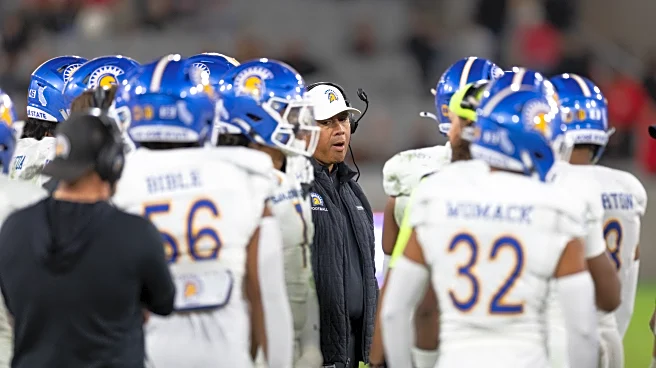


The easiest way to explain how San Jose State football digs itself out of the wreckage of 2025 is this: Ken Niumatalolo didn’t just add coaches, he injected deep perspective.
After a season defined by late-game breakdowns, missed kicks and a fan base wondering how things unraveled so quickly, SJSU’s latest staff moves feel less like routine off-season churn and more like a philosophical reset.
New blood matters. Especially in a program that, at times, felt stuck leaning on ideas that once worked but
no longer fit whatever the state and dynamics of college football reality is today.
Making it official with Bojay Filimoeatu.
Elevating Filimoeatu to defensive coordinator is both a nod to continuity and a break from stagnation. Filimoeatu isn’t married to a single scheme and that flexibility is precisely why he works in today’s Mountain West. His background under Jay Hill and Brady Hoke shows up in how he teaches leverage, angles, and accountability; the basics that quietly disappeared during the 2025 malaise. More importantly, players respond to Filimoeatu.
Case in point, Jordan Pollard’s rise from productive linebacker to national name wasn’t an accident; it was development, clarity, and trust. Pollard’s Fresno State finale — 19 tackles and a pick-six — felt less like a fluke and more like a glimpse of what Filimoeatu defenses can become when they’re truly empowered.
Pairing Filimoeatu with Brian Norwood is where this thing gets interesting.
Norwood’s resumé reads like a survival guide for defensive football across eras. He’s seen offenses evolve, conferences dissolve, and recruiting landscapes flip upside down and he’s still producing elite secondaries. Norwood’s work at UCLA and Kansas State proves he knows how to build pass defenses quickly, which matters in a league where one missed rotation turns into six points.
There’s also a subtle but important connective tissue here: Norwood coached at Navy in 2019, during one of the Midshipmen’s best seasons. That shared philosophical DNA with Niumatalolo isn’t coincidence. It’s alignment.
Joe Dale and Brian Norwood together also signal something else: accountability without ego. Dale’s Weber State defenses were physical, disciplined, and ruthless in assignment football. It’s exactly what SJSU lacked when games slipped late last season.
This staff isn’t chasing splash; it’s chasing reliability.
On offense, Ramsen Golpashin might quietly be the most important hire of the group. In a NIL-and-portal era, offensive line play is both harder to build and easier to lose overnight. Golpashin’s NFL background and Power Four experience bring professional standards to a unit that has to stabilize if SJSU wants to compete week-to-week. You don’t survive by rebuilding every year. You survive by developing.
Special teams, too often an afterthought, gets credibility back with an old friend: Fred Guidici. Anyone who’s watched any football game swing on a missed assignment knows how valuable competence is in this phase. Guidici’s return feels like institutional memory used correctly.
And that’s the larger point.
This staff represents new voices without severing identity.
Niumatalolo doesn’t need to think about or recreate Navy wholesale success; that wouldn’t work here. But philosophically, returning to clarity, toughness, and player belief absolutely can. In a finicky market where NIL money is uneven and the transfer portal never sleeps, confidence is currency. Fans feel it. Players feel it.
San Jose State didn’t fix everything in one off-season. But for the first time since 2020, the direction feels very intentional. And sometimes, that’s how all-around trust starts coming back to Sparta.