
There were, if not outright concerns, certainly questions about how good the New York Giants defense could be in 2026.
Between edge defenders Brian Burns, Abdul Carter, and Kayvon Thibodeaux, as well as off-ball linebackers Tremaine Edmunds, Arvell Reese, and Micah McFadden, the Giants’ linebacking corps was expected to be one of the best in the NFL. And the hope was that their defensive line would at least be serviceable after the addition of veteran defensive tackles D.J. Reader and Shelby Harris.
The bigger questions were about the Giants’ secondary, particularly after Cor’Dale Flott left in free agency.
2025 free agents Paulson Adebo and Jevon Holland hadn’t panned out in their first years as Giants, while 2023 first round pick Deonte Banks had regressed badly under DC Shane Bowen and was considered a bust. The Giants signed former Cleveland Browns and Jacksonville Jaguars cornerback Greg Newsome II, as well as former Baltimore Ravens safety Ar’Darius Washington, in the 2026 free agency period and drafted Tennessee cornerback Colton Hood in the second round of the draft.
However, those moves weren’t viewed as much more than Band-Aids for a Giants’ secondary, and national commentors suggested that the Giants’ scondary could be putrid in the first year of John Harbaugh’s rebuild.
Fast-forward nine games, and the Giants’ secondary has been much, much, better than anticipated under Dennard Wilson, Donald D’Alesio, and Addison Lynch.
The Giants are currently fielding the NFL’s fourth-best defense in total yardage allowed (2,751 total yards). They’re third-best in passing yardage allowed per game (184.1 yards per game), second in yards per completion allowed (9.8 yards per completion), and 2nd in yards per attempt allowed (6.2 yards per attempt).
The Giants are accomplishing this feat with smothering coverage from their starting corners. Both Deonte Banks and Greg Newsome II have been incredibly sticky in man coverage, allowing little separation for receivers.
Banks is allowing just 2.1 yards of separation as the nearest defender, per NFL NextGenStats, while Newsome is allowing all of 2.6 yards of separation. Banks and Newsome are both forcing tight window throws on over 40 percent of the plays in which they’re the closest defender — which is exactly what the “step coverage” Dennard Wilson’s defense calls for.
(note: “step coverage” calls for the defensive back to be within a step of the offensive player)
And while slot corner Dru Phillips is allowing more separation (3.6 yards on average), he’s allowing -5.9 EPA in coverage and a Catch Rate Over Expected of -13.0 percent.
Defensive coordinator Dennard Wilson praised the Giants’ safeties when he spoke to the media on Thursday, saying,
“I think Ar’Darius played his best game the last outing against Washington. Obviously, he tackled extremely well. You saw him, in the fourth quarter in a critical situation, come up with an interception. He’s been doing everything that I know he could do, from being around him in Baltimore when he was there. He is a smaller guy that plays with a big stick. He is going to attack the line of scrimmage. He tackles well. He can cover. So he’s doing a good job. I think all the safeties are doing a good job in their role. It’s kind of safety by committee. All of them deserve the opportunity to play. So that’s why we’ve been playing them.”
And Wilson wasn’t just puffing up his players. Each of the Giants’ safeties have played very well in coverage as well.
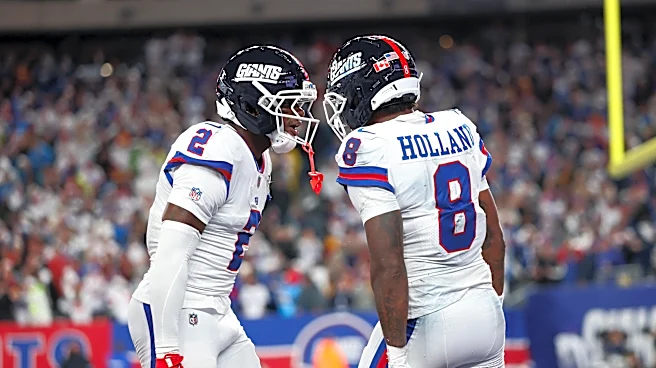
Jevon Holland has been among the best safeties in the NFL this year, allowing a -27.8 percent catch rate over expected which is 3rd best among all DBs in the NFL and -13.4 EPA allowed. Jason Pinnock has proven to be remarkably sticky in coverage
The Giants’ airtight coverage is allowing them to lead the NFL in the rate of Cover-0, that is man coverage across the board, at 10.8%. That jumps to 11.8% in obvious passing situations, and the Giants are sixth in EPA allowed in those situations.
Interestingly, the Giants’ pressure rate has been remarkably low when only rushing four defenders, even with their sticky coverage. That’s led to frustrations from fans when it comes to sack totals (or the lack thereof), particularly with regard to Abdul Carter and Kayvon Thibodeaux. Both of the Giants’ starting EDGEs have elite get-offs, but have all of 2.0 sacks between them.
NextGenStats has shown us that part of the problem is that the Giants’ opponents specifically game plan for their hyper-athletic pass rushers. The Giants’ opponents feature the second-fastest Time To Throw of any defense in the NFL, as well as a Top-3 deviation from their usual Time To Throw.
The Giants’ sticky Cover-0 packages work with Wilson’s aggressive blitz patterns (as he refers to them) to provide an answer.
The Giants are now second only to the Minnesota Vikings — and the madman that is Brian Flores — in the average number of pass rushers sent at 4.90.
The Giants are currently sitting at 5-3-1 on the season, and they can thank their defense for closing out four of those wins, as well as forcing the tie against the Washington Commanders.
All told, the Giants’ secondary has been one of the most surprising units in the entire NFL, and it’s powering a defense that is finally playing up to its potential. I suspect they’d be getting much more attention on the national level it weren’t for the low sack numbers and what Flores is doing in Minnesota.
Now, the Giants will need them to keep it up, or perhaps even find another level if they can.