

The New York Yankees know what it’s like to hold some of the league’s best relievers in its bullpen. Names like Goose Gossage, Sparky Lyle, Dave Righetti, and Mariano Rivera are the talk of the town for the Bombers of old, while Dellin Betances resonate with those in the modern era. But another reliever of the modern era—who wasn’t with the team for a long time and competed with the likes of Betances—defined his career on nasty stuff.
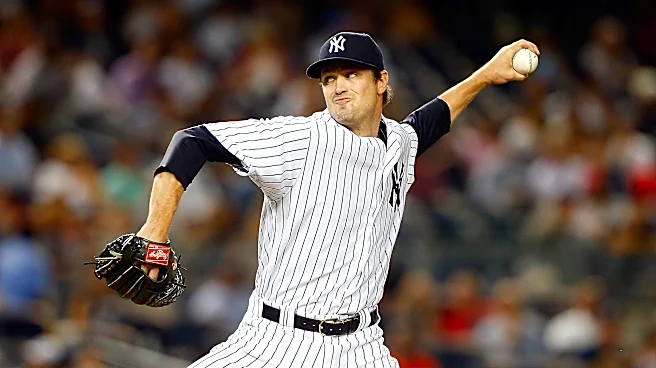
Andrew Miller didn’t throw the hardest. He never did. But every
time he stepped on the mound, opposing hitters knew they were going to face that nasty stuff. The 6-foot-7 left-hander made a living on movement and deception, which allowed his career to span 16 seasons and seven teams.
Andrew Mark Miller
Born: May 21, 1985 (Gainesville, FL)
Yankees Tenure: 2015-16
Miller was born and raised in Florida and attended Buchholz High School, where he won the Florida Gatorade Baseball Player of the Year award in his senior season. He was selected by the then-Devil Rays in the third round of the 2003 MLB Draft, but Miller elected to attend the University of North Carolina at Chapel Hill, where he was a starting pitcher for the program from 2004 to 2006. He set Tar Heel strikeout records for both single-season with 133 in his junior season in 2006 and 325 in his career. And in 2006, all his work in the ACC paid off, as he was drafted sixth overall by the Tigers. Miller was considered as a potential option for the first overall pick, but dropped a few spots due and became the pick for Detroit. They gave him a $3.55 million bonus, the highest of anyone in that draft class.
Following just three games in A-ball, Miller was immediately thrown into the fire, coming into the major leagues at the ripe age of 21. He made his debut on August 30th against his future team at Yankee Stadium in the Bronx. He pitched an inning with no trouble, finishing the inning by inducing a groundout from no less than Derek Jeter.

Detroit used him sparingly down the stretch for their eventual pennant-winning team in 2006, and while he was understandably left off the playoff roster, he appeared in eight big-league games with a 6.10 ERA. The next year, the Tigers tried Miller as a starter, the role they always imagined for their prized draft pick. He spent time in the minors and was out with an injury, but he did make 13 starts with 64 innings pitching, notching a 5.63 ERA.
A career in Detroit was short-lived, though, as Miller was included in a franchise-altering trade before the 2008 season. On December 5, 2007, Tigers GM Dave Dombrowksi struck a deal with the Marlins, sending Miller, fellow well-regarded up-and-comer Cameron Maybin, catcher Mike Rabelo, and pitchers Dallas Trahern, Frankie de la Cruz, and Burke Badenhop to Florida for popular left-hander Dontrelle Willis and future Hall-of-Fame infielder Miguel Cabrera, then a third baseman. It was considered quite the haul for the Marlins, but for a talent as young and elite as Miggy, it was more than well-worth the price for Detroit.
Miller never quite clicked as a starter in the Motor City, and that trend continued in South Beach. He spent three seasons in Florida, tallying a total of 58 games with 41 starts and an ERA of 5.89 through 220 innings, including an 8.54 ERA in nine games (seven starts) in 2010 following injuries to his oblique and assignments to the minors. The Marlins were out of patience with Miller by the end of 2010, and by the start of 2011, he had moved on to the Red Sox. In his last effort to make it in a big-league rotation, he had a 5.54 ERA in 17 games, including 12 starts.
By the spring of 2012, it was clear that something had to change if Miller was going to remain in The Show. Indeed, the beginning of the rest of his career kicked off when new Red Sox manager Bobby Valentine decided* that Miller’s arsenal best suited him for the bullpen. And in 2012, playing in 53 games with zero starts, Miller posted the lowest ERA of his career (3.35). His ERA+ shot up from 78 to 127 with the lesser workload and more focused arsenal, and he found a position that best suited his talents.
*One could argue that this was literally Bobby V.’s only smart move for that infamously bad Red Sox team.
From 2012 onward, Miller did not start a single game for the rest of his career. In 2013, Miller suffered a foot injury and was forced to miss almost half the workload that he had had the season prior due to the injury and his recovery time. However, in the time that he did pitch, he put up the best year of his career to that point. He posted a 2.64 ERA with 48 strikeouts in 30.2 innings pitched, and while he missed the postseason, he earned a World Series ring when Boston beat St. Louis in a six-game Fall Classic.
Miller took his game to another level in 2014 as he began to dramatically cut down on his walks in addition to striking out well over a third of the batters he faced. That made him an attractive lefty relief target as Boston’s repeat attempt went sour. In July, he was moved to the contending Orioles for young arm Eduardo Rodriguez, who MLB fans would soon know as a consistent, innings-eating starter for Boston, Detroit, and now Arizona. Miller added to his bona fides with a 1.35 ERA and 34 strikeouts in 20 innings down the stretch for the O’s, who won the AL East for the first time in 17 years. He was nearly untouchable in October too, posting a pristine 0.00 ERA across 7.1 innings, allowing a grand total of one hit and one walk while fanning ten in Baltimore’s longest playoff run of this century to date. They got swept by the surprising Royals in the ALCS, but that clearly wasn’t his fault. It was the beginning of a run of 24.1 consecutive scoreless innings across 15 games to begin his postseason career between 2014-16.
Such a performance attracted the Yankees’ eyes, and they were so encouraged by Miller that they were willing to let a good homegrown closer in David Robertson walk away in free agency, instead signing Miller to a four-year, $36 million contract on December 5, 2014. In 2015, Miller’s only full season with the Yankees, he had his best single season with one team, posting a 2.04 ERA in 61.2 innings with 100 K’s on the dot while putting up 36 saves. Miller paired with the All-Star Betances to establish a formidable one-two punch for manager Joe Girardi at the end of ballgames. That 200 ERA+ would begin a trend that he would continue (and then some) for the next few years of his career.
Although the Yankees went one-and-done in the Wild Card playoff that year, Miller had quickly become a fan favorite, and he had such respect around the league that he won the award named for one of his predecessors as Yankees closer, the Mariano Rivera American League Relief Pitcher of the Year.
The following offseason however, the relentless Yankees decided to take another step to fortify their bullpen, acquiring the flamethrowing Aroldis Chapman from the Reds in a controversial deal. He had been a closer longer than Miller, and since the latter was perfectly fine shifting roles, Miller became a setup man. The Betances/Miller/Chapman trio was one that no one relished seeing.
Not only would the bullpen order go from a righty to two left-handers, but it was two left-handers with completely different stuff — Miller with the decimating slider that hitters only batted .092 against in 2015, versus Chapman, who was averaging at least 100 heading into the 2016 season (and upped his velocity during the season with Chicago). Chapman had been suspended for 30 games at the start of the season, so Miller filled in at closer during that time until he joined the team.
The major drawback to the 2016 Yankees was that while they had an absolute force for the seventh, eighth, and ninth innings, they didn’t have much else. The offense was underwhelming and the rotation after Masahiro Tanaka was not particularly inspiring. At their absolute best, they hovered around .500, and it became more clear by the day that this was not a squad bound for October. So the Yankees traded the rental Chapman to the Cubs and somewhat reluctantly parted ways with Miller as well amid his first career All-Star season.
Although there were two and a half years remaining on Miller’s contract, the reliever trade market was buzzing and the Yankees decided to capitalize. The lanky lefty was traded to Cleveland for outfielder Clint Frazier and left-hander Justus Sheffield—the No. 1 and No. 5 prospects in Cleveland’s system—and right-handers Ben Heller and J.P. Feyereisen.
After the trade to Cleveland, Miller showcased his talents on the national stage, using his incredible slider to dominate the opponents he came up against in the postseason. He won the 2016 ALCS MVP during their memorable pennant run thanks to incredibly clutch performances on relatively long outings for a short reliever, and it was all well-deserved. The best performance from Miller that sealed his MVP came in Game 5 in Toronto, when he posted 2.2 innings scoreless to seal the series victory.
Cleveland wouldn’t be able to finish the job, famously losing to the Cubs in Game 7 of the World Series, but Miller’s arsenal was on full display regardless of the team’s results. He unscored against for his first 15 innings and 11 games, with manager Terry Francona frequently using him as a fireman or a closer depending on whatever his team needed.
Miller remained with Cleveland until 2018, posting the best year of his career with a 319 ERA+ in an All-Star 2017. And that season, at the age of 32, he posted a 1.44 ERA in 57 games, the third-best among all relief pitchers and 2.3 fWAR, eighth among all relievers. Cleveland won another division title, but this time around, his old friends in New York were his undoing. First baseman Greg Bird’s clutch homer off Miller in ALDS Game 3 combined with Tanaka’s excellence in a 1-0 win, sparking a Yankees comeback from down 0-2 in the series.
That season was the last time Miller was a truly dominant presence in a bullpen. He had an ERA over 4.00 in three of his last four seasons, including in his last season with Cleveland and in two of his three with the St. Louis Cardinals, with whom he signed a two-year, $25 million deal, with an option for a third year. He pitched 73 games in 2019, 16 in 2020 (the COVID-shortened season), and 40 in 2021. The 2020 season was the only one in his final four in which he posted an ERA under 4.00, with a 2.77 ERA in 13 innings pitched for an ERA+ of 155.
Miller’s final game came on October 1, 2021, pitching against the Cubs, where he recorded two strikeouts in one inning. The 36-year-old finished out his MLB career on a high note, and he left the fans with exactly the kind of picture that they remembered him by — one of dominance in the reliever role, thanks to a couple of strikeouts on a sinker and, of course, a slider in a high-leverage situation to get out of the inning.
Long an appreciated figure in the MLB Players Association, Miller retired in March 2022, just after helping lead his union in a hard-fought CBA negotiation with MLB owners. Fittingly, he now works directly for the MLBPA as a special assistant for strategic initiatives, as well as trustee for the Players Trust.
We wish him well on his 41st birthday!
See more of the “Yankees Birthday of the Day” series here.