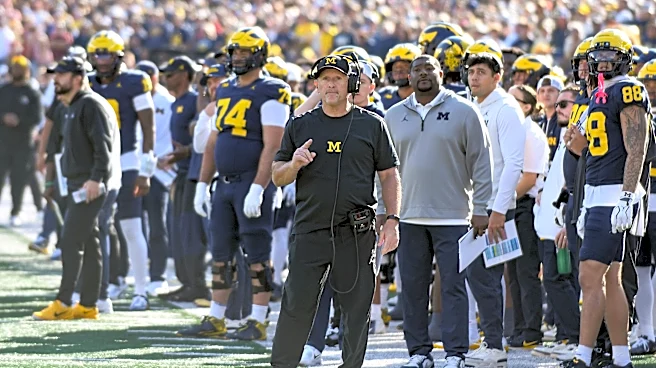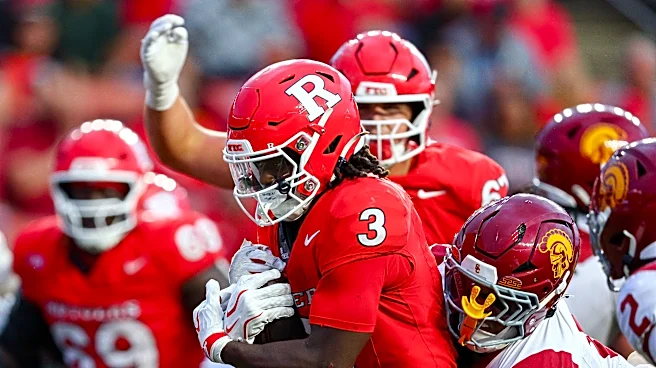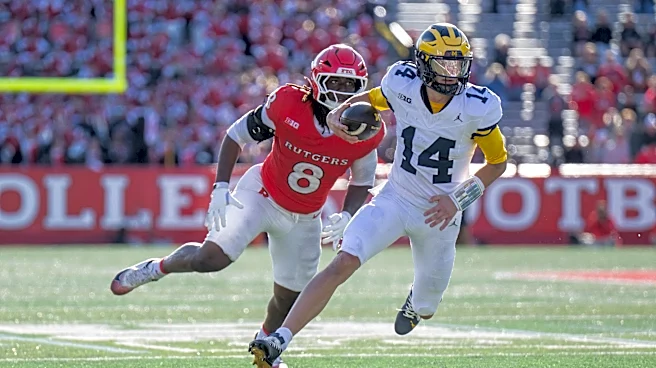


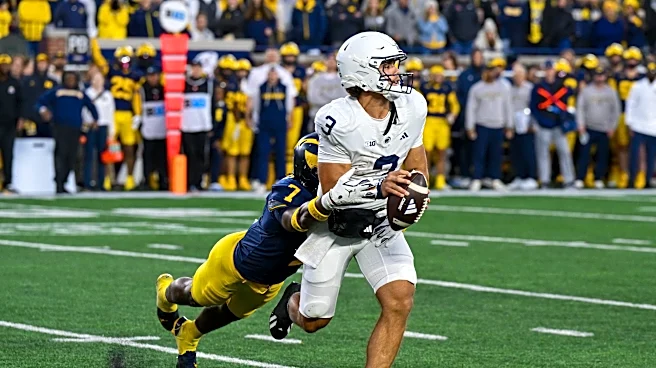

Michigan returned to the win column Saturday afternoon, surviving a fourth-quarter scare to defeat Rutgers, 28-21, in Piscataway.
Coming off a disappointing 13-6 loss to Indiana, the Wolverines desperately needed an offensive spark. Freshman quarterback Tommy Carr provided exactly that in his second career start, completing 22-of-27 passes for 266 yards and a touchdown while adding 54 rushing yards and two scores.
Despite allowing just 249 total yards and nine first downs, Michigan’s defense struggled with explosive plays and tackling inconsistencies. The Wolverines also missed two field goals and committed seven penalties for 90 yards, preventing them from putting the game away earlier.
Here’s a closer look at how the Wolverines performed according to PFF.
Offensive team grades
Michigan’s offense earned a 77.3 overall PFF grade against Rutgers, a significant improvement from its season-low 50.6 grade last week against Indiana.
The Wolverines earned an 82.1 passing grade, their second-highest mark of the season, trailing only the 88.1 they had vs Iowa. Their 75.8 receiving grade was also an improvement from the previous week, while the offensive line earned a 73.1 pass-blocking grade.
Michigan’s rushing grade improved from 56.5 against Indiana to 72.7 against Rutgers. However, run blocking remained an issue, with the Wolverines earning a 56.1 grade in that category.
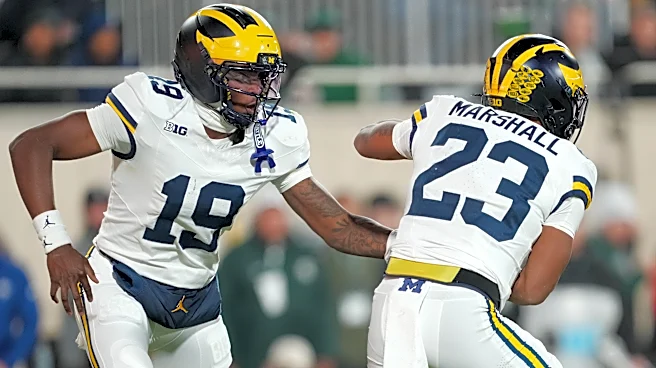
Although Michigan finished with 161 official rushing yards, the running backs themselves struggled to consistently generate explosive plays. Savion Hiter led the team with 76 yards on 20 carries, while Jordan Marshall mustered a confounding zero net yards on five attempts.
Offensive snap counts (snap count \ overall grade)
- Tommy Carr — 74 \ 83.1
- JJ Buchanan — 71 \ 77.5
- Bryson Kuzdzal — 13 \ 73.1
- Brady Norton — 48 \ 72.0
- Hogan Hansen — 28 \ 71.8
- Jalen Hoffman — 33 \ 70.5
- Mason Bonner — 15 \ 69.0
- Salesi Moa — 17 \ 68.3
- Savion Hiter — 43 \ 68.2
- Manuel Beigel — 28 \ 66.6
- Andrew Marsh — 60 \ 64.6
- Evan Link — 74 \ 63.1
- Nathan Efobi — 74 \ 62.6
- Jake Guarnera — 74 \ 60.4
- Jordan Marshall — 19 \ 60.0
- Houston Ka’aha’aina-Torres — 1 \ 60.0
- Eli Owens — 4 \ 59.7
- Avery Gach — 26 \ 58.3
- Channing Goodwin — 22 \ 53.8
- Travis Johnson — 16 \ 53.0
- Blake Frazier — 74 \ 49.1
Five highest-graded offensive players (min. 5 snaps)
- Tommy Carr — 83.1
- JJ Buchanan — 77.5
- Bryson Kuzdzal — 73.1
- Brady Norton — 72.0
- Hogan Hansen — 71.8
Carr delivered Michigan’s highest-graded offensive performance of the game, earning a season-high (as far as his starts are concerned) 83.1 overall grade and an 82.1 passing grade. The freshman completed 81.5 percent of his passes, throwing for 266 yards and a touchdown. He also scored twice on the ground, including the game-winning score in the fourth quarter.
It was an encouraging response after Carr struggled in his first career start against Indiana, where he threw for 167 yards and an interception. Against Rutgers, the Wolverines showed greater confidence in their passing attack, allowing Carr to stretch the field and make plays outside the pocket.
Buchanan followed with a 77.5 overall grade and a 78.1 receiving grade. According to PFF’s receiving chart, he was credited with six receptions for 77 yards and a touchdown. Meanwhile, Kuzdzal earned a 73.1 overall grade after rushing for 37 yards on six carries, averaging 6.2 yards per attempt. His 72.8 rushing grade was the highest among Michigan’s running backs.
Norton led Michigan’s offensive linemen with a 72.0 overall grade, including a team-high 73.3 run-blocking grade. Hansen rounded out the top-five with a 71.8 overall grade and a 78.2 receiving grade after reeling in three receptions for 42 yards.
Five lowest-graded offensive players (min. 5 snaps)
- Blake Frazier — 49.1
- Travis Johnson — 53.0
- Channing Goodwin — 53.8
- Avery Gach — 58.3
- Jordan Marshall — 60.0
Frazier received Michigan’s lowest offensive grade at 49.1 after playing all 74 offensive snaps. His biggest struggles came in the run game, where he posted a 45.4 run-blocking grade. He also received a 56.2 pass-blocking grade. Gach finished with a 58.3 overall grade, although his individual blocking grades told two different stories. He earned an impressive 80.7 in pass-blocking but struggled on the ground with a 54.4 run-blocking mark.
Despite the struggles in the run game, Michigan’s offensive line produced several encouraging pass-protection performances. Efobi earned an 86.1 pass-blocking grade, followed by Guarnera at 83.6 and Gach at 80.7. However, four of Michigan’s five primary starting offensive linemen finished with run-blocking grades below 65.0, reflecting the unit’s continued difficulty creating consistent rushing lanes.
Finally, Johnson earned a 53.0 overall grade across 16 snaps, failing to record a reception on his lone target. Goodwin followed suit with a 53.8 overall grade, including a 54.1 receiving grade and a 56.2 run-blocking grade.
Defensive team grades
Michigan’s defense earned a 63.5 overall against Rutgers, its lowest defensive grade of the season. That represented a considerable decline from the 75.1 grade it received against Indiana last week.
The Wolverines posted a 70.2 run-defense grade, a 68.7 tackling grade and a 67.0 in pass-rushing. PFF credited Michigan with 14 quarterback pressures, including three sacks, five quarterback hits, and six hurries. Coverage was the biggest concern, with Michigan receiving a season-low 51.6 grade after earning an 83.2 against Indiana.
Rutgers completed just 3-of-12 pass attempts for 123 yards, including an 80-yard touchdown. The Scarlet Knights failed to complete a pass in the second half, but their explosive plays helped keep the game competitive despite Michigan controlling possession and limiting their overall offensive production.
Rutgers also found success on the ground at key moments, including a 54-yard run by running back Antwan Raymond that helped set up the fourth-quarter touchdown that tied the game.
Defensive snap counts (snap count \ overall grade)
- Chase Taylor — 29 \ 76.2
- Jonah Lea’ea — 27 \ 71.8
- Benny Patterson III — 35 \ 70.9
- Enow Etta — 32 \ 70.7
- Nate Marshall — 12 \ 70.7
- Mason Curtis — 44 \ 67.9
- Jyaire Hill — 43 \ 67.0
- Nathaniel Owusu-Boateng — 13 \ 64.3
- Jeremiah Earby — 6 \ 62.7
- Smith Snowden — 39 \ 62.5
- Lugard Edokpayi Jr. — 4 \ 61.9
- Aisea Moa — 2 \ 60.8
- Troy Bowles — 22 \ 60.6
- Tariq Boney — 37 \ 59.4
- Trey Pierce — 19 \ 57.0
- Zeke Berry — 42 \ 48.1
- Chris Bracy — 44 \ 44.9
- Nathaniel Staehling — 34 \ 41.8
Five highest-graded defensive players (min. 5 snaps)
- Chase Taylor — 76.2
- Jonah Lea’ea — 71.8
- Benny Patterson III — 70.9
- Enow Etta — 70.7
- Nate Marshall — 70.7
Taylor led Michigan’s defense with a 76.2 overall grade across 29 snaps. He earned a 75.4 run-defense grade and a 71.8 pass-rushing grade, generating two pressures, including a sack and a quarterback hit.
Lea’ea followed with a 71.8 overall grade, highlighted by a 74.6 run-defense grade. He played 27 snaps and was one of Michigan’s more effective defensive linemen against the run. Patterson finished with a 70.9 overall, including an 81.1 tackling grade and a 72.3 in coverage. PFF also credited him with a sack.
Etta finished with a 70.7 overall grade, recording two quarterback pressures, including a sack and a hurry. His 71.7 pass-rushing grade was among Michigan’s highest, and his first solo sack of the season. Marshall matched Etta’s 70.7 overall grade despite playing just 12 snaps. He generated three quarterback pressures, including a hit and two hurries, while earning a 71.0 pass-rushing grade.
Five lowest-graded defensive players (min. 5 snaps)
- Nathaniel Staehling — 41.8
- Chris Bracy — 44.9
- Zeke Berry — 48.1
- Trey Pierce — 57.0
- Tariq Boney — 59.4
Staehling received Michigan’s lowest defensive grade at 41.8 across 34 snaps. His struggles were particularly evident in coverage, where he earned a 29.5 grade after allowing two receptions for 43 yards on two targets.
Bracy’s hot streak finally comes to an end after posting a 44.9 overall grade, including a 34.4 in coverage and a 35.7 in tackling. PFF also has him with two missed tackles against the run, although it’s more than noteworthy he was a part of some of the Wolverines’ biggest defensive plays with two quarterback hits, six tackles and a sack.
Pierce finished with a 57.0 overall grade across 19 snaps, earning a 57.4 run-defense grade and a 58.1 pass-rushing grade. He managed one quarterback hurry on 10 pass-rushing opportunities. Boney rounded out the bottom-five with a 59.4 overall grade. He struggled particularly as a tackler, receiving a 31.8 tackling grade after missing on a would-be sack that became one of the Scarlet Knights’ biggest plays of the day.
Snowden managed an impressive 83.1 pass-rushing grade after generating some pressure on his lone pass-rushing snap, but received a 55.4 in coverage after PFF credited him with allowing the 80-yard touchdown.
Michigan’s defense ultimately did enough to secure the victory, but its season-low overall defensive grade and struggles giving up explosive plays remain things to lock in on heading into the Wolverines’ rivalry matchup against Michigan State.