

A couple of weeks ago, some were complaining that the Wildcats couldn’t start games. Now, they can’t finish them.
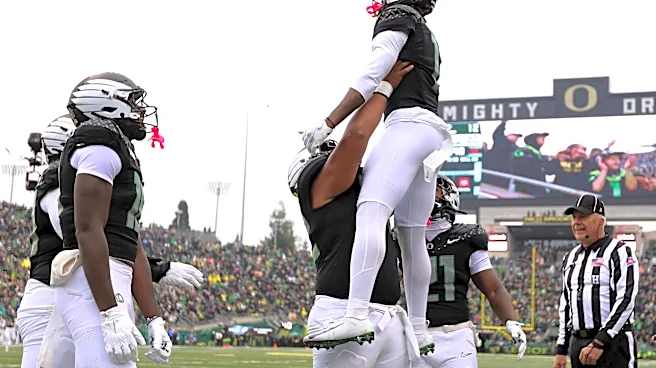
In Saturday’s game, Northwestern finished with 456 total yards to Oregon’s 441, rushed for 175 yards to the Ducks’ 105 and held the ball for nearly 11 more minutes. On paper, this was a win — and yet, here we are.
The scoreboard showed an eight-point loss, and if this game was anything, it was a tale of two halves: two completely different 30 minutes that showed two completely different teams.
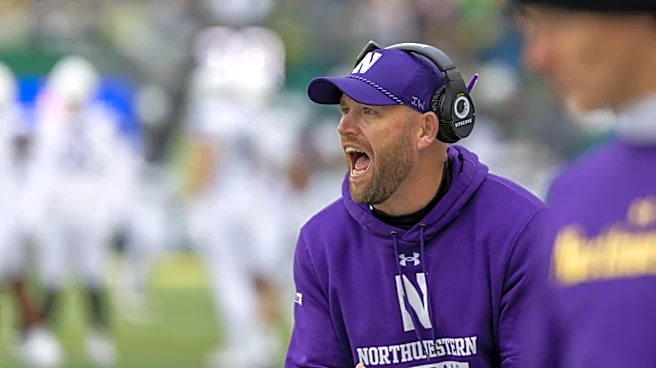
“Every weekend in the Big Ten, you have to expect a four-quarter battle,” head coach David Braun said at the post-game press conference.
If the Northwestern squad didn’t feel this before, I imagine they certainly do now.
In the first half, Northwestern started explosively, tallying double the points in any road game thus far. Aidan Chiles methodically moved the ball downfield, and overall, the ‘Cats converted on six of nine third downs and kept Oregon’s offense on the sideline for all but 10 minutes. By the break, Northwestern had never trailed and had outgained the Ducks by more than 130 yards.
Then some Halloween witch must have swapped the teams, because the group that came out of the Northwestern locker room looked nothing like the one that went in.
The passing game that went 17-of-23 for 214 yards before the break managed just 5-of-15 for 67 yards after it. The third downs that had kept drives alive (6-of-9 in the first half) became dead ends (1-of-8). An Oregon defense that hadn’t sacked anyone in the first half got home three times in the second.
The run game, for what it’s worth, was better: 105 yards at 5.5 yards per carry. But a team can’t ground its way out of third-and-long, and it certainly can’t do it with three penalties for 25 yards while the other sideline goes the entire half without a flag.
The result was a half with no touchdowns. Northwestern’s six second-half points came on two field goals, and settling for three against a team that kept finding the end zone was a losing bet. Oregon threw for 214 yards after being held to 122 in the first half, and the Ducks won the half 21-6 despite losing a fumble.
Every stall sent the defense back onto the field, and every stop it couldn’t make handed Oregon a little more confidence. I imagine that’s exactly what Braun will think about when he looks back at the film.
“There were opportunities for us to get stops on defense when [we were] up by two scores, to really keep that momentum — hold that momentum,” Braun said. “We could have backed our offense and given them momentum to go get a touchdown.”
Oregon came out of halftime hitting the plays Northwestern had spent two quarters taking away, and the momentum swung with them. The Ducks’ once-quiet passing game found its rhythm and averaged 8.5 yards per play after the break (a 2.4 increase). The explosive plays fueled Oregon, something Braun said wasn’t characteristic of his defense.
Case in point: Oregon had a three-play, 24-yard drive; a seven-play, 80-yard drive; and a 10-play, 76-yard drive in the third quarter. Then there was the one-play, 75-yard strike in the fourth. Three of those drives ended in touchdowns.
It’s a simple formula that’s hard to fix. One chunk gain flips the field, the next flips the momentum, and suddenly a team that spent 30 minutes controlling the game is chasing it.
This isn’t entirely new, either. When playing Rutgers just over a week ago, Northwestern led 28-6 at halftime behind 311 first-half yards, then slowed to 5.6 yards per play in the second half while Rutgers outgained it 228-191. That time, the cushion was big enough. Against Oregon, it was not.
Now at 6-2, the ‘Cats head into a tough stretch of their schedule. Facing Iowa at home will be a blessing, but Ohio State away, even in the absence of Julian Sayin, and Minnesota away will be remarkably hard.
The playoff conversation isn’t necessarily over, especially with how the Top-25 shakes up every week, but the margin for error is smaller than ever for the Evanston team. The purple and white can’t afford to play only one good half in the games ahead.
The talent is there, and Northwestern has consistently shown it — even if only in bursts. Now, the Wildcats need four quarters.
They need to keep their foot on the gas.