
Late in the 2024–25 campaign, the Bucks featured a three-guard look that was quite effective, even in the playoffs: Kevin Porter Jr., AJ Green, Gary Trent Jr., Giannis, and Bobby Portis. It was so intriguing that many fans thought the answer this year would be to replace Portis with newcomer Myles Turner and run with it. But while that lineup has been good, we’ve barely seen it thanks to injuries and ineffectiveness. Still, we’ll attempt to figure out how playing three guards is going this year.
Yesterday, we found that when the best lineups stayed together over the 2024 offseason, they remained pretty good, even with a drop-off from increased playing time. That generally held when these teams swapped or added significant talent to their rotations too, improving their holdover lineups on paper. It also held when said talent came in the form of a big man.
But that was only entering last season. To get a handle on how it’s gone in recent years, we’re going to increase the scope here. I looked at teams that made a significant frontcourt acquisition the previous offseason, particularly additions who regularly played the five, then I compared how they integrated with smaller or less-talented groups from one year to the next. This dates back to offseason big man additions since 2018:
These aren’t all elite teams by any means, but does the pattern above—the best lineups fell off but were still generally very good, and increased exposure lowered net ratings overall—hold? Well, lineups that shifted their biggest guy down the positional spectrum, then installed their shiny new big man in place of a guard or wing, sometimes saw a nice jump. Look at the Celtics replacing Malcom Brogdon with Kristaps Porzingis in 2023, then further down the list, Tristan Thompson with Al Horford in 2021. A post-ACL tear DeMarcus Cousins elevated some Warriors holdovers too.
On the other hand, newcomer Rudy Gobert plus lesser defender Karl-Anthony Towns lineups in Minnesota were a mixed bag, as were groups that added John Collins alongside one of Utah’s returning bigs, Kelly Olynyk or Walker Kessler. Even Lopez couldn’t elevate two of the Bucks’ better quintets in 2017–18, though they were still solid (the 20.7 net with Sterling Brown looks quite fluky).
Generally, though, new big men lineups did fit the pattern I mentioned: the four-returnees-plus-one-new-guy groups averaged a 1.5 points per 100 possessions decrease in their net rating. And when previous-year lineups saw an uptick in minutes, their net decreased 73% of the time. But the truly elite groups didn’t usually maintain a standard of excellence. Of all the fivesomes with net ratings above 12 (usually around 80th percentile), nearly all sank to league average or below in net, except for the Porzingis crews.
We now finally arrive to this year’s Bucks. Unfortunately, only two Milwaukee lineups with Turner replacing Lopez and the other four not changing have carried over from 2024–25 to 2025–26 thus far. The sample size is far too small to glean anything from:
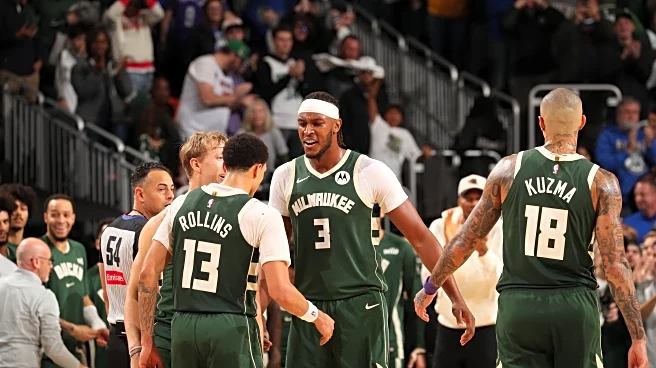
Though Giannis may be returning soon, we may not get more data on last year’s three-guard trio since Trent seems to have been replaced by Cam Thomas in the rotation. But it’s really Rollins who has replaced him in the Bucks’ three-guard groups, which they have used a lot this year: they’ve played 373 minutes together, which CTG defines as 754 non-garbage time possessions. They have a very solid 119.9 offensive rating and 111.0 defensive rating; a +8.9 net rating, good for the 90th percentile. Their most successful and most used groups slot Giannis alongside Portis, Turner, or Kuzma, though using Portis and Turner together has also worked in small doses (only seen in four games):
Of the four lineups that are made up of returning players from 2024–25, only one saw any action last year: the one at the very bottom, with just five possessions. But the third lineup down, with its +30.2 net, is probably the best analogue for Porter/Green/Trent/Giannis/Portis, and the top lineup is the closest we’ll get to Porter/Green/Trent/Giannis/Lopez. If we use Rollins as our Trent equivalence (not too far off, given Trent’s excellent shooting last year and scratch defense), here’s how they compare across seasons:
In a sense, the Bucks’ small-ball “death lineup” didn’t go anywhere, if you just replace Rollins with Trent, and the three-guard “triumverate” still exists with him alongside Porter and Green. The sample sizes of Porter/Green/Trent/Giannis/Portis and Porter/Rollins/Green/Giannis/Portis are now about the same, and though it’s seen a net falloff of 24.4, it’s still 96th percentile. That’s in line with findings from other teams dating back several years: the best lineups fell off but remained generally very good, and increased exposure lowered net ratings overall.
And as much as we’ve bemoaned the Bucks’ lack of size on the wing, playing AJG as an undersized three has actually worked pretty well as long as he has the right frontcourt: CTG gives lineups with Green playing alongside two smaller guards (not just Rollins and KPJ, but also small doses of Cole Anthony and Cam Thomas) a +7.8 net. What you don’t want, though, is him plus another non-ballhandling guard (-28.6 in 35 possessions). Or worse yet, one of Trent or Gary Harris moving up a spot to the three (-9.4 in 1228 possessions).
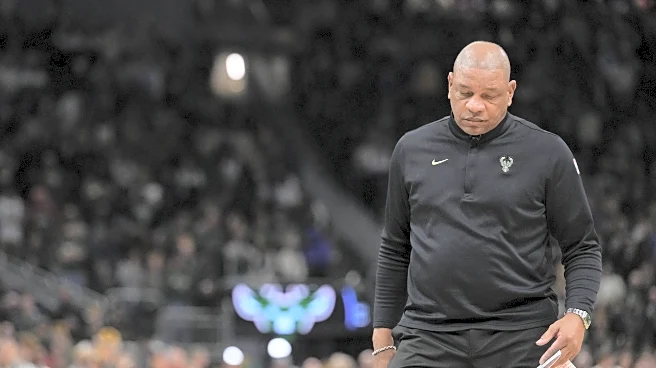
Rollins’ emergence has been so critical to the Bucks this year, as roster construction and an injury to Taurean Prince have dictated that they play three guards very often. Though they can now play bigger on the wing when necessary, thanks to Ousmane Dieng, it’s still a good weapon. One question moving forward is how it will work with Thomas: playing next to any of Rollins, KPJ, or Porter, will he bring enough offense to keep three-guard lineups above water? If so, how high above even, and who do they need in the frontcourt? We’ll check on this down the road, provided Doc doesn’t abandon the three-guard look, which he shouldn’t, even if playing that small is usually a necessity.