






Vitals
Player: Artūrs Šilovs
Born: March 22, 2001 (25 years old)
Height: 6’4”
Weight: 208 pounds
Hometown: Riga, Latvia
Catches: Left
Draft: 2019, Vancouver Canucks (Sixth round, No. 156 overall)
2025-26 Statistics: 39 games played (38 starts), 19-12-8 record, 3.07 GAA, .888 SV%. Playoffs: 3 GP (3 starts), 2-1 record, 1.52 GAA, .939 SV%.
Contract Status: Pending restricted free agent on July 1, completed a two-year, $1.7 million contract ($850,000 cap hit)
Monthly Splits
via Yahoo!

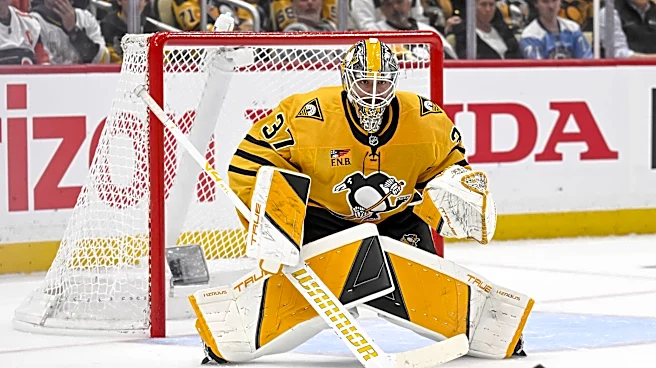
Šilovs was an NHL rookie who saw the most
ice time of any Penguins goaltender in 2025-26, remaining a regular member of the rotation whether it was Tristan Jarry, Sergei Murashov or Stuart Skinner on the other side of the tandem.
Story of the Season
Penguins general manager Kyle Dubas acquired Šilovs amid a flurry of free agency moves last July by sending former Wilkes-Barre/Scranton forward Chase Stillman and a 2027 fourth-rounder to the Vancouver Canucks.
Šilovs, who had never made more than nine starts in a season during his tenure with the Canucks, went on to make his debut on opening night of the 2025-26 season.
He took advantage of getting the nod over Jarry by recording his first career regular-season shutout of his career.
Šilovs spent the first two and a half months of the season trading starts with either Jarry or Murashov, right up until the Penguins traded Jarry to the Edmonton Oilers for a package including Skinner on Dec. 12.
Skinner and Šilovs spent the rest of the regular season mostly alternating starts. Skinner got the nod for the start of the postseason, although the Penguins ultimately turned to Šilovs after falling into an 0-3 first-round deficit to the Philadelphia Flyers.
Šilovs posted three strong postseason performances to help the Penguins push the series to Game 6 before the team’s elimination 1-0 overtime loss.
The netminder told reporters in his exit interviews he had been playing through a knee injury for the last three to four weeks of the regular season.
Regular season 5v5 advanced stats
HDSV%: .800
HDGAA: 1.40
GSAA: -6.74
Shots Against/60: 27.13
Saves/60: 24.22
HD Shots Against/60: 7.02
HD Saves/60: 5.62
Rush Attempts Against/60: 0.9
Rebound Attempts Against/60: 5.35
Average shot distance: 33.92 feet
Average goal distance: 21.36 feet
Both Šilovs and Skinner struggled this season when faced with shots from dangerous areas, a task given to them fairly often amid the Penguins’ defense collapses. Those two netminders ranked 34th and 33rd, respectively, in high-danger save percentage out of 42 goaltenders who played at least 1,500 minutes last season.
It’s impossible to talk about Šilovs’ season without talking about his .409 save percentage in shootouts. The Penguins lost eight of them with him in net.
Charts n’at
Via Advanced Hockey Stats and NHL Edge

Šilovs remains a work in progress as far as WAR metrics go. His save percentage in the bottom right corner is starting to catch up to the expected, which is a good sign. It’ll be interesting in the future if he can draw out strong performances and boost his quality and excellent starts and bring down the totals of what is considered ‘bad’.

Šilovs has an interesting breakdown by zones. According to the NHL Edge data, he struggled in high danger moments but then again he had to face his fair share of them in front of a defense that struggled at times. Šilovs was at his best from mid-zone shots, especially to his right side (.943 save%), which came in handy since that location was the area the second highest amount of shots he faced came from (116 saves, 123 shots).
Goals in the NHL are often times the result of going to the net, being stronger in that situation is an opportunity for improvement. Šilovs gave up 64 goals from the high danger zones on 285 shots, had he been able to give a league average performance (.811%) that would have meant 10 fewer goals allowed on the season. That alone would have lowered his season GAA from 3.07 to 2.74 (a difference of being 41st place as he was, up to 25th) and raised his save percentage from .888% to .898%. Whether that comes from his performance, help from defense or a combination of both is a growth area that player and team should strive for next season.

When you talk Šilovs, you have to mention his small but impressive sample in the playoffs for Games 4-6. He raised his game across virtually all areas, save for that fateful shot from the right point that ended the Pens’ season courtesy of traffic in front of the net. While you couldn’t expect this type of performance over the long haul, it’s data to support the narrative that Šilovs is capable of playing his best games in the moments that matter the most – a growing trend in his young career.
Highlights
Questions to ponder
Is Murashov ready for regular-season NHL action after shining in the AHL last season? If so, does Šilovs return next season?
Should Šilovs return, will he be able to improve on his numbers from last season and get closer to the ceiling he showed this postseason he’s capable of reaching?
Šilovs capped off the campaign with a strong playoff run, but some of his numbers down the stretch of the regular-season were less than ideal.
Examples: Šilovs went a nine-game stretch without posting a save percentage over .900 from Nov. 21 to Jan . 4 (3.8 goals against average over that span).
He allowed at least four goals against in seven of his last 11 appearances of the season (.850 save percentage, 3.6 goals against average over the stretch). It should be noted that, according to Šilovs’ exit interviews, he would have been playing through a knee injury around that time.
Can stronger defensive play and improvements from Šilovs help limit those stretches in a second season as a regular starter? How much was Šilovs’ injury impacting him down the stretch?
What Dubas feels those answers are could impact what the goaltending rotation looks like next season in Pittsburgh.
Ideal 2026-27
Šilovs is a 25-year-old with a relatively limited sample size of regular-season action (56 career starts) and time to potentially improve in high-danger situations.
An ideal 2026-27 for the Penguins could look like Murashov taking the next step toward the AHL with a stronger Šilovs as his tandem partner should Skinner walk in unrestricted free agency.
Bottom line
Šilovs’ best stretch of the season came when it mattered most. His strong play helped the Penguins win two elimination contests to push the Flyers to Game 6.
This isn’t the first strong playoff run of Šilovs’ young career. He also made 10 playoff starts while helping the Canucks come within one win of the Western Conference Finals in 2024, and he was named Calder Cup MVP after leading the Canucks’ AHL affiliate to a title in 2025.
Šilovs’ ability to step up in the clutch could help make his case for the Penguins to re-sign him this offseason.
Final Grade
B
Šilovs struggled at times to limit scoring, especially when faced with high-danger chances or shootouts, during the regular season. He also helped the Penguins make the playoffs in his first season as an NHL starter, and he was a key reason his team exited the postseason with two wins under their belts.
What grade do you think Šilovs earned in his first season with the Penguins ahead of his upcoming restricted free agency?