
I am thinking of a pitcher.
He made 17 starts early in his career and the results were not good: 5.49 ERA, 1.341 WHIP, his teams were 5-12 in those 17 games.
Then this pitcher was traded — twice in one offseason,
incidentally — and converted to relief. Almost immediately he became a dominant closer, eventually pitching in four postseasons and winning a World Series ring. He accumulated 330 saves, which ranks 17th all time.
You could look this up, but I will tell you who this is. It’s John Wetteland, noted as one of the earliest successful starter-to-reliever conversions.
Perhaps you’d like some more recent examples. I have some!
Wade Davis, who posted a 32-save season for the Cubs in 2017, began his career as a starter for the Rays. It did not go well, as he posted a 4.57 ERA and 1.452 WHIP in 88 career starts. The Royals acquired him, converted him to relief and he helped the Royals to the World Series title in 2015.
Brandon Morrow posted 22 saves for the Cubs in the first half of 2018 before missing the rest of that season with injuries. Perhaps if he’d been converted to starting earlier, he might have pitched longer. Morrow posted a 4.32 ERA and 1.324 WHIP in 113 starts for the Mariners, Blue Jays and Padres before being converted to relief in San Diego.
Andrew Miller was a starter for the Tigers, Marlins and Red Sox early in his career, posting a 5.70 ERA and 1.732 WHIP in 66 starts. His 547 relief appearances were much better — 2.95 ERA, 1.095 WHIP, 12.9 SO/9 inning ratio, along with 63 saves (he was mainly a middle relief guy).
One more? Raisel Iglesias made 21 starts for the Reds his first two years, posting a 3.88 ERA, which isn’t too bad — but he’s been much better as a reliever, with a 2.71 ERA in 579 relief appearances and 253 saves.
I remember when Aroldis Chapman first came to MLB, many said the Reds should use him as a starter. They never did — Chapman has never started a MLB game — but I believe that if he had started, throwing that many 100 mile per hour fastballs would have shortened his career. Instead, Chapman has 367 career saves and probably had the best year of his career in 2025 at age 38.
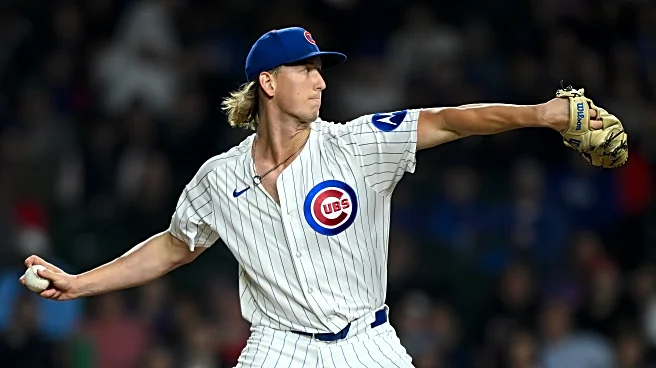
Now, to the subject of this article, Ben Brown. Brown has a 5.26 ERA as a starter (23 starts) and 4.79 as a reliever, not all that different, although the split was more pronounced in 2025 (6.30 ERA in 15 starts, 4.99 ERA in 10 relief appearances).
Brown also doesn’t have a varied pitching repertoire:
 Baseball Savant" />
Brown’s fastball velocity was actually down a tick in 2025 (it was 96.4 miles per hour in 2024), but I believe that if he were to be used exclusively as a one-inning reliever, he’d tick back up, perhaps even to 98 or 99. The curveball can be devastating if used properly.
This is the repertoire of a relief pitcher. Modern starters need sliders and cutters and other offspeed stuff and Brown just doesn’t have that. Sending him to Triple-A Iowa to “work on that” is not anything that, in my view, would change this. Brown is 26 and he is, in my opinion, who he is.
“But!” some will say. “Justin Steele has a repertoire like this and he’s a starter!”
That is demonstrably false. Here’s Steele’s repertoire from 2024 (I’m using that because he made only four starts in 2025, though those splits were similar):
 Baseball Savant" />
Brown doesn’t throw a sinker or slider, and while his curveball use is much higher than Steele’s, overall Steele has more choices of pitches — much more like a starter’s repertoire.
The Cubs have five good starters: Matthew Boyd, Edward Cabrera, Cade Horton, Shōta Imanaga and Jameson Taillon. They have Colin Rea as a swingman backing up those five. They will have Javier Assad at Triple-A Iowa ready to go if needed in case of injury. Steele will rejoin the rotation at some point this year. After that, top prospect Jaxon Wiggins is next man up.
Thus the Cubs already have nine available starting pitchers who will likely throw a pitch in the rotation this year. They don’t need Ben Brown to be a starting pitcher.
The Cubs do need relief pitchers who can dial it up to 98 miles per hour plus, and I believe Ben Brown can do that. Most pitchers do better with defined roles; Brown has never really had one with the Cubs. If they put him in the bullpen and assign him a setup role with the idea that he might even close games from time to time, I think he will become a successful MLB reliever.
Remember Andrew Chafin’s shirt? Perhaps Ben Brown could be the next “failed starter” to succeed in relief.