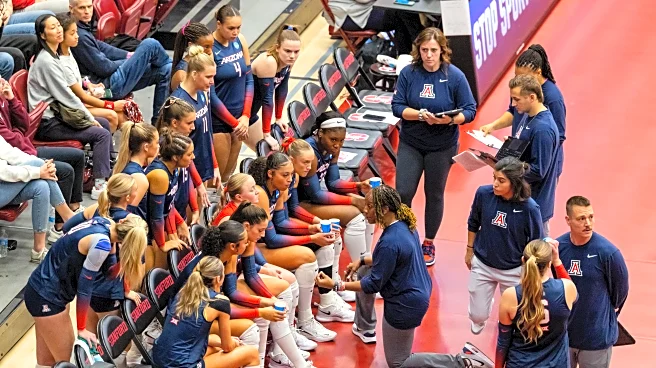



Arizona volleyball head coach Rita Stubbs has a complete staff for the first time since her first season at the helm. She will also have two new faces on the sidelines and three on the court as the Wildcats host their spring tournament on Saturday morning.
Stubbs made a huge hire when she brought former Texas and UNLV setter Jhenna Gabriel aboard just after the season was over. Gabriel was the 2020-21 Big 12 Setter of the Year and a third team AVCA All-American after leading Texas to the national
title game. She took them back to the Elite Eight the following year, then spent her fifth and final season at UNLV.
Texas left an enduring impression on her.
“Oh, my goodness, insane in the best ways possible,” she said. “I got to be a part of a program where immediately upon stepping foot on campus, there was somebody there, an upperclassman, to grab my hand and be like, All right, this is what we do here. And there was such a strong tradition and routine and recipe to winning, and it worked, and it still works to this day, but there was no doubt in anybody’s mind, like, No, this is what we’re here to do. You don’t have a choice. So you’re either going to saddle up and get some grit in you and do it, or you’re not going to survive here. And that was really fun, so it’s really hard, but really fun at the same time.”
It was quite a climb for Gabriel to get there. She started playing volleyball because her older sister was a setter.
“I finally started playing, and I was really, really bad,” Gabriel said. “I was like, 12 years old, and everybody was good already, and I was, oh my gosh, it was so awful. I couldn’t serve the ball over the net. And then I told my parents that I wanted to quit everything else and just play volleyball. As I got older, they told me, that was concerning, because I was that bad and I was good at basketball.”
That was just the first thing she overcame. She brings other experiences that are especially important for this year’s team. One of them is her size.
The Wildcats added setter Maria Olga ‘Mo’ Siapani during the transfer season. Siapani is listed at 5-foot-8, a rather small stature for a Power 4 setter. That brought up the possibility of Arizona running a 6-2 offense.
Stubbs immediately dismissed that as being the goal, although she said that they could put another right side in if they needed to pull Siapani off the court for blocking purposes. Siapani will compete with former Notre Dame setter Harmony Sample and returning Wildcat Chloe Giehtbrock to run a 5-1, although the competition will likely be between Siapani and Sample with Giehtbrock as a backup.
Gabriel was highly successful in Power 5 volleyball despite being listed at the same height as Siapani. She knows the perceptions people have about a smaller setter. She also knows that they don’t define an individual player and there are ways to overcome size. In short, blocking isn’t everything. Go get digs instead is the outlook of both Gabriel and Stubbs.
“You always have something to prove, and depending on the way that you choose to handle that, you can get really good,” Gabriel said. “Like, I loved it. I loved that people didn’t think that I could do it because I knew that I could do it. So, like, Okay, well, this will be fun. And I used to list 5-8 on the roster. I’m like 5-7. I wasn’t really lying that much, but there would be times after games where like, grown men, like grown fathers, would come up to me, size me up. ‘I knew you weren’t 5-8.‘”
Stubbs also feels that Siapani has the ability to get hands up fairly well because of her athleticism and points at former Wildcat Penina Snuka as an example of what a smaller setter can do. Snuka was listed at just 5-foot-6.
“There are certain balls that someone’s going to tee off on, and that’s fine,” Stubbs said. “You just move on. You don’t dwell on it. But you think about Penina, who kept us in system. You know, everyone’s always asked, are you ever going to get her off the floor? And I was like, you couldn’t afford to take her off the floor. So she made up for what she didn’t do at the net blocking on defense. Mo gives us almost three digs a set, I’m happy.”
Gabriel sees coming to Tucson as something that’s been in the making for years.
“This was my dream as a 14-year-old,” Gabriel said. “I’ll never forget that experience of coming to camp, and it was my first time ever traveling by myself and all the things. So it was a lot of firsts. I loved Tucson back then, and could just imagine myself here. And so when the opportunity presented itself again, that’s just such a full circle moment. It’s something that’s hard to say no to. Rita is a hard person to say no to.”
Gabriel followed her UNLV head coach Dawn Sullivan to Missouri after college. She was on the staff for three years after playing for Sullivan for one season. She brings a youthful but highly successful sensibility to the staff.
“I think there’s times where you’re at a place and it’s probably your time to move on and be a part of something different and go learn new things,” Gabriel said. “And I think that this place, and Rita especially, just presented an opportunity of an environment that I was really excited to learn from. I learned a lot at my previous school, and am very grateful for all of it. And so this being different in terms of where you’re at in the country, it’s a different conference, it’s a different level, all of those things.”
Not long after Gabriel was hired, Stubbs learned that she would lose pins coach Simone Asque-Favia, who had just joined the staff for the 2025 season.
“She just started crying, and I’m like, ‘Whoa, dude, what happened?’” Stubbs said. “And then she’s like, ‘Oh, I have to leave. My husband has a job.’”
The question was whether Stubbs would make another hire or push ahead with a short staff for the third straight season. She was given the go-ahead to make the hire. She got another coach with a championship pedigree and big dreams.
Ryan Ammerman is also a former setter, but he will coach the pins. He won two national titles with UC Irvine and was the 2009 Most Outstanding Player in the NCAA Tournament. He has also spent time with the U.S. Men’s National Team and playing professionally overseas.
“It’s intense, but it’s hard because you’re with your pro team for nine months a year in Europe, and then everyone, all the guys on the team, their favorite part of the year is the three months that we’re all training together, and they become your best friends,” Ammerman said. “But it’s a lot of work and a lot of sacrifice. I mean, I missed weddings and birthdays and funerals and everything for a long time in pursuit of that dream. At the same time, I got to travel the world, meet new people, experience different cultures, and grew up a lot, so it’s all the emotions.”
The highs and the lows of his playing career have helped him relate to athletes as they progress through their own careers.
“My first year in college, I was the worst player, and our team was one of the worst teams in the conference,” Ammerman said. “We didn’t even make the conference tournament. And then I was the backup setter, and we won a national championship, and then I was like fighting for the starting role my junior year on the team. I was kind of starting, and I kind of wasn’t. And then my senior year, I was first team All-American, MVP to the Final Four national championship, national champion. So I know what all the emotions that every athlete on this roster is feeling whether they’re the worst kid and they’re questioning if they’re good enough to be there or they’re the best kid, and they’re trying to figure out how to help other people put in the work and come along with them. So I really feel like I have a lot of empathy towards everyone and able to connect with everyone in different ways at different times.”
That empathy will be especially useful in his role at Arizona. Bringing a setter’s experience to coaching the pins can help both sides understand each other. Whether the pins are insisting the setter needs to give them better sets or the setter says the pins need to put balls away, there’s something for both sides to learn.
“A thing I say a lot is two things can be true,” Ammerman said. “Could the set have been better? Yes. Could you have hit a good shot? Yes. And having empathy to them that they are trying to put the ball in the best spot that they can and understanding that, and then going and hitting the best shot that you can with that. Like we’re all on the same team. We all want the same thing, and so we’ve got to learn how to work together, compete together, have those conversations that are important about what needs to be different or improved, but at the same time, there’s still a solution to every set that you get.”
He said those conversations aren’t always easy for people to have.
“I’m helping them find the solutions for the different situations, and then also helping them learn how to have those conversations that can be productive to winning and helping the setter have a better chance of locating the next time, because I’ve had lots of people tell me in different ways, and some of them are positive, some of them are negative,” Ammerman said.
The staff playfully calls Ammerman “Fun Ryan” to set him apart from associate head coach Ryan Windisch. Windisch has a reputation for being a serious guy, although family, co-workers, and players insist he’s not as dour as he might first appear once you get to know him.
Ammerman may be “Fun Ryan,” but he has serious aims that brought him to Arizona. He’s taking steps to get to reach his ultimate career goal of being a head coach. He believes that Stubbs has things to teach him that will help him when the time comes to take over a program.
“A friend of mine told me that it’d be a good idea to be an assistant at a few different schools for two to three years to see how different people run their programs, to kind of get an idea of how I want to do it,” Ammerman said. “So I was at Maryland for three years, and when this opportunity came up, the big thing that stood out to me was that Rita had failed before, and she was starting to have success after the failure. So she was at NC State, and then her first year here, the season wasn’t great, and then they’ve had two really good years after that. And I think that is such a important thing to learn how to lead through those hard times, because it’s going to happen to every coach.”
Notes
Spring Tournament
The spring tournament will run from 9 a.m.-2 p.m. MST on Saturday, March 28 in McKale Center.
Carlie Cisneros on the beach
Junior-to-be Carlie Cisneros will not be playing in Arizona’s spring tournaments, although she is involved with morning lifting. She is currently competing with Arizona’s beach volleyball team.
She came to Stubbs and said she wanted to do it this year because she knew she would be called on to be more offensive next season. The departure of Jordan Wilson leaves a big hole in the Arizona roster. She felt playing in the sand would help her be more explosive.
“She’s always had the shots, so that’s not it,” Stubbs said. “But just from an experience standpoint, and being that person, I think it will help with her being more explosive. I think it’s tougher in the sand than it is on the court, so I think that that will translate very well.”
While Cisneros hasn’t played beach in years and only did so “for fun” when she was very young, she’s matched with grad student Regan Holmer as the No. 1 pair.
Transfer additions
Two of the Arizona transfers and one freshman are with the team. Transfers Siapani and Payton Woods have joined the squad, as has freshman Hayden Reeder. Sample, who committed to Arizona several months ago, has not yet completed her transfer from Notre Dame.